On this page
How to identify it
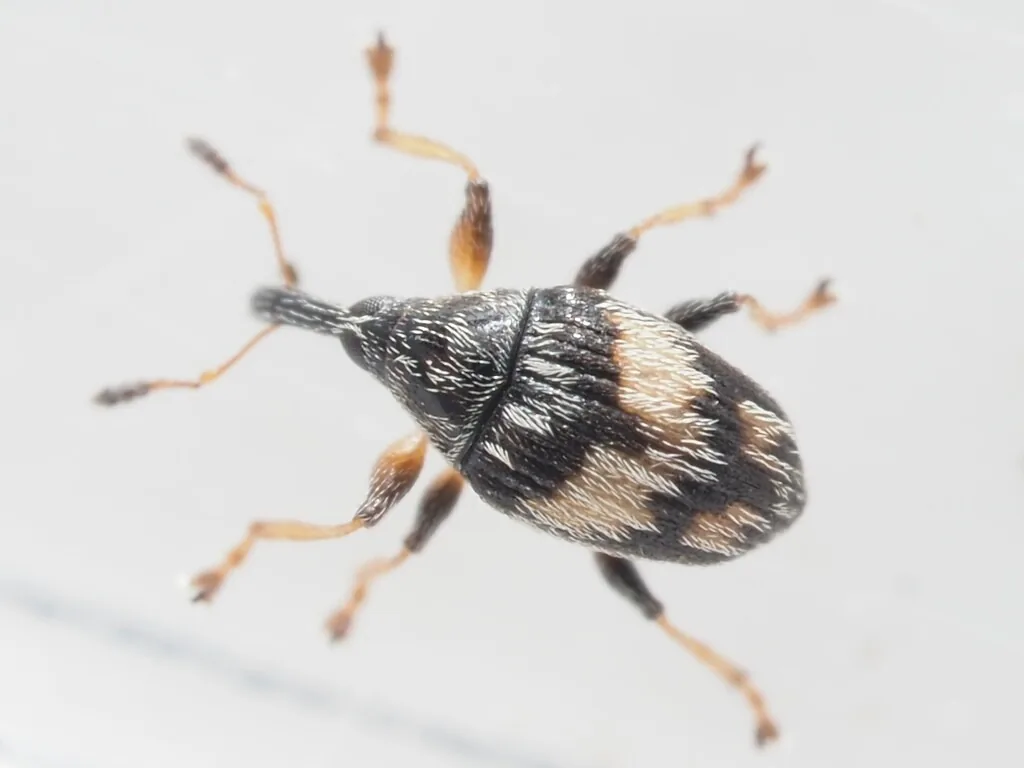
- Adults are very small, up to 2.5 mm long, with a wide body and a long snout. They are dark brown with orange legs and large whitish-yellow patches on the shoulders.[1]
- Larvae are C-shaped, creamy white with a brown head and up to 2 mm long, and live hidden inside purple loosestrife flower buds. Eggs are tiny, spherical and white.[1]
- Attacked buds stay closed and often drop. Buds that remain on the stem often show the exit hole the new adult made, which the Forest Service describes as a distinctive circular hole at the base of the dead bud.[3][2]
Look-alikes
| Look-alike | How to tell them apart |
|---|---|
| Loosestrife leaf beetles (Galerucella) | The two leaf-feeding Galerucella beetles are typically 5 mm long and orange-brown or light gold. Their greenish-yellow larvae have black spots down the back and feed openly on the foliage, leaving window-pane damage, while the adults leave shot holes; flower weevil larvae feed only inside buds.[1] |
| Loosestrife root weevil (Hylobius transversovittatus) | The root weevil is reddish brown and thick-bodied, up to 12 mm long by FHTET (10 to 14 mm by the 2022 Forest Service review), with two rows of dots made of white hairs on its back; its off-white larvae feed in the roots rather than the flower buds.[1][2] |
Where it lives
Weevils from France and Germany were released in the eastern United States beginning in 1994 (Connecticut, Iowa, Indiana, Minnesota, Nebraska, New Jersey, New York, Pennsylvania, South Dakota and Wisconsin), and German stock went to Manitoba in 1997. A 2022 Forest Service review says the limited information suggests it is now common and established at release sites across temperate North America, including Manitoba and Ontario, and a 2013 Canadian survey recorded it from Ontario and Quebec for the first time. In Minnesota it is one of the four loosestrife agents released after testing in Europe and in North American quarantine between 1987 and 1991. GBIF holds 111 U.S. records since 1990, led by New York (43), Massachusetts (18) and Minnesota (10).[1][2][4][5][6]
Biology and life cycle
Overwintered adults appear on purple loosestrife in spring and feed first on the shoot tips and youngest leaves, making a shot-hole pattern. As soon as flower buds develop they move up to the flower spikes, where they mate and feed on the flower parts.[3][1][2]
Females lay 60 to 100 eggs singly inside immature flower buds through the summer; the Minnesota DNR says eggs go into the tips of the buds before the petals are fully developed and egg laying continues into August. The larva eats the stamens, in most cases the petals, and then the ovary, passing through three instars, and pupates at the base of the bud.[1][3]
Development from egg to adult takes about a month. The new adults appear mainly in August, feed on the remaining green leaves, and then overwinter in the leaf litter. There is one generation a year.[3][1]
Damage and signs
- Adult and larval feeding make the flower buds abort, which lowers the plant's seed output. At high weevil densities larval feeding can cut a plant's seed output by up to 60 percent, and attack rates can exceed 70 percent. The weevil does not kill existing plants but helps reduce the rate of spread.[1][3][2]
- Its populations are sometimes limited by competition with the leaf beetles: plants defoliated by Galerucella often do not flower, removing the weevil's food and egg-laying sites. It complements the leaf beetles by attacking flowers on plants that escape defoliation, and FHTET calls it an important agent at sites where loosestrife is decreasing and other agents are scarce. Oregon's Department of Agriculture rates its control in Oregon as fair and notes it may be limited by leaf beetle competition.[1][7]
- The Minnesota DNR credits the flower weevil with severely reducing purple loosestrife seed production.[5]
Health risk
A tiny plant-feeding weevil; none of these sources describes any risk to people.[1][3][2]
Control
Prevention
No source read treats it as something to control: it is an approved biological control agent of purple loosestrife, and exit holes in old buds show it is present at a site. FHTET advises against releasing it where Galerucella populations are high.[1][3][5]
Biological control
Releases are made by agencies and their partners: in Minnesota the DNR introduced four approved loosestrife beetles, including this weevil, after the species passed host testing in Europe and in North American quarantine.[5]
Where the sources disagree
Classification: GBIF lists Nanophyes marmoratus with doubtful status in the family Brentidae, and the 2013 Canadian survey also places it in Brentidae; FHTET puts it in Nanophyidae and the 2022 Forest Service review in Curculionidae. This page keeps the name all of these sources use.[8][4][1][2]
Spring emergence: the Minnesota DNR says overwintered adults appear in mid-spring, FHTET says late spring.[3][1]
Canadian range: FHTET (2017) says it occurs in Canada only in Manitoba, while the 2013 Canadian survey recorded it from Ontario and Quebec and the 2022 Forest Service review lists Manitoba and Ontario.[1][4][2]
Effect: the Minnesota DNR says it severely reduces seed production, while Oregon's Department of Agriculture rates its attack medium and its control fair.[5][7]
Common questions
- Why are the flower buds on the purple loosestrife closing up and dropping?
- Larvae of the loosestrife flower weevil may be eating the stamens, petals and ovary inside. Attacked buds stay closed and often fall; buds that stay on the spike show a circular exit hole at the base once the new adults leave.[3][2]
- Does it kill purple loosestrife?
- No. It reduces seed output, by up to 60 percent on heavily attacked plants, which helps slow the weed's spread, but it does not kill existing plants. The leaf beetles and the root weevil are the agents that can kill plants.[1]
- How do I tell it from the loosestrife leaf beetles?
- Size and color: the flower weevil is only about 2.5 mm, dark brown with orange legs, pale shoulder patches and a long snout, and it stays on the flower spikes. The leaf beetles are typically 5 mm, orange-brown or light gold, and chew the foliage.[1]
Sources
- USDA Forest Service, Forest Health Technology Enterprise Team, “Winston, Randall, Blossey, Tipping, Lake and Hough-Goldstein. Field Guide for the Biological Control of Weeds in Eastern North America (FHTET-2016-04, April 2017).” www.fs.usda.gov/foresthealth/technology/pdfs/FHTET-2016-04_Biocontrol_Field_Guide.pdf (accessed 2026-11-14)
- USDA Forest Service, Forest Health Assessment and Applied Sciences Team, “Endriss, Nuzzo and Blossey (Cornell University). Success Takes Time: History and Current Status of Biological Control of Purple Loosestrife in the United States, chapter 27 in Van Driesche, Winston, Perring and Lopez, eds. Contributions of Classical Biological Control to the U.S. Food Security, Forestry, and Biodiversity (FHAAST-2019-05, June 2022).” www.fs.usda.gov/foresthealth/technology/pdfs/FHAAST-2019-05-Contributions-Classical-Biocontrol.pdf (accessed 2026-11-14)
- Minnesota Department of Natural Resources, “Nanophyes marmoratus (Purple loosestrife biological control).” www.dnr.state.mn.us/invasives/aquaticplants/purpleloosestrife/biocontrol_nm.html (accessed 2026-11-14)
- Zookeys 2013;(309):13-48, via PubMed, “Douglas et al. New Curculionoidea (Coleoptera) records for Canada (2013).” pubmed.ncbi.nlm.nih.gov/23794927/ (accessed 2026-11-14)
- Minnesota Department of Natural Resources, “Purple loosestrife control: Biological.” www.dnr.state.mn.us/invasives/aquaticplants/purpleloosestrife/biocontrol.html (accessed 2026-11-14)
- Global Biodiversity Information Facility (GBIF), “Nanophyes marmoratus: U.S. occurrence records since 1990 by state (GBIF occurrence search).” api.gbif.org/v1/occurrence/search?taxonKey=1173721&country=US&hasGeospatialIssue=false&occurrenceStatus=PRESENT&year=1990%2C2026&facet=stateProvince&facetLimit=400&limit=0 (accessed 2026-11-14)
- Oregon Department of Agriculture, Noxious Weed Control Program, “Biological Control of Noxious Weeds in Oregon (brochure, created June 2015).” www.oregon.gov/oda/Documents/Publications/Weeds/BiocontrolBrochure.pdf (accessed 2026-11-14)
- Global Biodiversity Information Facility (GBIF), “Nanophyes marmoratus (Goeze, 1777) (GBIF Backbone Taxonomy).” api.gbif.org/v1/species/1173721 (accessed 2026-11-14)
- iNaturalist, “Nanophyes marmoratus taxon page (order and family).” www.inaturalist.org/taxa/455171 (accessed 2026-11-10)