On this page
How to identify it
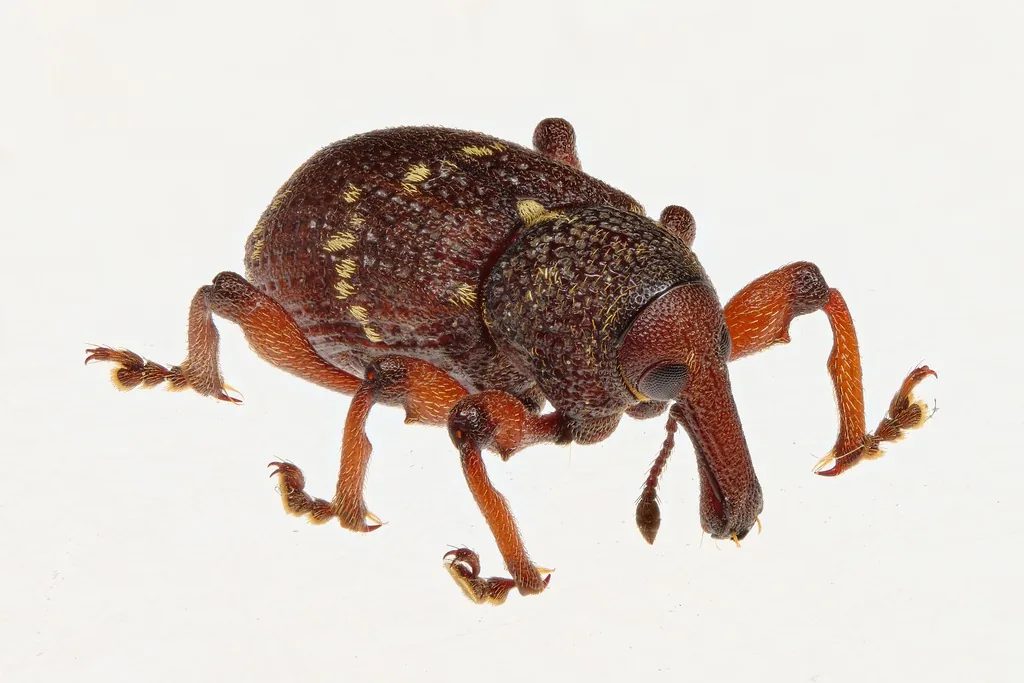
- Adults are thick-bodied, reddish-brown weevils, up to 12 mm long by FHTET and 10 to 14 mm by the 2022 Forest Service review, with two rows of dots made of white hairs on the back. The other loosestrife agents are much smaller: the Galerucella leaf beetles are typically 5 mm and orange-brown or light gold, and the flower weevil is dark brown with whitish-yellow shoulder patches and up to 2.5 mm.[1][2]
- Larvae are C-shaped, off-white grubs with brown heads, up to 10 mm long, that feed inside the roots and fill their tunnels with frass. Digging up roots reveals obvious larval damage.[1][2]
- Eggs are white and oval, laid singly in the soil close to the plant or in the lower stem.[1][4][2]
- Adults often leave characteristic chew marks along the leaf margins, sometimes with an 'ink dot' of frass on the leaf, and stem tips may wilt and die above a feeding site.[11][2]
- All four biocontrol agents approved against purple loosestrife in North America are beetles; NAISMA says this one stands out as reddish-brown, thick, up to 12 mm long and long-snouted.[11]
Look-alikes
| Look-alike | How to tell them apart |
|---|---|
| Loosestrife leaf beetles (Galerucella calmariensis and G. pusilla) | Leaf beetles typically 5 mm long and orange-brown or light gold. Their greenish-yellow larvae have black spots down the back and feed openly on the foliage, leaving window-pane damage, while the adults leave shot holes.[1] |
| Loosestrife flower weevil (Nanophyes marmoratus) | The other loosestrife weevil: dark brown with orange legs and whitish-yellow shoulder patches, up to 2.5 mm long; its creamy white larvae feed inside the flower buds.[1] |
Where it lives
Weevils from Germany, Finland, Austria, France, Sweden and Switzerland, largely from Germany and Finland, were released beginning in 1992 across the eastern United States, from Kansas and the Dakotas to Maine and Virginia, and in Manitoba, Nova Scotia and Ontario. FHTET believes it has well-established populations in New York and Minnesota and may be established throughout purple loosestrife's North American range; the 2022 Forest Service review says it established across temperate North America and that its damage has been found throughout New York State, including at sites where it was not released. By 1999 more than 100,000 root weevil eggs and adults had been released, along with more than 3 million leaf beetles, in over 1,500 wetlands in 30 states and several Canadian provinces. GBIF holds 10 U.S. records since 1990; those with a state are from Minnesota (2), Colorado, Idaho, Utah and Washington. NAISMA says it is slower to disperse and reproduce than the other established agents and believes it well established in Oregon, New York and Minnesota and perhaps Washington and Idaho, with information elsewhere limited because the secretive root feeder is hard to confirm; its overall impact in Canada remains unknown.[1][2][5][11]
Biology and life cycle
Adults overwinter and appear shortly after purple loosestrife shoots begin to grow in spring. They are nocturnal and may be seen feeding at dusk or on rainy, overcast days; on warm, sunny days they hide in the plant litter at the base of the plants.[4][1]
Females lay eggs singly, up to 100 a year, in the soil near the host or in the stem, from May into September. In Blossey's European study, overwintered females laid eggs from May to early September, producing 3 to 4 eggs a day at the peak.[1][4][6]
NAISMA says adults mate within two weeks and the eggs hatch in about 11 days. Larvae from eggs laid in the soil mine the outer parts of the roots, and those from eggs in the stem mine the stem, before they move into the root center. Larvae stay active as long as soil temperatures allow, and flooding stops their feeding, though they can tolerate many weeks under water.[11]
Larvae mine into the roots, overwinter there and feed for one to two years through three instars. Adults and larvae can survive extended submersion, but permanently flooded sites keep adults off the plants and eventually kill the larvae.[1][4]
Pupation takes place in a chamber in the upper root, mainly in early summer, and adults emerge between June and October by the Minnesota DNR. Adults often overwinter and can live up to three years, and a generation often takes two years. In Europe, Blossey found a one- or two-year cycle depending on when the egg was laid, and new-generation adults mated on the spot, some laying eggs before overwintering.[1][4][6]
In Europe the weevil was found in every habitat of its host except permanently flooded sites, in two-thirds of the loosestrife populations examined, with a mean attack rate of 76.3 percent; dispersal flights let it reach scattered loosestrife stands.[6]
Very occasionally a pupa may overwinter.[11]
Damage and signs
- Adult feeding is of little consequence. The larvae do the damage: attack rates vary with rootstock age and size, up to one larva per 10 grams of fresh root, and up to 40 larvae have been found in one rootstock. Small root systems can be killed, while large rootstocks withstand substantial feeding and need several larval generations before significant impacts are seen.[4][1]
- Attacked roots lose reserve capacity, so plants grow smaller, produce less seed and may die. The Minnesota DNR says larval feeding reduces shoot growth, seed output and shoot and root biomass and can ultimately kill the plant, and its overview page describes it as leading to the complete destruction of mature plants.[1][4][3]
- NAISMA says larval impact depends on the size and age of the root system, the density of the loosestrife and the number of weevils at the site. Where root feeding complements defoliation by Galerucella leaf beetles, the result is often a significant decrease in purple loosestrife accompanied by increases in native and other plants.[11]
- Extensive root feeding can complement defoliation by Galerucella leaf beetles, often resulting in plant death. In four years of field cage experiments the two agents showed no competition, though in potted plants heavy leaf beetle feeding reduced weevil larval survival; the authors judged that unlikely unless heavy damage kills belowground tissue.[1][7]
- In pre-release laboratory tests, root weevil larvae could complete development on native winged loosestrife and swamp loosestrife, but post-release field studies showed such minor spillover feeding is unlikely to cause population declines; at New York monitoring sites swamp loosestrife was thriving two decades after releases.[2]
Health risk
A plant-feeding weevil and a weed biological control agent; none of these sources describes any risk to people.[11][1][4][2]
Control
Prevention
It tolerates a wide range of conditions and survives long submersion, but permanently flooded sites keep adults off the plants and eventually kill the larvae.[1]
Biological control
This weevil is a biological control agent released on purpose against purple loosestrife. Its establishment and impact are hard to assess because the larvae are hidden and the adults work at night, so not seeing it does not mean it is absent; FHTET says dissecting roots for larval damage over the next few growing seasons is the easier way to confirm it.[1]
Where the sources disagree
Adult size: FHTET and NAISMA give up to 12 mm; the 2022 Forest Service review gives 10 to 14 mm.[1][11][2]
When adults emerge: the Minnesota DNR says June to October; the 2022 Forest Service review says mid-summer to late fall; Blossey's European study found adults with a one-year cycle emerging July to October and those with a two-year cycle within three weeks in July and August.[4][2][6]
Effect on mature plants: the Minnesota DNR overview says larval feeding leads to the complete destruction of mature plants, while its species page and FHTET say large rootstocks withstand substantial feeding and need several larval generations.[3][4][1]
How common it is: Oregon's Department of Agriculture lists it as widespread in Oregon with heavy attack and good control, and FHTET believes it may be established throughout loosestrife's range, yet GBIF holds only 10 U.S. records since 1990, which fits the Forest Service's point that the nocturnal adults and hidden larvae make it hard to track.[8][1][5][2]
Native plants: NAISMA reports no nontarget effects; the 2022 Forest Service review notes that in pre-release laboratory tests larvae could complete development on native winged and swamp loosestrife, but that field studies found such minor spillover unlikely to cause population declines.[11][2]
Common questions
- Why have I never seen this weevil on my loosestrife?
- Adults feed mostly at night and hide in litter at the base of the plants on warm, sunny days, and the larvae are inside the roots. Look at dusk or on rainy, overcast days, search at night with a flashlight, or dig up roots and look for larval damage.[4][1][2]
- How long does it take the root weevil to kill purple loosestrife?
- On large old rootstocks, several larval generations, and a generation often takes two years. Small root systems can be killed much sooner.[1][4]
- Does it work together with the leaf beetles?
- Yes. Root feeding below ground can complement defoliation above it, often resulting in plant death, and field cage studies found no competition between the two over four years.[1][7]
- What does root weevil feeding look like above ground?
- Look for chew marks along the leaf margins, sometimes with an 'ink dot' of frass on the leaf, and for stem tips that wilt and die above a feeding site. The larval damage itself is visible only when the roots are dug up and cut open.[11][1]
Sources
- USDA Forest Service, Forest Health Technology Enterprise Team, “Winston, Randall, Blossey, Tipping, Lake and Hough-Goldstein. Field Guide for the Biological Control of Weeds in Eastern North America (FHTET-2016-04, April 2017).” www.fs.usda.gov/foresthealth/technology/pdfs/FHTET-2016-04_Biocontrol_Field_Guide.pdf (accessed 2026-11-14)
- USDA Forest Service, Forest Health Assessment and Applied Sciences Team, “Endriss, Nuzzo and Blossey (Cornell University). Success Takes Time: History and Current Status of Biological Control of Purple Loosestrife in the United States, chapter 27 in Van Driesche, Winston, Perring and Lopez, eds. Contributions of Classical Biological Control to the U.S. Food Security, Forestry, and Biodiversity (FHAAST-2019-05, June 2022).” www.fs.usda.gov/foresthealth/technology/pdfs/FHAAST-2019-05-Contributions-Classical-Biocontrol.pdf (accessed 2026-11-14)
- Minnesota Department of Natural Resources, “Purple loosestrife control: Biological.” www.dnr.state.mn.us/invasives/aquaticplants/purpleloosestrife/biocontrol.html (accessed 2026-11-14)
- Minnesota Department of Natural Resources, “Hylobius transversovittatus (Purple loosestrife biological control).” www.dnr.state.mn.us/invasives/aquaticplants/purpleloosestrife/biocontrol_ht.html (accessed 2026-11-14)
- Global Biodiversity Information Facility (GBIF), “Hylobius transversovittatus: U.S. occurrence records since 1990 by state (GBIF occurrence search).” api.gbif.org/v1/occurrence/search?taxonKey=5021463&country=US&hasGeospatialIssue=false&occurrenceStatus=PRESENT&year=1990%2C2026&facet=stateProvince&facetLimit=400&limit=0 (accessed 2026-11-14)
- Oecologia 1993;94(3):380-387, via PubMed, “Blossey. Herbivory below ground and biological weed control: life history of a root-boring weevil on purple loosestrife (1993).” pubmed.ncbi.nlm.nih.gov/28313675/ (accessed 2026-11-14)
- Oecologia 2005;142(4):554-63, via PubMed, “Hunt-Joshi and Blossey. Interactions of root and leaf herbivores on purple loosestrife (Lythrum salicaria) (2005).” pubmed.ncbi.nlm.nih.gov/15619100/ (accessed 2026-11-14)
- Oregon Department of Agriculture, Noxious Weed Control Program, “Biological Control of Noxious Weeds in Oregon (brochure, created June 2015).” www.oregon.gov/oda/Documents/Publications/Weeds/BiocontrolBrochure.pdf (accessed 2026-11-14)
- Global Biodiversity Information Facility (GBIF), “Hylobius transversovittatus (J.A.E.Goeze, 1777) (GBIF Backbone Taxonomy).” api.gbif.org/v1/species/5021463 (accessed 2026-11-14)
- iNaturalist, “Hylobius transversovittatus taxon page (order and family).” www.inaturalist.org/taxa/221940 (accessed 2026-11-10)
- North American Invasive Species Management Association (PDF hosted on Bugwood), “Blossey (Cornell University) and Endriss. Purple Loosestrife Biocontrol Agents: History and Ecology in North America. In: Winston, ed., Biological Control of Weeds in North America, NAISMA-BCW-2023-28-PURPLE LOOSESTRIFE-A (2023).” bugwoodcloud.org/resource/files/27701.pdf (accessed 2026-11-14)