On this page
How to identify it
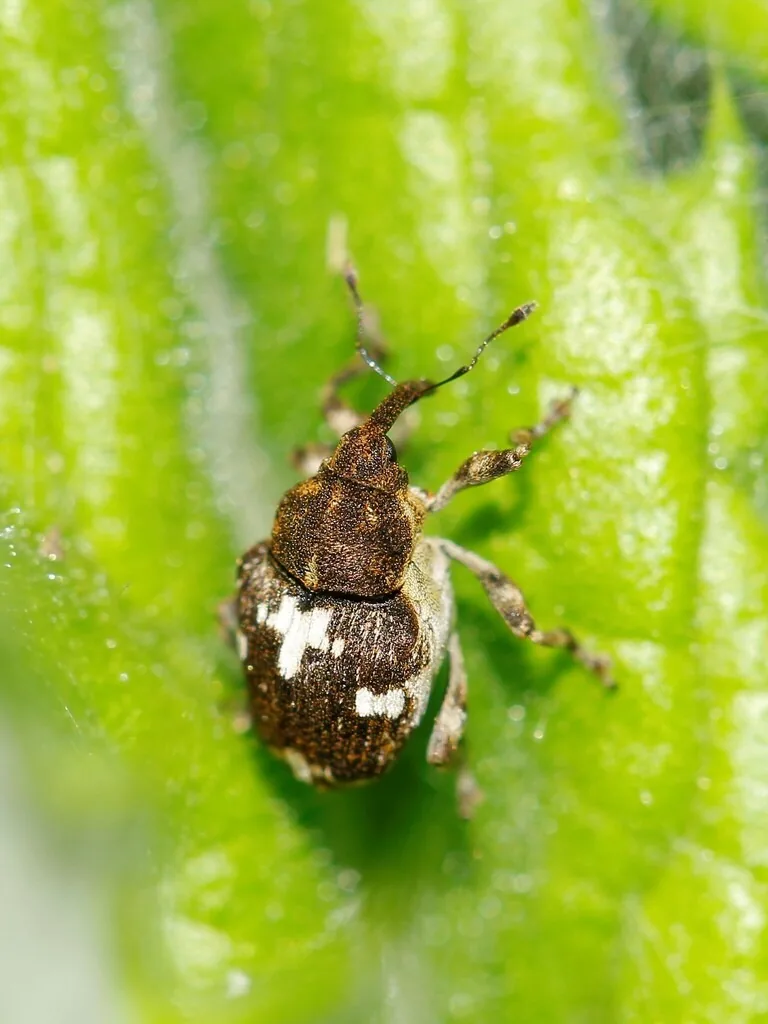
- Adults are 2 to 3 mm long and brown with a white cross on the back.[1]
- Larvae are 1 to 4 mm long, white with a brown head, and curl in a C-shape inside the roots in summer.[1]
- Adult feeding leaves circular or oval holes in houndstongue leaves from spring to fall. Look for adults on the plants in spring and fall.[1]
Where it lives
Approved for release in Canada in the late 1990s; it has made its way into Montana, and a monitoring project in Montana, Washington and Idaho is looking for effects on other plants where it has moved in naturally. GBIF holds about 640 records, most from Europe (about 260 from Sweden, 100 from Poland, 60 from Ukraine), with 18 from Canada and 5 from the US; its 5 US records since 1990 come from Washington, Montana and Oregon.[1][2][3]
Biology and life cycle
Adults overwinter in the soil and emerge in spring. From spring to early summer they feed on houndstongue leaves, mate and lay eggs at the base of the leaves.[1]
The larvae feed on the roots, then leave them to complete the life cycle in the soil. New adults emerge in late summer and early fall and feed on the foliage before overwintering in the soil.[1]
Canadian field work shows how it treats native relatives of houndstongue. After houndstongue its strongest preference is for Hackelia species, yet weevils released among the native Hackelia micrantha with little or no houndstongue present could not be found two years later, and feeding on the native plant was limited to rare, low-level spillover. Adult feeding scars went with egg laying on 90 percent of houndstongue plants but only 30 percent of the natives.[4]
In release experiments, 95 percent of feeding on the native Hackelia occurred within 4.25 metres of the release point whatever the houndstongue density, while feeding on houndstongue extended across the whole 14 metre study radius; marked weevils were recaptured on houndstongue more often than chance but not on Hackelia. The weevil simply does not seek out the native plant, which leaves it refuges a few metres from any concentration of weevils.[5]
A survey of 24 houndstongue sites in the northwestern United States found that where weevil attack was higher, plants flowered at a smaller median size. The authors note the weevil preferentially attacks large plants. Sites with more winter precipitation and no weevils had a greater share of plants that flowered more than once.[6]
Damage and signs
- The larvae do the most significant damage, feeding on the roots, which can kill the plant, prevent flowering or reduce seed production.[1]
- It has been very effective at reducing houndstongue in Canada and in the parts of the US it has reached on its own; where it has been present for multiple years, houndstongue is rare or absent.[1]
- Feeding on native plants in the houndstongue family has been documented in both Canada and the US, but so far this non-target attack seems minor, sporadic and temporary. Montana State says the biggest concern is its potential impact on federally listed plants.[1]
- A study by Belgian researchers exposed 119 houndstongue plants to a range of larval root damage by the weevil. Infested plants were smaller, had fewer flowers, drew fewer pollinator visits and set less seed; the authors put the seed loss down mainly to the plants having fewer resources, not to a shortage of pollen.[7]
Health risk
Montana State describes it only as a root-feeding weevil of houndstongue; no cited source describes any risk to people or pets from the weevil. The weed is the hazard to livestock: Washington's weed board says houndstongue contains pyrrolizidine alkaloids toxic to cattle, horses and goats.[1][8]
Control
Prevention
Do not collect or move it. Montana State says it is not an approved biocontrol agent in the US, that it is illegal to aid in its movement, and that until it is approved it is considered an agricultural pest that cannot be intentionally moved.[1]
Traps and physical control
For the weed itself, Washington's Noxious Weed Control Board recommends pulling or digging, cutting rosettes below the root crown, keeping the plant out of hay, cleaning seeds off clothing and animals, and reseeding with competitive plants.[8]
Biological control
Where it is present it needs no control. Canadian researchers recommend protecting valued native relatives of houndstongue by removing the houndstongue growing around them, since the weevil's spillover feeding stays within a few metres of dense weevil populations.[4][5]
Where the sources disagree
Approval: Montana State says it was approved for release in Canada in the late 1990s but is not approved in the US; Washington's weed board says there are currently no approved biological control agents available for houndstongue.[1][8]
Native plants: Montana State calls non-target attack minor, sporadic and temporary but names federally listed plants as the biggest concern; the Canadian studies found spillover rare and confined to within a few metres of dense weevil populations.[1][4][5]
Records: GBIF's 5 US records come from Washington, Montana and Oregon, while Montana State's monitoring covers Montana, Washington and Idaho.[3][1]
Common questions
- Can I move houndstongue root weevils onto my pasture in Montana?
- No. It is not an approved biocontrol agent in the US, and Montana State says it is illegal to aid in its movement even though it has made its way into Montana.[1]
- How do I know this weevil is in my houndstongue?
- Look for the small brown adults with a white cross on the plants in spring and fall, circular or oval feeding holes in the leaves, and white C-shaped larvae in the roots in summer.[1]
- Does it harm native plants?
- It has fed on native plants in the houndstongue family in Canada and the US, but Montana State describes that attack as minor, sporadic and temporary, and Canadian field studies found the spillover rare, low-level and confined to a few metres around dense weevil populations.[1][4][5]
- Does the weevil change how houndstongue grows?
- It seems to. Northwestern US sites with heavier weevil attack had plants flowering at a smaller size, and in a Belgian study infested plants were smaller, with fewer flowers and lower seed set.[6][7]
Sources
- Montana State University Extension, “Monthly Weed Post, April 2021: Houndstongue Root Weevil (Mogulones crucifer) (M. Maggio, Montana Biocontrol Coordination Project).” www.montana.edu/extension/invasiveplants/extension/monthly-weed-posts/2021-april-houndstongue-root-weevil.html (accessed 2026-11-14)
- Global Biodiversity Information Facility (GBIF), “Mogulones crucifer: occurrence records by country (GBIF occurrence search).” api.gbif.org/v1/occurrence/search?taxonKey=4464019&facet=country&facetLimit=20&limit=0 (accessed 2026-11-14)
- Global Biodiversity Information Facility (GBIF), “Mogulones crucifer: U.S. occurrence records since 1990 by state (GBIF occurrence search).” api.gbif.org/v1/occurrence/search?taxonKey=4464019&country=US&hasGeospatialIssue=false&occurrenceStatus=PRESENT&year=1990%2C2026&facet=stateProvince&facetLimit=400&limit=0 (accessed 2026-11-14)
- Ecological Applications (Ecological Society of America), “Catton, Lalonde and De Clerck-Floate (Agriculture and Agri-Food Canada, University of British Columbia). Nontarget herbivory by a weed biocontrol insect is limited to spillover, reducing the chance of population-level impacts. Ecological Applications 25: 517-530 (2015), doi:10.1890/14-0250.1.” pubmed.ncbi.nlm.nih.gov/26263672/ (accessed 2026-11-14)
- Environmental Entomology (Entomological Society of America), “Catton, Lalonde and De Clerck-Floate. Differential host-finding abilities by a weed biocontrol insect create within-patch spatial refuges for nontarget plants. Environmental Entomology 43: 1333-1344 (2014), doi:10.1603/EN14041.” pubmed.ncbi.nlm.nih.gov/25259695/ (accessed 2026-11-14)
- Am J Bot 2020;107(10):1366-1374, via PubMed, “Life history variation in an invasive plant is associated with climate and recent colonization of a specialist herbivore.” pubmed.ncbi.nlm.nih.gov/32914886/ (accessed 2026-11-14)
- Plant Biol (Stuttg) 2016;18(1):156-163, via PubMed, “Is there a missing link? Effects of root herbivory on plant-pollinator interactions and reproductive output in a monocarpic species.” pubmed.ncbi.nlm.nih.gov/25731922/ (accessed 2026-11-14)
- Washington State Noxious Weed Control Board, “Houndstongue (Cynoglossum officinale).” www.nwcb.wa.gov/weeds/houndstongue (accessed 2026-11-14)
- Global Biodiversity Information Facility (GBIF), “Mogulones crucifer (P.S.Pallas, 1771) (GBIF Backbone Taxonomy).” api.gbif.org/v1/species/4464019 (accessed 2026-11-14)