On this page
How to identify it
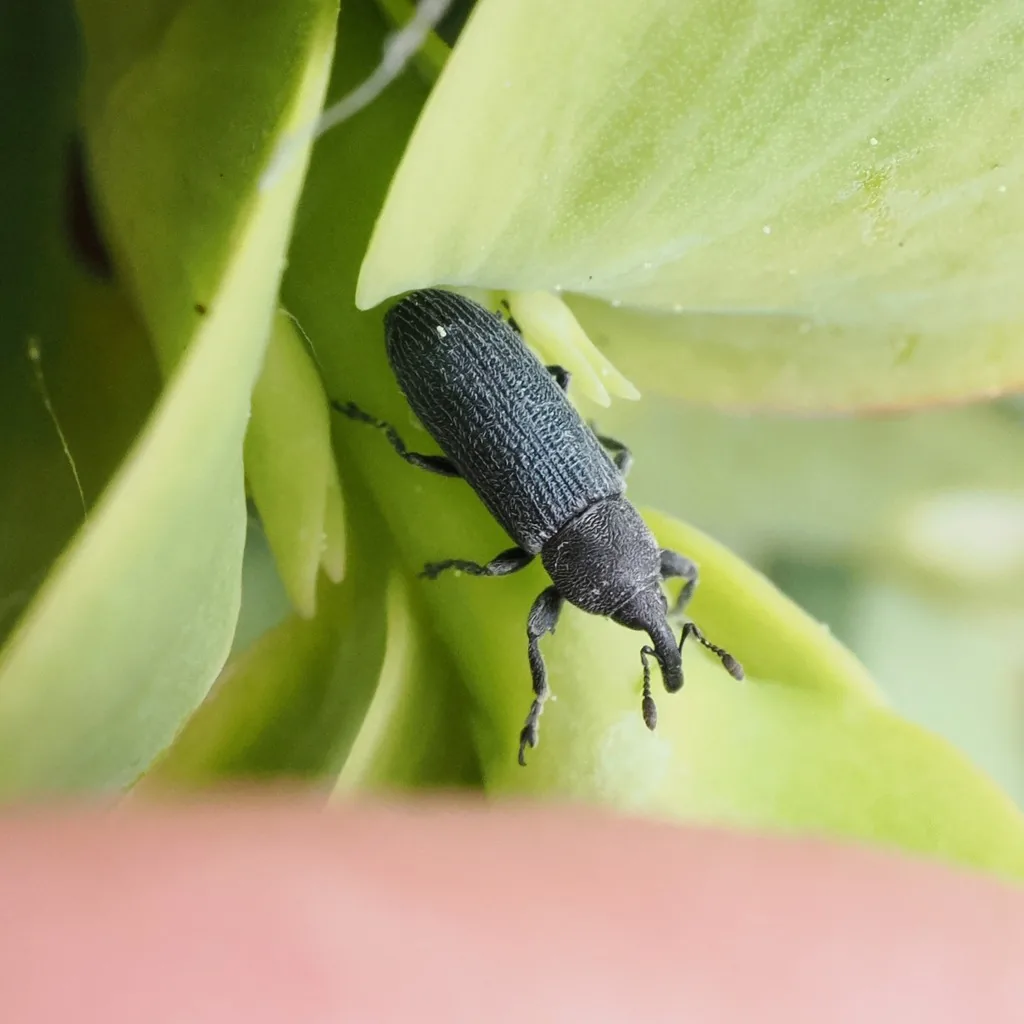
- Adults are elongated, bluish-black (rarely greenish-black) weevils with long snouts; newly emerged adults may have a subtle metallic sheen that dulls to black with age. M. janthinus is smaller, 2.4 to 3.4 mm against 3.2 to 6.0 mm for M. janthiniformis (excluding the snout), and its snout is less abruptly curved. MSU Extension notes the sizes can overlap, so the two are generally told apart by the toadflax they are collected from.[1][2]
- Adult feeding on shoot tips and leaves leaves a distinctive shot-hole pattern, more obvious on Dalmatian toadflax. Heavily attacked shoot tips may turn brown and shrivel.[1]
- Larvae are C-shaped, creamy white with a brown head, up to 5 mm long, and feed in short tunnels inside the stems; cut a stem open to find them.[1]
- Mecinus can be told from the other toadflax weevils by shape: the Rhinusa weevils have more rounded bodies, and the toadflax beetle Brachypterolus pulicarius has no snout at all.[1]
Look-alikes
Where it lives
M. janthinus is native to Eurasia; stock from France and Germany was first released in Canada in 1991 and the US in 1996. M. janthiniformis, native to southeastern Europe, came from Macedonia and was first released in Canada in 1992, reaching the US via Canada after 1996. M. janthiniformis is well established on Dalmatian toadflax through the US Northwest and southern British Columbia, with a few small populations in southern Alberta. M. janthinus is encountered less often but is confirmed established at limited sites in the US and Canada, as far north as 53.5 degrees N in northern Alberta, and has given successful yellow toadflax control at elevations above 7,000 feet (2,180 m).[1]
Biology and life cycle
Adults overwinter inside toadflax stems and emerge in early spring to feed on shoot tips. In the native range M. janthinus emerges a few weeks before M. janthiniformis; in North America emergence varies with latitude, elevation, aspect and lingering snow, and in northern Utah the seasonal pattern of adults on the plants was described better by degree-day accumulation than by calendar date.[1][3]
Females chew holes into the stems, lay eggs singly (up to 45 in a lifetime) and cover them with chewed plant tissue. Larvae feed through three instars in short tunnels inside the stem, M. janthinus usually lower in the stem than M. janthiniformis.[1]
Pupation takes place in midsummer in chambers in the feeding tunnels, adults form by late summer, and they overwinter in the pupal chambers. There is one generation a year, and everything from egg to emerging adult happens in the same stem.[1]
In northern Utah, M. janthiniformis hatched in spring and early summer, larvae were in the stems in June, the first adults formed in mid-July and most had finished pupating by early August. Two thirds or more survived from hatching to adulthood; mortality was highest during larval development, with parasitism by at least three parasitoid species causing most deaths. Males appeared on the plants first and females peaked later, when the toadflax stems reached maximum height and density and began flowering widely.[4][3]
Dead Dalmatian toadflax stems typically stand above the snow, so the adults overwintering inside face swings in temperature and humidity; adult mortality can reach 75 to 100 percent below -18.5 F (-28 C), though populations can rebound. Both species are strong fliers. Dalmatian toadflax keeps live prostrate stems under the snow, so emerging M. janthiniformis have food and little reason to move, while yellow toadflax has no overwintering rosette, so M. janthinus adults disperse in spring to find host plants. In southern British Columbia M. janthiniformis spread over 2 miles (3.2 km) in four years.[1]
Damage and signs
- Adult chewing weakens the plant, can suppress flowering and seed production and severely stunts shoots; large groups of M. janthiniformis adults on new growth can significantly injure shoot tips and leaves.[1]
- Larval mining severs the stem's water- and nutrient-conducting tissue, so mined stems dry out and die, and larval feeding likely depletes the root reserves the plant needs to persist from year to year. Repeated yearly attack by adults and larvae can strikingly reduce toadflax density, and M. janthiniformis has reduced Dalmatian toadflax dramatically at some locations.[1]
- The impact of either weevil on hybrid toadflax has not yet been fully determined.[1]
Health risk
These are plant-feeding weevils. The USDA Forest Service manual and MSU Extension don't mention any risk to people or pets.[1][2]
Control
Prevention
Adults overwinter inside the standing dead stems, so last year's stems carry this year's weevils. MSU Extension says heavily grazed sites, and sites without snow cover during long freezes, are at higher risk of establishment failure.[1][2]
Traps and physical control
For monitoring, Montana evaluates yellow toadflax stem weevils in May and Dalmatian toadflax stem weevils from mid-May to mid-June, when populations peak, and counts a release as established if any stem weevils are found five or more years after release. Utah work found degree-day accumulation a better guide than the calendar for timing surveys of adults, especially females, and summer monitoring can be done by dissecting stems.[2][3][4]
Biological control
The weevils are the control: M. janthiniformis on Dalmatian toadflax and M. janthinus on yellow toadflax, with results coming from repeated yearly attack. MSU Extension says stem weevils should be released in one spot rather than scattered, and on a hillside only at the bottom of the slope, because they prefer to move uphill.[1][2]
Where the sources disagree
M. janthiniformis size: the Forest Service manual gives 3.2 to 6.0 mm excluding the snout; MSU Extension gives 3 to 6 mm. Both give 2.4 to 3.4 mm for M. janthinus.[1][2]
Parasitism: the Forest Service manual reports low rates of parasitism in the USA and Canada; in northern Utah, parasitism by at least three species caused most deaths within stems, though two thirds or more of the weevils still survived to adulthood.[1][4]
Naming: GBIF's backbone credits Mecinus janthinus to Thomson, 1865; the Forest Service manual cites Germar.[5][1]
Common questions
- How do I know if the stem weevils are in my toadflax?
- Look for small, elongated blue-black weevils and shot-holed shoot tips in spring and early summer. Later in the season, split a few stems to find larvae, pupae or adults in short tunnels.[1]
- Which species do I have?
- Most likely the one that matches the weed: M. janthiniformis on Dalmatian toadflax and M. janthinus on yellow toadflax. Their sizes can overlap and early releases mixed the two species, so sorting out where each is established is still a work in progress.[1][2]
- Why did the weevils disappear after a hard winter?
- The adults spend winter inside dead stems that stand above the snow, and mortality can reach 75 to 100 percent where temperatures drop below -28 C (-18.5 F). Affected populations can rebound over time.[1]
Sources
- USDA Forest Service, “Biology and Biological Control of Dalmatian and Yellow Toadflax (FHTET-2016-01, 2nd edition), by Sing, De Clerck-Floate, Hansen, Pearce, Randall, Toševski and Ward (2016).” www.fs.usda.gov/rm/pubs_journals/2016/rmrs_2016_sing_s001.pdf (accessed 2026-11-14). Read from the Forest Service PDF; agent chapters for Rhinusa and Mecinus.
- Montana State University Extension, Invasive Plants, “Leblow and Maggio (Montana Biocontrol Project), Evaluating Biocontrol: Toadflaxes (Monthly Weed Post, May 2026).” www.msuinvasiveplants.org/extension/monthly-weed-posts/2026-may-evaluating-biocontrol-toadflaxes.html (accessed 2026-11-14)
- Environmental Entomology (via PubMed), “Willden and Evans (Utah State University). Phenology of the Dalmatian toadflax biological control agent Mecinus janthiniformis (Coleoptera: Curculionidae) in Utah. Environmental Entomology 47: 1-7 (2018), doi:10.1093/ee/nvx174.” pubmed.ncbi.nlm.nih.gov/29145607/ (accessed 2026-11-14). Cited from the abstract, read through NCBI E-utilities.
- Environmental Entomology (via PubMed), “Willden and Evans (Utah State University). Summer development and survivorship of the weed biocontrol agent, Mecinus janthiniformis (Coleoptera: Curculionidae), within stems of its host, Dalmatian toadflax (Lamiales: Plantaginaceae), in Utah. Environmental Entomology 48: 533-539 (2019), doi:10.1093/ee/nvz042.” pubmed.ncbi.nlm.nih.gov/31034548/ (accessed 2026-11-14). Cited from the abstract, read through NCBI E-utilities.
- Global Biodiversity Information Facility (GBIF), “Mecinus janthinus Thomson, 1865 (GBIF Backbone Taxonomy).” api.gbif.org/v1/species/8157767 (accessed 2026-11-14). ACCEPTED; order Coleoptera, family Curculionidae; read 2026-11-14.
- Global Biodiversity Information Facility (GBIF), “Mecinus janthiniformis Tosevski & Caldara (GBIF Backbone Taxonomy).” api.gbif.org/v1/species/8916156 (accessed 2026-11-14). ACCEPTED; order Coleoptera, family Curculionidae; read 2026-11-14.