On this page
How to identify it
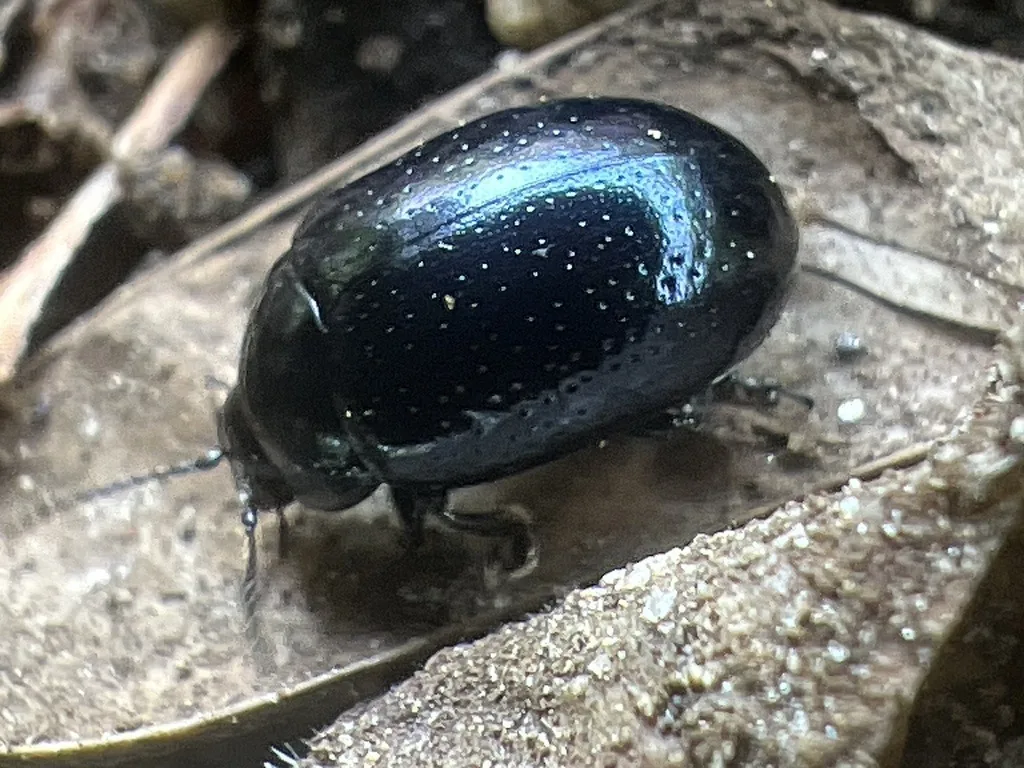
- Adults are oval, robust leaf beetles about 1/4 inch (6 mm) long, shiny metallic blue, bronze, green or purple. The two species look very much alike; the Forest Service says C. quadrigemina is slightly larger.[1][3]
- Larvae are orange when young and later gray, orangish or pinkish, growing to about 1/4 inch (6 mm). Eating St. Johnswort makes them sensitive to light, so most feeding happens before sunrise.[1][3]
- Eggs are orange and cylindrical, about 1/25 inch (1 mm) long.[1][3]
- Chewed, defoliated St. Johnswort points to the beetles; the Forest Service calls adult defoliation striking. Washington's weed board notes that larvae of the St. Johnswort moth (Aplocera plagiata) also eat the leaves.[3][4]
Where it lives
The Forest Service says the two species came from England and France via Australia and were released in the western United States in 1945 and 1946, then redistributed to eastern Canada from 1969; in the US both are established mainly in western states. UC IPM says C. quadrigemina is the most common species in California. GBIF holds about 930 records of C. quadrigemina, about 290 from Australia, 210 from Chile and 210 from the US, and about 7,000 of C. hyperici, about 1,000 of them from the US. Since 1990 GBIF has 61 US records of C. quadrigemina, mostly from Massachusetts, California and Colorado, and about 1,000 of C. hyperici, mostly from Washington, Oregon and California. A 1951 Forest Service review records that Australia released seven insect species against the weed beginning in 1934, three of which established, including two Chrysolina beetles, and that the California stock was flown in from Australia.[3][1][5][6][7][8][9]
Biology and life cycle
Adults emerge mainly in April and May and feed, then rest in the soil through the hot summer. If fall rains are sufficient they return to the plants, feed and lay eggs on the leaves.[1][3]
UC IPM says a female can lay about 1,000 eggs. The beetles overwinter mainly as eggs, or as eggs or larvae; when fall rains are poor, adults overwinter instead and lay eggs in spring. There is one generation a year. The Forest Service's 2010 St. Johnswort manual adds that in mild climates, fall-hatched larvae can survive the winter.[1][3][10]
Larvae feed on young foliage, mostly before sunrise, and burrow about 1 inch into the soil to pupate.[1][3]
Populations of beetle and weed often boom and bust: when St. Johnswort control is high the beetles crash, and the weed returns, but at lower than historical levels. C. quadrigemina is now typically considered the more abundant and effective species, especially at drier, warmer sites, and prefers more maritime conditions; C. hyperici is more tolerant of cold and moisture.[3]
Damage and signs
- On Klamathweed the beetles are the intended control. By the early 1940s the weed covered over 2 million acres in California; beetles obtained from Australia were introduced beginning in 1946, and by 1957 the weed had been reduced by over 99 percent. The Forest Service says they can reduce the weed by more than 97 percent at most open, sunny sites in the West.[1][3]
- Both species are ineffective in shady habitats and do poorly in barren or rocky areas; they prefer warm, sunny regions with wet winters.[3]
- In landscapes, adults and larvae chew ornamental Hypericum species, especially creeping St. Johnswort (H. calycinum). Heavy feeding can defoliate plants when beetles are abundant, but irrigated plants generally recover and the damage is mainly aesthetic.[2][1]
- The beetles also eat other St. Johnsworts. The Forest Service says C. quadrigemina attacks the native Hypericum concinnum and H. punctatum and the exotic H. calycinum, and a New York field study found it readily eats native H. punctatum but found no evidence that it limits that plant to forest edges. The 2010 manual calls H. concinnum a forb or small shrub found only in California, says long-term impacts on it have not been recorded, and notes that both beetles may harm the St. Johnswort root borer (Agrilus hyperici), another biocontrol agent, though the data are inconclusive.[3][11][10]
- Their release in California in 1945 and 1946 began the first classical biological control program in the United States and Canada. The beetles worked so well that grateful California landowners put up a monument to them, and Scientific American ran an article on the program in 1957.[10]
- Results varied by region. In some places the weed was wiped out; in others it rebounded from time to time, followed by the beetles, holding infestations around 3% of their 1940s peak; elsewhere it seemed unaffected and kept spreading. That led to more agents; the 2010 manual lists five insects approved in the US against the weed.[10]
Health risk
UC IPM describes them only as leaf beetles that chew Hypericum; no cited source describes any risk to people or pets. The weed they eat is toxic to cattle and sheep.[1][2]
Control
Prevention
On landscape Hypericum, UC IPM says control is generally not warranted. Water deeply and regularly during the dry season, especially in hot weather, and protect roots from compaction and soil disturbance; vigorous plants tolerate moderate feeding.[2]
Sanitation
In hot areas, removing litter under the plants may reduce survival of the adults that rest there through summer. Keeping the soil under plants moist in spring may raise disease and mortality among the larvae pupating near the surface.[2]
Biological control
Entomopathogenic nematodes (Heterorhabditis or Steinernema species) applied to the soil under plants in late winter, shortly before the larvae pupate, may provide control. Watch the lowest parts of the plant for larvae to time the application.[2]
On rangeland Klamathweed the beetles are the control and need no management. They do best in warm, sunny regions with wet winters and poorly in shade or on barren, rocky ground.[3]
Washington's Noxious Weed Control Board lists the Klamathweed beetles among the biological controls for common St. Johnswort, along with the St. Johnswort moth (Aplocera plagiata), whose larvae eat the leaves, and the St. Johnswort root borer (Agrilus hyperici), whose larvae feed inside the roots.[4]
Pesticides
If the chewing cannot be tolerated, UC IPM lists Bacillus thuringiensis ssp. galleriae, which selectively kills leaf beetle adults and larvae that eat treated foliage; because it does not persist long, spray the lower foliage when young larvae are present. Azadirachtin and spinosad are the other options it gives. It advises against foliar carbamates, organophosphates and pyrethroids, which can harm bees and natural enemies and can drift or contaminate surface waters.[2]
Where the sources disagree
Effect: UC IPM says Klamathweed in California was reduced by over 99 percent by 1957; the Forest Service gives more than 97 percent at most open, sunny sites in the West.[1][3]
Larval stages: UC IPM gives three instars; the Forest Service gives four.[1][3]
Release dates: the Forest Service gives western US releases in 1945 and 1946; UC IPM says the beetles were introduced beginning in 1946.[3][1]
Overwintering: UC IPM says mainly as eggs or larvae; the Forest Service says mainly as eggs, with adults overwintering when fall rains fail.[1][3]
Which species: UC IPM says C. quadrigemina is the most common in California, but GBIF has about 1,000 US records of C. hyperici since 1990 against 61 of C. quadrigemina.[1][6][8]
Adult emergence: UC IPM says adults emerge mainly in April and May; the Forest Service's 2010 manual says they emerge in early summer as St. Johnswort begins flowering.[1][10]
Common questions
- Are Klamathweed beetles good or bad?
- Both, depending on the plant. On Klamathweed, a rangeland weed toxic to cattle and sheep, UC IPM credits them with cutting the weed in California by over 99 percent by 1957. On ornamental St. Johnswort they chew the foliage, though irrigated plants generally recover and the damage is mainly aesthetic.[1][2]
- When do the beetles do their damage?
- Larvae chew the lower leaves and stem bases from late fall through winter and spring; adults feed higher on the plant mainly in spring and early summer, rest in the soil through hot weather, and feed again more lightly in fall.[1][2]
- Should I spray my St. Johnswort?
- Usually not. UC IPM says vigorous, well-watered plants tolerate moderate feeding and that control is generally not warranted. If damage is intolerable, Bacillus thuringiensis ssp. galleriae, azadirachtin or spinosad on the lower foliage when young larvae are present are the first choices.[2]
- Will Klamathweed beetles eat my native St. Johnswort?
- They can. The Forest Service says C. quadrigemina attacks native Hypericum concinnum and H. punctatum, and a New York study found the beetle readily ate native H. punctatum.[3][11]
- Why are Klamathweed beetles called a biocontrol success story?
- They started the first classical weed biocontrol program in the United States and Canada and brought California's Klamathweed down so sharply that landowners erected a monument to them. The Forest Service notes results were uneven elsewhere, and more agents were released later.[10]
Sources
- University of California Statewide IPM Program, “Klamathweed Beetle (Natural Enemies Gallery).” ipm.ucanr.edu/natural-enemies/klamathweed-beetle/ (accessed 2026-11-14)
- University of California Statewide IPM Program, “Klamathweed Beetle (Home and Landscape).” ipm.ucanr.edu/home-and-landscape/klamathweed-beetle/ (accessed 2026-11-14)
- USDA Forest Service, Forest Health Technology Enterprise Team, “Field Guide for the Biological Control of Weeds in Eastern North America, FHTET-2016-04 (R. L. Winston, C. B. Randall, B. Blossey, P. W. Tipping, E. C. Lake and J. Hough-Goldstein, 2017).” www.fs.usda.gov/foresthealth/technology/pdfs/FHTET-2016-04_Biocontrol_Field_Guide.pdf (accessed 2026-11-14)
- Washington State Noxious Weed Control Board, “Common St. Johnswort (Hypericum perforatum).” www.nwcb.wa.gov/weeds/common-st-johnswort (accessed 2026-11-14)
- Global Biodiversity Information Facility (GBIF), “Chrysolina quadrigemina: occurrence records by country (GBIF occurrence search).” api.gbif.org/v1/occurrence/search?taxonKey=1047387&facet=country&facetLimit=20&limit=0 (accessed 2026-11-14)
- Global Biodiversity Information Facility (GBIF), “Chrysolina quadrigemina: U.S. occurrence records since 1990 by state (GBIF occurrence search).” api.gbif.org/v1/occurrence/search?taxonKey=1047387&country=US&hasGeospatialIssue=false&occurrenceStatus=PRESENT&year=1990%2C2026&facet=stateProvince&facetLimit=400&limit=0 (accessed 2026-11-14)
- Global Biodiversity Information Facility (GBIF), “Chrysolina hyperici: occurrence records by country (GBIF occurrence search).” api.gbif.org/v1/occurrence/search?taxonKey=1047392&facet=country&facetLimit=20&limit=0 (accessed 2026-11-14)
- Global Biodiversity Information Facility (GBIF), “Chrysolina hyperici: U.S. occurrence records since 1990 by state (GBIF occurrence search).” api.gbif.org/v1/occurrence/search?taxonKey=1047392&country=US&hasGeospatialIssue=false&occurrenceStatus=PRESENT&year=1990%2C2026&facet=stateProvince&facetLimit=400&limit=0 (accessed 2026-11-14)
- USDA Forest Service, Northern Rocky Mountain Forest and Range Experiment Station, “St. Johnswort on Western Ranges: A Review of the Literature and Bibliography, Research Paper No. 26 (G. A. Harris, February 1951; historic document).” archive.org/details/stjohnswortonwes26harr (accessed 2026-11-14). Scanned copy on the Internet Archive; text read from the archive.org full-text (djvu.txt) file.
- USDA Forest Service, Forest Health Technology Enterprise Team, “Biology and Biological Control of Common St. Johnswort, FHTET-2010-05 (R. L. Winston, M. Schwarzländer, C. B. Randall and R. Reardon, December 2010).” www.fs.usda.gov/foresthealth/technology/pdfs/FHTET-2010-05_StJohnswort.pdf (accessed 2026-11-14)
- PeerJ 2016;4:e1886, via PubMed, “Spillover of a biological control agent (Chrysolina quadrigemina) onto native St. Johnswort (Hypericum punctatum).” pubmed.ncbi.nlm.nih.gov/27069816/ (accessed 2026-11-14)
- Global Biodiversity Information Facility (GBIF), “Chrysolina quadrigemina (Suffrian, 1851) (GBIF Backbone Taxonomy).” api.gbif.org/v1/species/1047387 (accessed 2026-11-14)
- Global Biodiversity Information Facility (GBIF), “Chrysolina hyperici (Forster, 1771) (GBIF Backbone Taxonomy).” api.gbif.org/v1/species/1047392 (accessed 2026-11-14)