On this page
How to identify it
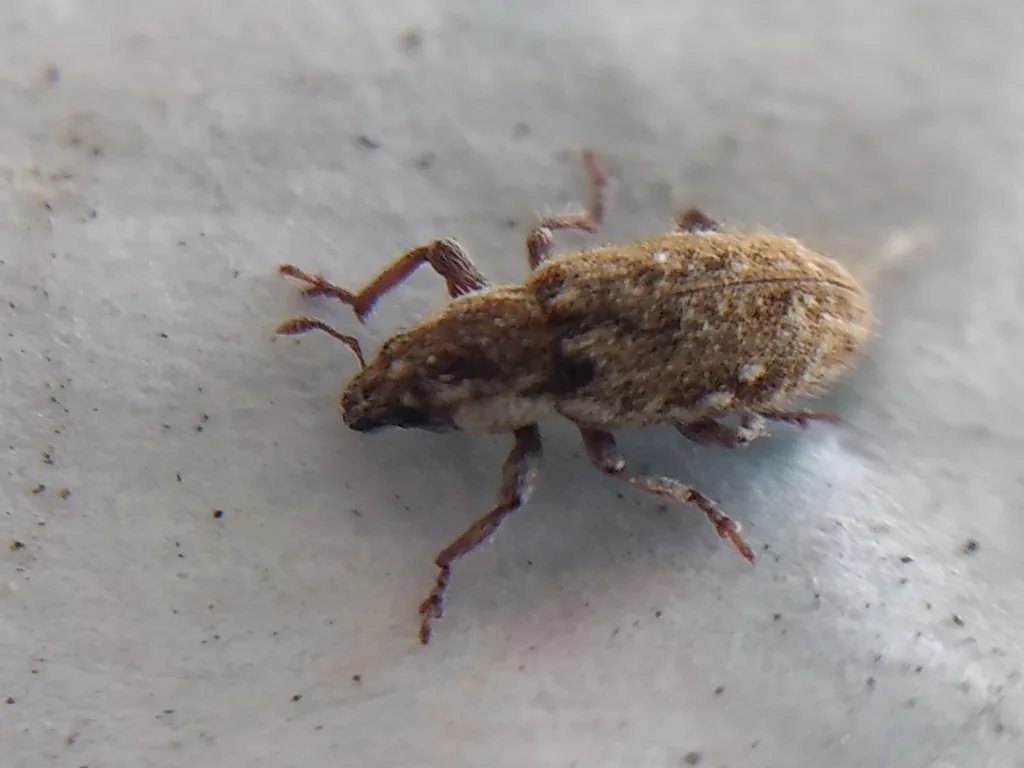
- UC IPM describes the adults as mottled brown, gray and whitish weevils with a snoutlike head, about 1/5 inch (5 mm) long and covered with fine pale hairs. NMSU describes the seed weevil adult as 1/4 inch (6.35 mm) or less, droplet shaped, brown and covered with white hairs that can look shaggy.[2][1]
- WeedCUT says the seed weevil has a shorter snout than the stem weevil.[3]
- The obvious sign is a round hole about 1/16 inch (1.5 mm) across in a seedpod or stem, chewed by the emerging adult. In early spring NMSU suggests checking the undersides of stems for white feeding scars and stem weevil exit holes.[2][1]
- Larvae are elongate, segmented and pale orange to whitish with a brown head; the last (fourth) instar is about 5 mm long. Pupae are pale orange to whitish and about 4 mm long. Eggs are oval and about 0.5 mm long, pale brown to yellow according to UC IPM and cream to pale yellow according to NMSU.[2][1]
Where it lives
NMSU says both species were imported from Italy, released in California in summer 1961, and then released across many western states and Hawaii in the early 1960s. A 2022 survey found weevils or their damage at nearly all puncturevine sites checked in New Mexico and Colorado, while 2023 surveys in Idaho, Oregon, Montana and Wyoming found none. UC IPM says they occur throughout California wherever puncturevine grows. At every New Mexico and Colorado site with weevils, NMSU says seed weevils were more common than stem weevils. WeedCUT says the weevils have been highly effective in Hawaii.[1][2][3]
Biology and life cycle
Both weevils overwinter as adults in organic litter on the ground or in protected spots on plants near where they fed.[2][3]
The seed weevil female chews a pit in a young bur and lays a single egg in it, then covers it (with fecal matter, NMSU says; WeedCUT describes a black secretion). The egg hatches in 2 to 3 days, the larva eats the seeds and pupates in the pod, and the adult chews a round exit hole.[1][3][2]
The stem weevil female chews a pit in the underside of a stem or in the root crown and lays an egg there. The larva mines inside the stem and pupates there; NMSU gives 45 to 51 days from egg to adult, about two weeks longer than the seed weevil.[2][1][3]
Stem weevil adults live about four months and lay about 250 eggs; seed weevil adults live about three months and lay about 200.[2]
UC IPM says quarantine studies found the weevils able to reproduce only on Tribulus species. In forced feeding tests, NMSU says, seed weevils also laid eggs on two closely related plants, Kallstroemia grandiflora and K. californica, and WeedCUT notes larvae found on Arizona poppy (K. grandiflora) in Arizona without substantial damage. Two native parasitoids and predators such as bigeyed bugs reduce the weevils' numbers.[2][1][3]
Damage and signs
- Seed weevil larvae kill the seeds and make seedpods turn brown and sometimes drop early. NMSU says up to 80 percent of goatheads show seed weevil damage in some locations, and seeds from damaged goatheads germinate less well, even when they look undamaged.[2][1]
- Stem weevil larvae make stems die early and dry up, reducing the weed's ability to produce seed. NMSU says stem weevils reduced plant biomass and survival, especially without irrigation.[2][1]
- WeedCUT cites a 46 percent drop in seed production within 5 years of the first southern California release, and a 70 to 100 percent drop in puncturevine cover in 5 of 6 regions studied over 15 years. Impact appears higher at non-irrigated sites or with less rain.[3]
- In Lassen County, WeedCUT reports the seed weevil established at 1 of 5 sites and the stem weevil at none. It says establishment has been difficult at higher elevations and latitudes, presumably because of cold winters.[3]
- NMSU reports that the two weevils together cut flower production by 29% in irrigated plots and 60% in unirrigated plots. UC IPM says the stem weevil is slightly more effective than the seed weevil when each is used alone.[1][2]
Health risk
They are plant-feeding weevils. UC IPM and NMSU don't mention any risk to people or pets.[2][1]
Control
Prevention
Keep irrigation water and runoff from reaching puncturevine. Dry plants produce less seed and grow less, and they die more readily from weevil feeding.[2]
WeedCUT notes that herbicides that kill puncturevine in summer also reduce weevil numbers. NMSU says seedlings are easy to pull by hand and should be removed as soon as they appear, because plants can set seed within 2 to 3 weeks.[3][1]
Biological control
The weevils are the biological control. UC IPM says they are most effective used together and where puncturevine is moisture-stressed.[2]
Before moving weevils, WeedCUT advises checking for them: adult feeding holes on leaves, stems and fruits, and larvae or feeding damage inside fruits and stems. If they are present, there is no need to release more. Adults can be vacuumed or hand-collected from under plants, or infested plants and litter held in a paper bag so adults emerge; collect only adult weevils so their parasites and predators are not moved too.[3]
Where the sources disagree
Range in California: UC IPM says the weevils occur throughout California wherever puncturevine grows; WeedCUT says they do not overwinter north of Sacramento.[2][3]
Development time: UC IPM gives about 1 month from egg to reproductive adult in summer; NMSU gives 45 to 51 days for the stem weevil.[2][1]
Host range: UC IPM says quarantine studies found the weevils able to reproduce only on Tribulus; NMSU and WeedCUT report egg laying or larvae on Kallstroemia, close relatives of puncturevine.[2][1][3]
The weed they were released against
NMSU says puncturevine was an accidental introduction to the United States, possibly on the wool of sheep imported from Mediterranean Europe, and was recognized as a problem in California as early as 1912. A 1932 University of California bulletin gives the earliest reported California collection as Port Los Angeles in 1903.[1][6]
Each spiny goathead has five segments holding one to five seeds apiece, and NMSU says the seeds can survive in the soil for at least eight years, leaving a large supply to reinfest an area. Plants can set seed within two to three weeks of germinating.[1]
The goatheads cling to people, animals and vehicle tires, which spreads the weed. The 1932 bulletin found the spines stout enough to penetrate a worn tire tread: bicycle tires were frequently punctured, while punctures in heavy cord or balloon tires were rare.[1][6]
For livestock owners, the Merck Veterinary Manual lists puncture vine (Tribulus terrestris) among plants whose poisoning has been tied to phylloerythrin, the agent in liver-related (hepatogenous) photosensitization, in which skin lacking protective hair, wool or pigment becomes more susceptible to ultraviolet light.[7]
In Florida, UF/IFAS's guide to vine weeds in citrus uses the name puncture vine for a different species, Tribulus cistoides, which it describes as a prostrate, branching summer annual with light yellow flowers 4 to 5 cm across and spiny, hairy fruit.[8]
Common questions
- Are these weevils a garden pest?
- UC IPM and NMSU describe them only as biological control agents of puncturevine. UC IPM says quarantine studies found them able to reproduce only on Tribulus, and NMSU adds that seed weevils laid eggs on two Kallstroemia species, close relatives of puncturevine, in forced feeding tests.[2][1]
- The weevils are here but the spiny burs are still a problem. Why?
- Seed weevil damage reduces seed production and germination, NMSU says, but damaged goatheads still form. Results also vary: WeedCUT says impact is higher at non-irrigated sites and that establishment has been difficult at higher elevations and latitudes.[1][3]
- Can I get puncturevine weevils for my property?
- In California, UC IPM says they already occur wherever puncturevine grows. NMSU's 2023 surveys found none in Idaho, Oregon, Montana or Wyoming.[2][1]
- Is puncturevine harmful to livestock?
- The Merck Veterinary Manual lists puncture vine (Tribulus terrestris) among the plants whose poisoning has been linked to hepatogenous photosensitization, a liver-related condition that makes exposed, lightly covered skin more susceptible to ultraviolet light. Ask a veterinarian about any animal that has grazed it.[7]
Sources
- New Mexico State University, College of ACES, “Bowers and King, History and Use of Puncturevine Weevils for Biological Control, Guide H-187 (2025).” pubs.nmsu.edu/_h/H187/index.html (accessed 2026-11-14)
- University of California Statewide IPM Program, “Puncturevine Weevils (Natural Enemies Gallery).” ipm.ucanr.edu/natural-enemies/puncturevine-weevils/ (accessed 2026-11-14)
- University of California Statewide IPM Program, “WeedCUT: Biological control of puncturevine.” weedcut.ipm.ucanr.edu/biological-control/puncturevine/ (accessed 2026-11-14)
- Global Biodiversity Information Facility (GBIF), “Microlarinus lareynii (GBIF Backbone Taxonomy).” api.gbif.org/v1/species/4292059 (accessed 2026-11-14). ACCEPTED; order Coleoptera, family Curculionidae; read 2026-11-14.
- Global Biodiversity Information Facility (GBIF), “Microlarinus lypriformis (GBIF Backbone Taxonomy).” api.gbif.org/v1/species/4292058 (accessed 2026-11-14). ACCEPTED; order Coleoptera, family Curculionidae; read 2026-11-14.
- University of California Agricultural Experiment Station, via Internet Archive scan, “The Puncture Vine in California, Bulletin 528 (Ethelbert Johnson, May 1932).” archive.org/details/puncturevineinca528john (accessed 2026-11-14). Historical bulletin read from the Internet Archive full text (djvu.txt); it predates the 1961 weevil releases.
- Merck Veterinary Manual, “Overview of Photosensitization in Animals.” www.merckvetmanual.com/integumentary-system/photosensitization/overview-of-photosensitization-in-animals (accessed 2026-11-14)
- University of Florida IFAS Extension, EDIS, “Identification of Vine Weeds in Florida Citrus, HS926/HS185 (S. H. Futch and D. W. Hall; archival copy).” journals.flvc.org/edis/article/download/108878/104022 (accessed 2026-11-14). Archival copy on the EDIS journal site; the EDIS address ask.ifas.ufl.edu/publication/HS185 returns 410 (withdrawn).