On this page
How to identify it
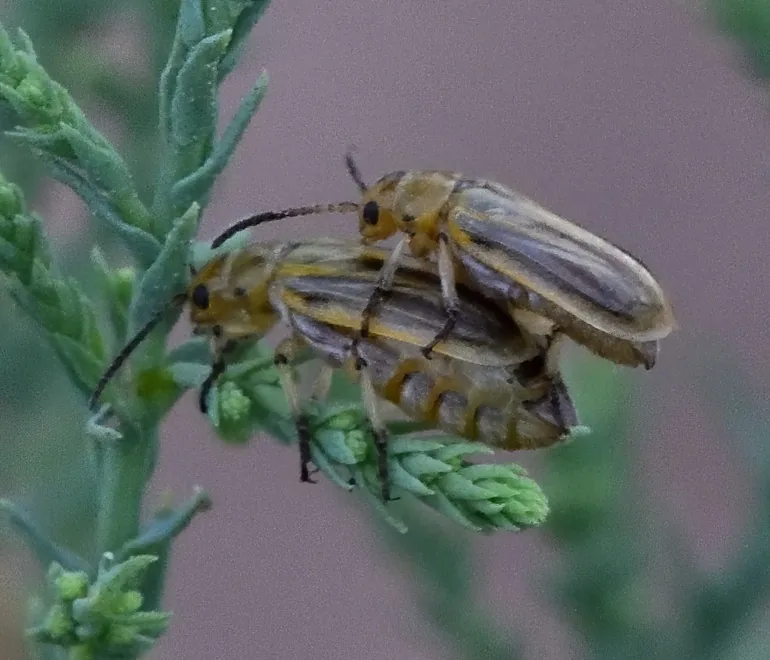
- In California, where the Mediterranean tamarisk beetle is the most prevalent species, adults are about 3/8 inch (9 mm) long and mostly yellowish brown or green, with brown to dark green lengthwise stripes on the wing covers.[1]
- First-instar larvae are black and about 1.5 mm long. Second and third instars are mostly grayish black with a yellowish green stripe along each side of the abdomen, and mature larvae are about 9 mm long.[1]
- Eggs are yellowish orange, globular and about 1.5 mm long, laid on saltcedar foliage in groups of several to about 20. Pupae, hidden in litter and topsoil, are yellow and about 7 mm long.[1]
- Gaffke and colleagues describe the three southern species by origin: D. carinata from eastern Europe and western Asia, D. sublineata from North Africa and the western Mediterranean, and D. elongata from the eastern Mediterranean.[2]
- IBiocontrol, summarizing the North American Invasive Species Management Association's 2023 saltcedar chapter, describes adults as 5½ to 6 mm long with tan to yellow bodies and two dark stripes on each wing cover; the stripes are more obvious on the northern tamarisk beetle than on the other species.[7][8][9][10]
- It describes larvae as up to 1 cm long, spotted grayish black, with distinct yellow or cream lengthwise stripes, and eggs as tan and spherical, laid in small clusters on saltcedar foliage.[7]
Look-alikes
| Look-alike | How to tell them apart |
|---|---|
| Coniatus splendidulus (a weevil) and Opsius stactogalus (a leafhopper) | Other insects feed on saltcedar in North America. Gaffke and colleagues list the splendid tamarisk weevil, a foliage-feeding weevil first detected in central Arizona in 2006 that then spread through the southwestern states, and the leafhopper Opsius stactogalus; how they arrived is unknown. They are a weevil and a leafhopper, not striped leaf beetles.[2] |
Where it lives
Gaffke and colleagues report open field releases from 2001, with establishment most dependable north of about 38°N. The northern tamarisk beetle has since evolved better-matched seasonal cues, and populations from Utah and Colorado dispersed south to the Mexico-US border, crossing the Colorado River Delta region of northern Mexico in 2019. IBiocontrol lists the native range of the released stock as Kazakhstan for the northern tamarisk beetle (Chilik ecotype), Crete for the Mediterranean tamarisk beetle (Crete ecotype), and Uzbekistan for both the larger tamarisk beetle (D. carinata) and the subtropical tamarisk beetle (D. sublineata).[2][3][7][8][9][10]
Biology and life cycle
They feed on saltcedars (Tamarix species): both adults and larvae chew the foliage.[1]
Adults overwinter in protected locations and become active in April or May, when they feed and mate and females begin laying eggs. Males produce an aggregation pheromone that draws beetles together.[1][2]
Adults live about 3 weeks, and each female lays about 200 eggs. Larvae pass through three instars; mature larvae drop or walk to the ground and pupate in cells in the litter or topsoil. IBiocontrol says females lay 100 to 200 eggs in small groups of up to 25, larvae hatch after about five days and feed on young saltcedar growth, and mature larvae move into the litter beneath the plants to pupate. Adults overwinter in that leaf litter or other sheltered spots near the host.[1][7]
UC IPM says egg to reproductive adult takes about 7 weeks at an average of 80°F, and the Mediterranean tamarisk beetle has 2 generations a year; the second does not reproduce until the next spring. Gaffke and colleagues give 1 to 2 generations of the northern tamarisk beetle in Montana and Wyoming, and as many as five per season in Texas for the southern species. IBiocontrol says the northern tamarisk beetle (Chilik ecotype) tends to have two generations a year north of the 38th parallel and the other three species 3 to 5.[1][2][7][8][9][10]
The northern tamarisk beetle at first failed south of the 38th parallel because its cues for entering diapause did not match the season there. Better-adapted cues later evolved, and it spread south. At the expanding southern edge, beetles reproduce earlier and lay more eggs, and edge females have evolved larger bodies.[2][3][4]
Gaffke and colleagues list predators: the red imported fire ant preys on pupae in the leaf litter, and Formica ants and other generalist arthropods also attack the beetles. In Texas and New Mexico, beetle densities high enough for areawide defoliation lasted only 3 to 4 years for each species.[2]
Damage and signs
- The beetles severely defoliate saltcedar, greatly reducing its reproduction and causing some plants to decline and die prematurely. Gaffke and colleagues report saltcedar mortality from northern tamarisk beetle feeding above 30 percent on average, reaching 50 percent at some monitoring sites, with widespread biomass reduction above 70 percent.[1][2]
- Spillover feeding on athel (Tamarix aphylla) was seen where beetle densities on nearby deciduous Tamarix were high; the athel re-foliated, often within the same season.[2]
- Concern for the endangered southwestern willow flycatcher, which nests in Tamarix, led to legal actions that ended federal involvement in the program nationally. IBiocontrol says the original permit barred releases within 200 miles (322 km) of known southwestern willow flycatcher nesting in saltcedar, and Arizona and New Mexico therefore do not allow beetle introduction or redistribution.[2][7]
- Larvae and adults sometimes kill more foliage than they eat by scraping the bark off young twigs, which dries out the stems. Newly defoliated plants are straw-colored and quickly leaf out again; plants defoliated several times may die back, leaving dead gray branches. They may regrow from the base, but repeated defoliation drains their reserves and gradually kills some plants, IBiocontrol says.[7]
Health risk
They are plant-feeding leaf beetles. UC IPM and the Forest Service chapter don't mention any risk to people or pets.[1][2]
Control
Prevention
A 2010 APHIS moratorium stopped permits for moving Diorhabda between states or holding it in culture, and revoked existing permits. IBiocontrol says the moratorium on interstate movement and release is still in place, redistribution to federal lands remains prohibited, and Arizona and New Mexico do not allow introduction or redistribution; releases within other states are legal. It lists all four species as approved with conditions in the United States and not approved in Canada.[2][7][8][9][10]
Biological control
Tamarisk beetles are the biological control of saltcedar. Gaffke and colleagues report that in Montana new releases made with the aggregation pheromone have established, though at low density, and that pheromone lures are used to gather the beetles and increase their impact.[2]
Where the sources disagree
Release date: UC IPM says the beetles were released beginning in 1999; Gaffke and colleagues date open field releases to 2001, after cage trials.[1][2]
Generations: UC IPM gives 2 generations a year for the Mediterranean tamarisk beetle; Gaffke and colleagues give 1 to 2 for the northern species in Montana and Wyoming and up to five per season in Texas.[1][2]
Adult size: UC IPM gives about 9 mm for the Mediterranean tamarisk beetle in California; IBiocontrol gives 5½ to 6 mm for each species.[1][8]
Eggs: UC IPM describes yellowish orange eggs in groups of several to about 20; IBiocontrol describes tan eggs in groups of up to 25.[1][7]
Origin of D. sublineata: Gaffke and colleagues place it in North Africa and the western Mediterranean; IBiocontrol lists its native range as Uzbekistan.[2][10]
Generations: IBiocontrol gives 3 to 5 a year for the three southern species; UC IPM gives 2 for the Mediterranean tamarisk beetle in California.[8][1]
Common questions
- Why are the saltcedar trees along the river brown?
- Tamarisk beetle feeding is one cause: UC IPM says adults and larvae chew saltcedar foliage and severely defoliate the plants. IBiocontrol adds that newly defoliated plants are straw-colored and quickly leaf out again, while plants stripped repeatedly may die back to dead gray branches.[1][7]
- Do tamarisk beetles eat other plants?
- Gaffke and colleagues report no recorded feeding outside the genus Tamarix twenty years after field release. Frankenia salina was fed on in the laboratory but avoided in the field, and athel was attacked only where nearby beetle densities were high.[2]
- Can I bring tamarisk beetles to my property to kill saltcedar?
- Not across state lines: a 2010 APHIS moratorium stopped permits for interstate movement of Diorhabda. IBiocontrol adds that redistribution to federal lands is prohibited and that Arizona and New Mexico do not allow introduction or redistribution at all.[2][7]
Sources
- University of California Statewide IPM Program, “Tamarisk Beetles (Natural Enemies Gallery).” ipm.ucanr.edu/natural-enemies/tamarisk-beetles/ (accessed 2026-11-14)
- USDA Forest Service, Forest Health Assessment and Applied Sciences Team, “Gaffke, Dudley, Bean, Drus, Johnson, Knutson, Weaver, Sing, Orr and Thompson, Tamarix Biological Control in North America (chapter 28 of FHAAST-2019-05, Contributions of Classical Biological Control to U.S. Food Security, Forestry, and Biodiversity).” www.fs.usda.gov/foresthealth/technology/pdfs/FHAAST-2019-05-Contributions-Classical-Biocontrol.pdf (accessed 2026-11-14)
- Evolutionary Applications (Wiley), full text in PubMed Central (PMC9753830), “Clark, Bitume, Bean, Stahlke, Hohenlohe and Hufbauer. Evolution of reproductive life-history and dispersal traits during the range expansion of a biological control agent. Evolutionary Applications (2022), doi:10.1111/eva.13502.” doi.org/10.1111/eva.13502 (accessed 2026-11-14)
- Current Research in Insect Science (Elsevier), full text in PubMed Central (PMC12051650), “Clark, Bean, Bitume, Stahlke, Hohenlohe and Hufbauer. Heritability of body size matches trait evolution in the range expansion of a biological control agent. Current Research in Insect Science (2025).” pmc.ncbi.nlm.nih.gov/articles/PMC12051650/ (accessed 2026-11-14)
- Global Biodiversity Information Facility (GBIF), “Diorhabda (genus) (GBIF Backbone Taxonomy).” api.gbif.org/v1/species/1047832 (accessed 2026-11-14). ACCEPTED; order Coleoptera, family Chrysomelidae; read 2026-11-14.
- Global Biodiversity Information Facility (GBIF), “Diorhabda carinulata (GBIF Backbone Taxonomy).” api.gbif.org/v1/species/4461350 (accessed 2026-11-14). ACCEPTED; order Coleoptera, family Chrysomelidae; read 2026-11-14.
- IBiocontrol (summary of the North American Invasive Species Management Association's Biological Control of Weeds chapters), “Northern tamarisk beetle (Chilik ecotype), Diorhabda carinulata.” ibiocontrol.org/bio/diorhabda-carinulata-chilik-ecotype/ (accessed 2026-11-14)
- IBiocontrol (summary of the North American Invasive Species Management Association's Biological Control of Weeds chapters), “Mediterranean tamarisk beetle (Crete ecotype), Diorhabda elongata.” ibiocontrol.org/bio/diorhabda-elongata-crete-ecotype/ (accessed 2026-11-14)
- IBiocontrol (summary of the North American Invasive Species Management Association's Biological Control of Weeds chapters), “Larger tamarisk beetle, Diorhabda carinata.” ibiocontrol.org/bio/diorhabda-carinata/ (accessed 2026-11-14)
- IBiocontrol (summary of the North American Invasive Species Management Association's Biological Control of Weeds chapters), “Subtropical tamarisk beetle, Diorhabda sublineata.” ibiocontrol.org/bio/diorhabda-sublineata/ (accessed 2026-11-14)