On this page
How to identify it
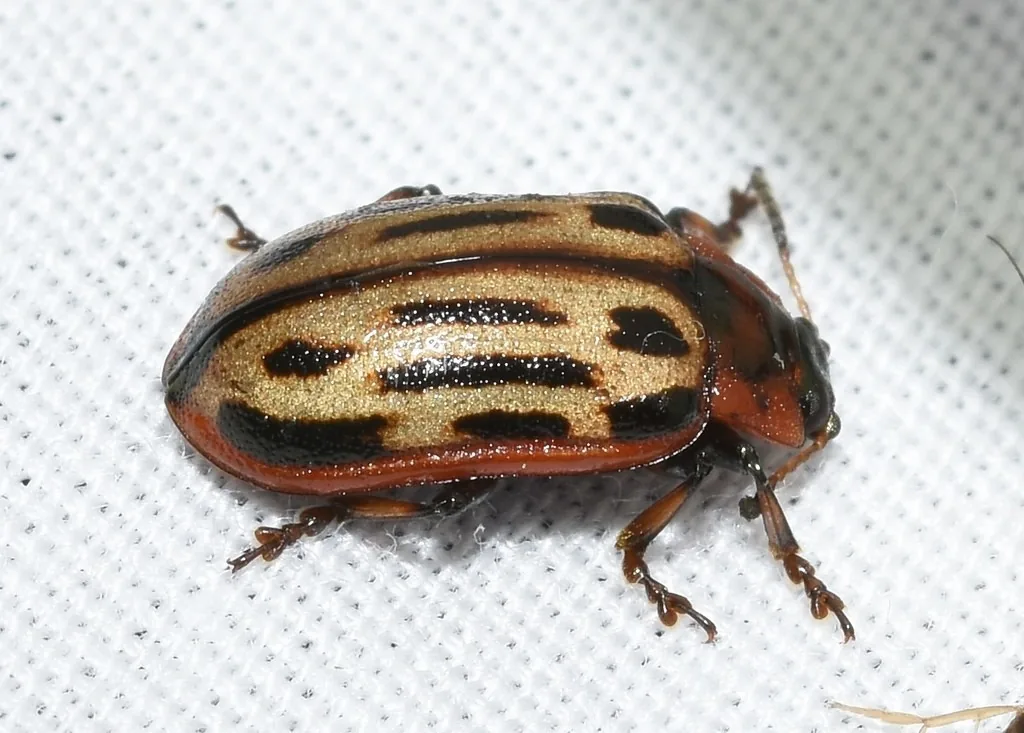
- Adults are oval, yellow and about 1/4 inch (6 mm) long, with slender black markings on the wing covers. The USDA Forest Service's Eastern Forest Insects handbook adds that the head and thorax are black with yellow or red edges on the thorax, and that the wing covers, usually yellowish with black stripes, are sometimes almost pure golden to black.[2][3]
- Eggs are tiny and yellow, laid in masses of 15 to 75 on the undersides of leaves. The eastern handbook gives the same 15 to 75 eggs per group, and the Western Forest Insects handbook describes the eggs as yellowish or reddish.[1][2][3][4]
- Newly hatched larvae are tiny and black. The sources describe older larvae differently (see Where the sources disagree); the larvae have a defensive secretion and a pungent odor. The eastern handbook says mature larvae are blackish and about 12 mm long, with whitish spots along each side at the scent glands, which give off a pungent odor when the larvae are disturbed.[1][2][3]
- Pupae are very dark and attach to leaves, stems, the trunk or nearby objects.[1]
Look-alikes
| Look-alike | How to tell them apart |
|---|---|
| Lady beetle eggs | Cottonwood leaf beetle egg masses look much like lady beetle eggs. Leaf beetles lay eggs only on their few host plants, while lady beetles lay near their prey; small size and color differences also separate the eggs.[5] |
| Other Chrysomela leaf beetles | Several Chrysomela species feed on willows, poplars and alders in the West. They are structurally very similar and their color and markings vary widely even within a species, so the locality and host plant are needed to name them. The aspen leaf beetle (C. crotchi) is light brown to dull orange without markings.[4] |
Where it lives
NC State reports it feeding throughout North Carolina. GBIF holds about 3,800 records filed under Chrysomela scripta: about 3,400 from the US, about 300 from Canada and about 100 from Mexico. Its US records since 1990 (about 2,800) come from 44 states and the District of Columbia, most from Florida, New Mexico and Louisiana. The USDA Forest Service's Eastern Forest Insects handbook says it occurs throughout the United States and Canada, and Western Forest Insects calls it a transcontinental species that occurs widely in the West.[1][6][7][3][4]
Biology and life cycle
Adults spend the winter under fallen leaf debris or in clumps of weeds and, in spring, feed on unfolding leaves or tender bark at the twig tips. The eastern handbook adds loose bark and clumps of grass as winter shelters, and the western handbook says adults appear early in spring and feed on the tender shoots.[2][1][3][4]
Young larvae feed side by side in groups and skeletonize the leaves; older larvae feed separately and eat all of the leaf except the larger veins.[2][1]
Larvae feed for about 2 weeks, then pupate on leaves, stems, bark, weeds or nearby objects; new adults emerge in 5 to 10 days. There are several generations a year, each taking about 35 days in the USDA Forest Service report. The western handbook says that in hot weather larvae reach maturity in about 15 days and reports five generations a year in the West.[1][2][4]
Damage and signs
- Hosts include cottonwood, aspen, other poplars and willows; NC State also names alder. The eastern handbook lists poplar, willow and alder; the western handbook says it feeds on both willows and poplars but not on quaking aspen (Populus tremuloides).[1][3][4]
- The USDA Forest Service report calls it one of the most serious pests of young trees in nurseries and plantations, with occasional severe damage in natural stands. In nurseries it stunts height growth and reduces the yield of cuttings, early defoliation weakens first- and second-year plantations, and heavy late-season populations can kill as much as 10 inches (25 cm) of the terminals, causing multiple-forked tops.[2]
- It is a major defoliating pest of poplars in North America; for 2-year-old poplars, researchers set the economic injury level for the second generation at 0.2 to 0.9 egg masses per actively growing terminal.[8]
- Signs include ragged foliage, brown patches, black droppings and the pungent odor of the larvae. The eastern handbook says severe infestations occur occasionally and cause considerable damage.[2][3]
Health risk
The sources describe it only as a leaf feeder on trees; no cited source describes any risk to people or pets.[1][2]
Control
Biological control
Natural enemies help: NC State says lady beetles feed on the eggs and pupae and predatory stink bugs feed on the beetles. The USDA Forest Service report says a red lady beetle, Coleomegilla maculata, can greatly reduce the spring generation but disperses later, and that several predatory bugs and a parasitic wasp attack the larvae.[1][2]
In trials on hybrid poplar, Bt var. tenebrionis, Bt var. kurstaki, spinosad and azadirachtin (larvae only) killed cottonwood leaf beetles without killing convergent or multicolored Asian lady beetles.[9]
Pesticides
NC State says that if defoliation is noticeable and the tree is small, various pyrethroid and other insecticides are available; follow the label. In the hybrid poplar trials, imidacloprid and carbaryl killed the beetles but also killed both lady beetle species.[1][9]
Where the sources disagree
Older larvae: NC State describes them as grayish brown with two rows of pale spots down the back; the USDA Forest Service report describes them as brown with prominent white scent-gland spots along the sides.[1][2]
Name: NC State, the USDA Forest Service report and the research trials use Chrysomela scripta; GBIF's backbone taxonomy lists Chrysomela scripta Fabricius, 1801 as a synonym of Aethiopocassis scripta.[1][2][9][8][10]
Aspen: NC State lists aspen as a host in North Carolina, but the USDA Forest Service's Western Forest Insects says the beetle does not feed on quaking aspen (Populus tremuloides).[1][4]
Generations a year: the USDA Forest Service report on cottonwood and the eastern handbook say several; the western handbook reports five in the West.[2][3][4]
Common questions
- What are the striped beetles eating my cottonwood leaves?
- Likely cottonwood leaf beetles: oval yellow beetles about 1/4 inch long with slender black markings on the wing covers.[2]
- Why do the beetle larvae on my willow smell?
- The USDA Forest Service report lists the pungent odor of the larvae as a sign of infestation, and NC State says the larvae have a defensive secretion. The eastern handbook says the larvae's scent glands give off a pungent odor when they are disturbed.[2][1][3]
- Do I need to spray?
- NC State mentions insecticides only for small trees with noticeable defoliation. Research trials found several biological products that killed the beetles while sparing lady beetles.[1][9]
Sources
- NC State Extension, “Cottonwood Leaf Beetle.” content.ces.ncsu.edu/cottonwood-leaf-beetle-1 (accessed 2026-11-14)
- USDA Forest Service, Southern Forest Experiment Station, “Insects and Diseases of Cottonwood, General Technical Report SO-8 (1975).” research.fs.usda.gov/download/treesearch/2367.pdf (accessed 2026-11-14)
- USDA Forest Service, “Eastern Forest Insects, Misc. Publication 1175 (W. L. Baker, Feb. 1972).” archive.org/details/easternforestins1175bake (accessed 2026-11-14). Scan of the USDA publication on archive.org; read via archive.org's djvu.txt full text.
- USDA Forest Service, “Western Forest Insects, Misc. Publication 1339 (R. L. Furniss and V. M. Carolin, Nov. 1977).” archive.org/details/CAT78702369 (accessed 2026-11-14). Scan of the USDA publication on archive.org; read via archive.org's djvu.txt full text.
- Colorado State University Extension, “Lady Beetles, Fact Sheet 5.594.” extension.colostate.edu/resource/lady-beetles/ (accessed 2026-11-14)
- Global Biodiversity Information Facility (GBIF), “Chrysomela scripta: occurrence records by country (GBIF occurrence search).” api.gbif.org/v1/occurrence/search?taxonKey=1048773&facet=country&facetLimit=20&limit=0 (accessed 2026-11-14)
- Global Biodiversity Information Facility (GBIF), “Chrysomela scripta: U.S. occurrence records since 1990 by state (GBIF occurrence search).” api.gbif.org/v1/occurrence/search?taxonKey=1048773&country=US&hasGeospatialIssue=false&occurrenceStatus=PRESENT&year=1990%2C2026&facet=stateProvince&facetLimit=400&limit=0 (accessed 2026-11-14)
- Journal of Economic Entomology, via PubMed, “Economic injury level for second-generation cottonwood leaf beetle in two-year-old Populus (Fang et al. 2002).” pubmed.ncbi.nlm.nih.gov/12020006/ (accessed 2026-11-14)
- Journal of Economic Entomology, via PubMed, “Management of cottonwood leaf beetle with a novel transplant soak and biorational insecticides to conserve coccinellid beetles (Tenczar & Krischik 2006).” pubmed.ncbi.nlm.nih.gov/16573329/ (accessed 2026-11-14)
- Global Biodiversity Information Facility (GBIF), “Chrysomela scripta Fabricius, 1801 (GBIF Backbone Taxonomy).” api.gbif.org/v1/species/1048773 (accessed 2026-11-14)