On this page
How to identify it
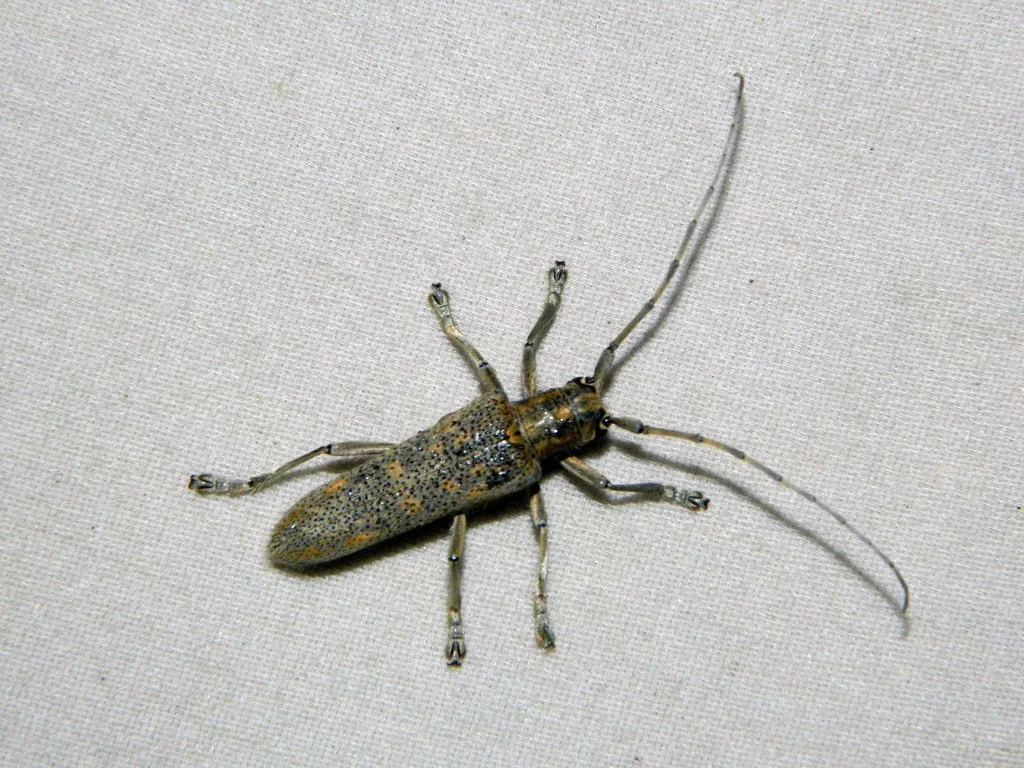
- Adults are longhorned beetles with antennae about as long as the body. Utah State's pest guide gives them as about 1 inch long, gray with black speckles and brown markings; its fact sheet says 1 to 2 inches, gray-blue with fine brown dots over a faint yellow pattern; Nebraska Extension says about 1 inch, gray-tan with small orange spots on the wing covers.[1][2][4]
- The larvae are legless, elongate, cream to yellow-white grubs. Utah State gives them as up to 1 1/4 inches (pest guide) or about 1 1/2 inches when full grown (fact sheet); Montana State says they can reach over an inch.[1][2][3]
- Infested trunks and larger limbs ooze sap mixed with fine frass from the borer holes, with rust-colored stains on the bark and piles of coarse frass at tunnel entrances; heavily infested trees may show a blackish stain below the attack.[2][1][3]
Where it lives
Utah State describes it as a major pest of aspen in Utah's landscapes and forests, Montana State covers it on aspen, cottonwood and poplar in Montana, and Nebraska Extension lists it among the borers of shade trees there.[1][3][4]
Biology and life cycle
Utah State and Nebraska Extension list aspen, cottonwood, poplar and willow as hosts; Montana State lists aspen, cottonwood and poplar. Utah State says egg-laying females target trees that are older, under stress or growing in full sun.[1][4][3][2]
Adults are active from June (Montana State) or mid-June (Utah State) through August. Montana State says females feed on leaves and shoots for a couple of weeks before laying eggs; Utah State says they chew slits in the bark and lay one to three eggs in each.[3][1][2]
The larvae bore into the sapwood and heartwood, mostly in trunks and limbs 3 inches or more across, though branches as small as 1.5 inches can be attacked. They spend the winter in the wood and, Montana State says, pupate beneath the bark in late spring.[1][2][3]
Development is slow: Utah State says one generation takes about three years, Montana State says the life cycle can reach up to three years, and Nebraska Extension says the larvae take three years to mature.[1][3][4]
Woodpeckers, parasitic wasps and nematodes attack the larvae; Utah State notes woodpeckers can eat up to 65 percent of them in some regions.[2]
Damage and signs
- The tunnels weaken trunks and branches, which can snap in high winds, and the wounds let wood rot and other pathogens in.[1][3]
- Larvae can girdle a tree (Montana State), and smaller-diameter trees can be killed (Utah State). Nebraska Extension says young trees can die quickly from the girdling, while older trees gradually decline and die with continued reinfestation.[3][1][4]
Health risk
It is a wood-boring beetle of trees. Utah State, Montana State and Nebraska Extension describe it only as a tree pest; none of them mentions bites, stings or any effect on people or pets.[1][3][4]
Control
Prevention
Keep trees healthy and well watered. Utah State advises against planting aspen at low-elevation valley sites, and Montana State suggests planting aspen in groups so their trunks are shaded.[1][3]
Sanitation
Remove heavily infested trees, chipping or burning them, since they can affect other trees in the area.[1][3]
Biological control
Insect-attacking (Steinernema) nematodes can be sprayed or injected into active larval galleries.[1][3]
Pesticides
To prevent new attacks, Utah State's pest guide suggests a pyrethroid on the bark in early June. Its fact sheet says products labeled for borer control on poplars contain a pyrethroid or carbaryl, with a first treatment about June 1 and a second on July 1, most thorough on bark already attacked and on the trunk and large branches. Montana State says contact insecticides sprayed on the trunk before egg laying can prevent further infestation. Systemic insecticides have given poor control of larvae already in the wood.[1][2][3]
Where the sources disagree
Adult size and color: Utah State's pest guide and Nebraska Extension say about 1 inch; Utah State's fact sheet says 1 to 2 inches. Colors are given as gray with black speckles and brown markings, gray-blue with fine brown dots, or gray-tan with small orange spots.[1][2][4]
Larva size: up to 1 1/4 inches (Utah State pest guide), about 1 1/2 inches (Utah State fact sheet), or over an inch (Montana State).[1][2][3]
Hosts: Utah State and Nebraska include willow; Montana State lists only aspen, cottonwood and poplar.[1][4][3]
Life cycle: about three years (Utah State), up to three years (Montana State), or three years for the larvae to mature (Nebraska).[1][3][4]
Woodpeckers: Utah State counts them among natural enemies that may eat up to 65% of larvae in some regions; Nebraska says their pecking and probing may increase the severity of injury.[2][4]
Spray timing: Utah State's pest guide gives one pyrethroid spray in early June, its fact sheet a first treatment about June 1 and a second on July 1; Montana State says only to spray the trunk before egg laying.[1][2][3]
Common questions
- What is the rusty, oozing sap and sawdust on my aspen trunk?
- Those match the signs Utah State lists for poplar borer: holes oozing sap mixed with frass, rust-colored stains on the bark, and coarse frass at the tunnel openings.[2][1]
- Can a heavily infested aspen be saved?
- Utah State and Montana State both recommend removing heavily infested trees, which can affect other trees in the area.[1][3]
- Will a systemic insecticide kill the borers inside my tree?
- Not reliably. Utah State says systemics such as acephate or neonicotinoids do not give satisfactory control of the larvae, and Montana State says systemics have shown limited success against larvae already in the tree; bark sprays before egg laying are aimed at preventing new attacks.[2][3]
Sources
- Utah State University Extension, Integrated Pest Management, “Poplar Borer (Ornamental Pest Guide).” extension.usu.edu/planthealth/ipm/ornamental-pest-guide/arthopods/wood-borers/poplar-borer (accessed 2026-11-13)
- Utah State University Extension, Integrated Pest Management, “Poplar Borer (IPM fact sheet, trees and shrubs).” extension.usu.edu/planthealth/ipm/notes_orn/list-treeshrubs/polar-borer (accessed 2026-11-13)
- Montana State University Extension, Urban and Horticulture IPM, “Poplar Borer (Saperda calcarata) (Urban Entomology Fact Sheets).” urbanipm.montana.edu/entomology/resources/fact-sheets/poplar-borer.html (accessed 2026-11-13)
- University of Nebraska-Lincoln Extension, “Insect Borers of Shade Trees and Woody Ornamentals, EC1580 (J. A. Kalisch and F. P. Baxendale, 2010).” extensionpubs.unl.edu/publication/ec1580/2010/pdf/view/ec1580-2010.pdf (accessed 2026-11-13)
- Global Biodiversity Information Facility (GBIF), “Saperda calcarata Say, 1824 (GBIF Backbone Taxonomy).” api.gbif.org/v1/species/1102694 (accessed 2026-11-13)
- iNaturalist, “Saperda calcarata taxon page (order and family).” www.inaturalist.org/taxa/230386 (accessed 2026-11-08)