On this page
How to identify it
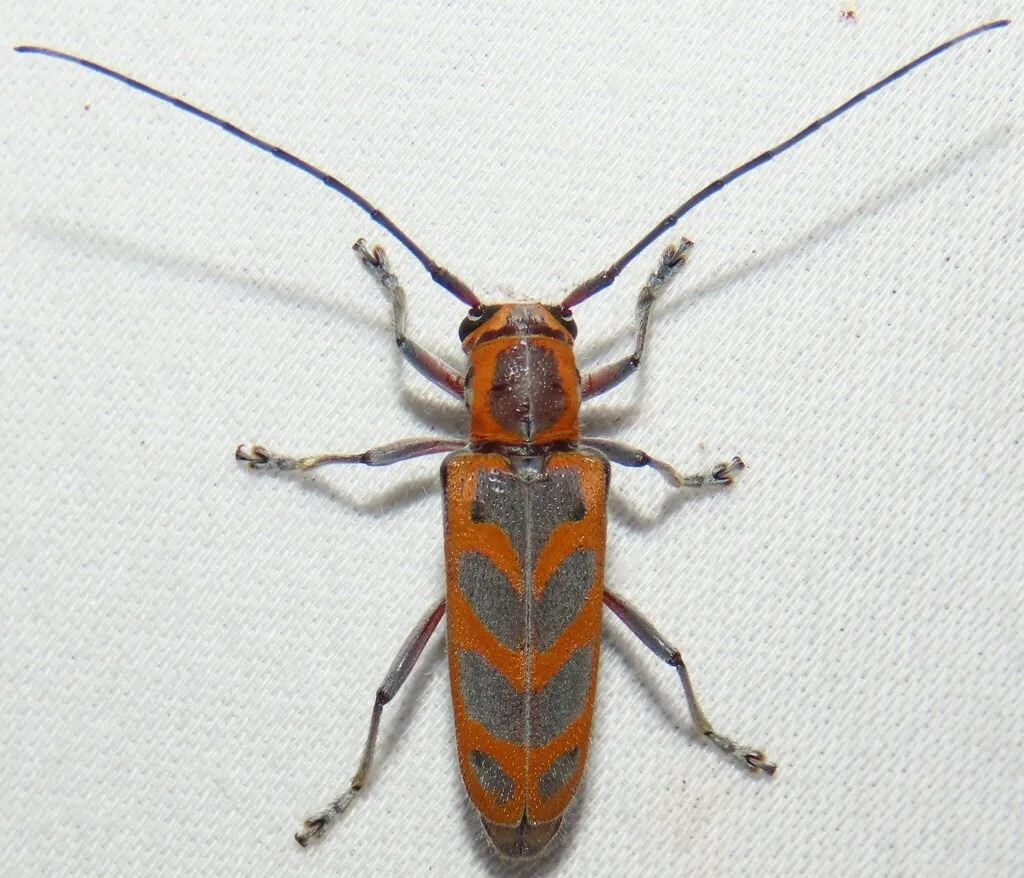
- Adults have distinctive orangish markings and a fine coat of grayish hairs over most of the body. Montana State gives a size of 10-17 mm and EFSA 9-17 mm (roughly 3/8 to 2/3 inch); males have antennae almost as long as the body, females shorter ones.[1][5][2]
- It is a flat-faced longhorned beetle with long antennae.[1]
- Larvae are whitish, legless and rather flattened, 12-25 mm long.[2]
Look-alikes
| Look-alike | How to tell them apart |
|---|---|
| Elm bark beetles | Tiny bark beetles, and the main carriers of the Dutch elm disease fungus; the elm borer is a much larger longhorned beetle that can carry the fungus but is not its main vector.[1][2] |
Where it lives
Eastern North America, west to Texas (Montana State). EFSA notes records of its spread west into Saskatchewan, Colorado and Idaho. GBIF holds about 1,240 U.S. records since 1990 from 39 state-level areas, the most from Texas (204), Oklahoma (85) and Ohio (72).[5][2][7]
Biology and life cycle
Females chew slits in the bark of weakened, stressed or recently dead branches, or freshly cut logs, and lay eggs there; there is no evidence they lay in healthy trees. Larvae tunnel between the bark and sapwood, meandering in all directions, and spend the winter under the bark.[2]
There is usually one generation a year, but larvae from eggs laid in late July and August usually need an extra year.[2]
Adults are out from late spring through summer: MDC gives May to August and Montana State lists a flight period of April to August. EFSA says adults chew the midrib and larger veins of leaves, leaf stalks and the bark of young twigs, are most active at night, and shelter among leaves or bark by day.[1][5][2]
EFSA says it feeds almost exclusively on American (white) elm, with red (slippery) elm also attacked and cedar elm reported as a host. In 2026 lab tests, adults also fed on four European elms and larvae developed in their logs, but they ignored the European maples and poplars offered.[2][6]
Damage and signs
- Larvae tunnel under the bark of elms; heavily infested bark loosens and peels back easily to show the tunnels. It mainly attacks trees that are already weakened, but severe infestations can kill trees.[1][2]
- It can carry the fungus that causes Dutch elm disease but is not the main carrier: MDC calls it one of the insects that can transmit the fungus, and EFSA notes it was once thought to be a vector while the disease spread mainly by the native elm bark beetle.[1][2]
- Indoors, roundheaded borers like it sometimes emerge from firewood brought into the house. The University of Kentucky says the potential for firewood borers to infest structural wood in the home is very low, because many attack only certain kinds of wood and need far more moisture than structural wood holds.[3]
Health risk
It is a wood-boring beetle of elms, and no cited source describes any risk to people or pets.[1][2]
Control
Prevention
Keep elms healthy and prune out dead or dying branches, since females prefer weakened, stressed or recently dead wood and freshly felled trees for laying eggs.[2]
Bring in only as much firewood as you will burn in a day or so, keep it in a cool place such as a garage or porch until then, use the oldest wood first, and inspect it for beetles before bringing it inside.[3][4]
Do not spray firewood with insecticides; the University of Kentucky and NPIC both advise against it.[3][4]
Do not move infested firewood, which can carry wood-boring beetles to new trees.[4]
Where the sources disagree
Adult season: MDC says adults are seen from May to August, Montana State gives a flight period of April to August, and EFSA says light traps catch them from May to August.[1][5][2]
Size: Montana State gives 10 to 17 mm for adults, EFSA 9 to 17 mm.[5][2]
Dutch elm disease: MDC calls it one of the insects that can transmit the fungus, while EFSA says it was once thought to be a vector and the disease spread in North America mainly by the native elm bark beetle.[1][2]
Healthy trees: EFSA cites early reports that found no evidence of attacks on healthy trees, but also a report that larvae established in a weakened branch can move into healthy parts of the tree.[2]
Hosts: Montana State lists elm, EFSA says American elm almost exclusively, with red elm and cedar elm also reported, and a 2026 study found European elms suitable for adult feeding and larval development.[5][2][6]
Common questions
- Why is a beetle with orange markings in my house in winter?
- It may be an elm borer or another roundheaded borer that developed in firewood and emerged once the wood warmed up indoors.[3][1]
- Will it damage my furniture or house?
- Very unlikely. The University of Kentucky says firewood borers have very low potential to infest structural wood in a home.[3]
- Does the elm borer spread Dutch elm disease?
- It can carry the fungus, but it is not the main carrier; the native elm bark beetle spread the disease in North America.[1][2]
- Should I spray the firewood?
- No. The University of Kentucky and NPIC both say not to treat firewood with insecticides.[3][4]
Sources
- Missouri Department of Conservation, “Elm Borer (Field Guide).” mdc.mo.gov/discover-nature/field-guide/elm-borer (accessed 2026-11-13)
- EFSA Journal 2020;18(1):e05940 (EFSA Panel on Plant Health), via PubMed Central, “Pest categorisation of Saperda tridentata.” pmc.ncbi.nlm.nih.gov/articles/PMC7008830/ (accessed 2026-11-13). PMID 32626494; full text read via NCBI E-utilities
- University of Kentucky Entomology, “Firewood Insects (ENTFACT-626).” entomology.mgcafe.uky.edu/ef626 (accessed 2026-11-13)
- National Pesticide Information Center, “Wood Boring Beetles.” www.npic.orst.edu/pest/woodborer.html (accessed 2026-11-13)
- Montana State University, Montana Entomology Collection, “Saperda tridentata (Wood Boring Insects of Montana).” mtent.org/projects/woodboring/saperda_tridentata.html (accessed 2026-11-13)
- Environ Entomol 2026;55(5):nvag094, via PubMed, “European elms as potential hosts of Saperda tridentata (Coleoptera: Cerambycidae).” pubmed.ncbi.nlm.nih.gov/42710868/ (accessed 2026-11-13)
- Global Biodiversity Information Facility (GBIF), “Saperda tridentata: U.S. occurrence records since 1990 by state (GBIF occurrence search).” api.gbif.org/v1/occurrence/search?taxonKey=8881782&country=US&hasGeospatialIssue=false&occurrenceStatus=PRESENT&year=1990%2C2026&facet=stateProvince&facetLimit=400&limit=0 (accessed 2026-11-13). Exact count at access: 1,241 U.S. records since 1990 (Texas 204; Oklahoma 85; Ohio 72; Illinois 66).
- Global Biodiversity Information Facility (GBIF), “Saperda tridentata Olivier, 1795 (GBIF Backbone Taxonomy).” api.gbif.org/v1/species/8881782 (accessed 2026-11-13)