On this page
How to identify it
Look-alikes
| Look-alike | How to tell them apart |
|---|---|
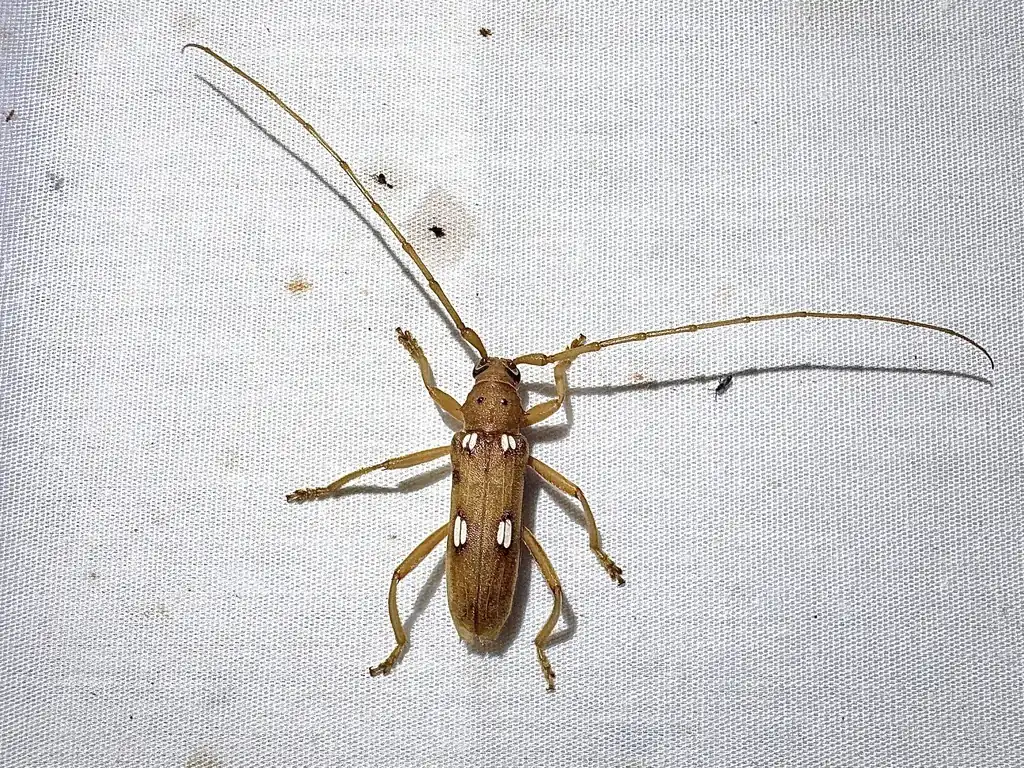
| Powderpost beetles | Much smaller beetles whose emerging adults can re-infest wood year after year, leaving small holes and fine powder; sealing exit holes in finished wood prevents re-infestation. The ivory-marked borer is a large spotted longhorned beetle whose grubs start in dead trees.[5][1] |
Where it lives
Found across the eastern and central United States, from Pennsylvania and North Carolina to Missouri, Kansas and Texas, with a few records from Mexico.[4][1][2]
Biology and life cycle
Females lay eggs in cracks of dead trees; grubs bore into the heartwood and usually finish in about two years.[1]
If infested wood is milled into flooring or furniture, the grubs can keep developing slowly; adults may appear five to seven years later, and one emerged from a 40-year-old bookcase.[1][2]
Adults feed on leaves and twigs and come to lights at night.[1]
Damage and signs
Health risk
Control
Prevention
Because it does not infest living trees, it is little threat in landscapes, and no chemical control is necessary.[1]
Traps and physical control
For any wood-boring beetle emerging from finished wood, sealing the emergence holes stops beetles from laying eggs in them; stained, varnished, painted or otherwise sealed surfaces are generally safe from future attack.[5]
Where sources disagree
How long it can hide in wood: NC State says adults may appear five to seven years after the wood is milled and cites a single beetle from a 40-year-old bookcase, while the Missouri Department of Conservation says adults are known to emerge from furniture and flooring after 40 years.[1][2]
Host wood: NC State says it infests dead hickory, locust, ash and apparently cypress, while Missouri lists oak, hickory, maple, cherry, ash and elm.[1][2]
Common questions
- Why did a beetle come out of my wood floor?
- Ivory-marked borer grubs can survive milling and emerge from flooring or furniture years later.[1][2]
- Will it spread to my other furniture?
- NC State notes it infests dead hardwood trees, not living trees, and says no chemical control is necessary.[1]
- Where is it found?
- Mostly the eastern and central United States: GBIF records come most often from Kentucky, Pennsylvania, Texas, Alabama, Kansas and Oklahoma, with a few from Mexico.[4]
Sources
- NC State Extension, “Ivory-marked Borer (PDIC Factsheet).” content.ces.ncsu.edu/ivory-marked-borer (accessed 2026-11-12)
- Missouri Department of Conservation, “Ivory-Marked Beetle (Field Guide).” mdc.mo.gov/discover-nature/field-guide/ivory-marked-beetle (accessed 2026-11-12)
- iNaturalist, “Coeleburia quadrigeminata taxon page (order and family).” www.inaturalist.org/taxa/1674296 (accessed 2026-11-12)
- Global Biodiversity Information Facility (GBIF), “Eburia quadrigeminata (Say, 1826): occurrence records.” www.gbif.org/species/5997001 (accessed 2026-11-12)
- University of Kentucky Entomology, “Powderpost Beetles (ENTFACT-616).” entomology.ca.uky.edu/ef616 (accessed 2026-11-12)