On this page
How to identify it
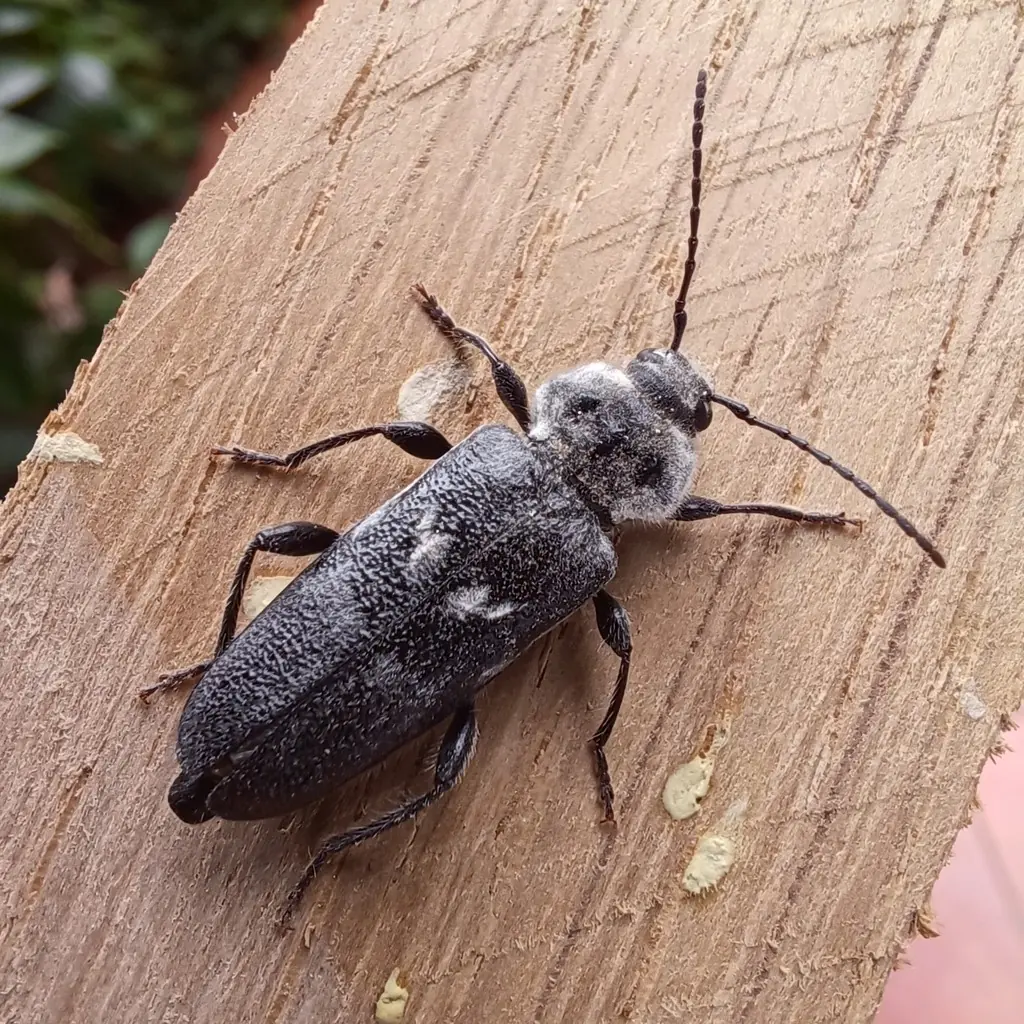
- Adults are brownish to black or dark gray beetles 5/8 to 1 inch long, with two shiny, raised black knobs on the section behind the head; Oregon notes the knobs can be mistaken for eyes.[1][2][5]
- Fine gray hairs cover the thorax, and patches of gray hair form irregular bands across the wing covers, including a faint light gray band about a third of the way down. The antennae are about one-third the body length.[2][5][1]
- In females the pointed abdomen typically extends past the ends of the wing covers.[2]
- Exit holes are oval, about 1/4 inch or a little larger, and sometimes have ragged edges.[1][2][5]
- Larvae are cream-colored grubs that taper toward the rear, with three tiny dark eyespots in a row on each side of the head; a hand lens or microscope is needed to see them.[2][1]
- Larval tunnels are packed with powder holding tiny barrel-shaped pellets, and the tunnel walls have a rippled look, like beach sand after water washes over it.[1][2][5]
Look-alikes
| Look-alike | How to tell them apart |
|---|---|
| Powderpost beetle | Old house borers attack only softwoods such as pine, fir and spruce, not hardwoods such as oak, ash or maple; powderpost beetles attack hardwoods and leave tiny round exit holes rather than oval ones.[1][3] |
| Carpenter ants | Oregon says carpenter ant damage is the most likely to be confused with old house borer damage: carpenter ants leave large, smoothly chewed chambers with thin wood partitions between them, while old house borer tunnels are packed tightly with sawdust.[5] |
Where it lives
Native to North Africa and believed to have reached North America around 1875; in the U.S. it ranges from Maine to Florida and west to Michigan and Texas, and is especially common along the Atlantic Seaboard.[2][1]
Biology and life cycle
Females lay about 50 to 200 eggs in cracks, crevices and joints between wood members; Penn State adds bark crevices of felled logs and wood stored in lumberyards. The eggs hatch in a few weeks and the larvae bore in.[1][2]
Larvae take years to mature, and how many depends on wood moisture and the nutritional quality of the wood; the sources give different ranges (below).[1][2][4]
Larvae do best at 15 to 25 percent wood moisture and are unlikely to survive below about 10 percent.[1]
Adults emerge in spring and summer and often try to reinfest wood near where they came out. Mississippi State says most large wood borers that come out of lumber won't reinfest it inside a building, but old house borers can and will.[1][4]
Most larvae are in the thicker timbers of a building; Penn State says very few have been found in wood less than one inch thick.[2]
Infestations usually start in lumber that already held larvae before construction.[1][2][4]
Damage and signs
- Larvae prefer the protein-rich sapwood of younger wood, so infestations are most common in structures less than about 10 years old; Penn State says many are noticed four to seven years after construction.[1][2][4]
- Dry, climate-controlled buildings often see damage to only a few boards, but in damp, poorly ventilated crawlspaces, attics and outbuildings, studs and joists can be reduced to powder. Penn State says poorly vented attics and leaky roofs let the beetles spread and do much damage in a short time.[1][2]
- Log homes are particularly vulnerable and often sustain more serious damage than frame houses; exit holes in logs can also let water in and lead to decay.[1]
- Grown larvae make a rasping or clicking sound while chewing that can often be heard through walls, floors and ceilings.[1][2][4]
- In a 2026 study, acoustic sensors reliably picked up single larvae feeding in test pieces of wood, with reliable detection up to about 30 cm away.[7]
Health risk
The old house borer threatens structural softwood, not people; none of these sources reports it biting or stinging. The larvae do the harm while hidden inside framing and timbers.[1][2][4]
Control
Prevention
Use kiln-dried lumber, since kiln heat kills all stages, and never build with wood that shows exit holes or powder, such as repurposed barn boards. Mississippi State notes kiln drying won't stop a later infestation if the wood's moisture rises again.[1][2][4]
Bring wood moisture down, ideally below about 10 percent, with vapor barriers, better ventilation and improved drainage in crawlspaces, basements and attics.[1][4]
Sanded and varnished or painted wood is not normally attacked, because females can't find crevices to lay eggs in.[2][5][4]
Traps and physical control
When activity is limited to a few boards, remove and replace them and consider replacing adjacent pieces; seal old holes and clean away powder so old damage isn't mistaken for new.[1][4]
Pesticides
Borate sprays on bare, unfinished wood kill newly hatched larvae before they tunnel deep; they won't penetrate varnished or sealed surfaces and must stay dry to last. Mississippi State says borates may not kill large larvae and adults due to emerge within a year or so.[1][2][4]
When to call a professional
Whole-structure fumigation by licensed professionals is very expensive and leaves no lasting protection. Kentucky says current sulfuryl fluoride fumigants are less effective on wood-boring beetles than methyl bromide, which is no longer available.[1][2]
Where sources disagree
Development time: Kentucky gives an average of about 3 to 6 years, as little as 2 under ideal conditions and 10 or more in poor conditions; Penn State gives 3 to 15 years, averaging 5 to 7 in heated Pennsylvania homes; Mississippi State gives two to ten years.[1][2][4]
Adult size: Kentucky, Penn State and Oregon give 5/8 to 1 inch; Mississippi State says adults range from 1/3 inch to one inch depending on how well they fed as larvae.[1][2][5][4]
Exit holes: Kentucky says oval, 1/4 to 3/8 inch; Penn State says somewhat oval, 1/4 inch; Oregon says circular to slightly oval, about 1/8 to 1/4 inch.[1][2][5]
Larva length: Penn State says up to 1-1/4 inch; Kentucky says roughly an inch when fully grown.[2][1]
Emergence: Kentucky says most often June to August; Penn State says mainly July and August.[1][2]
Moisture: Kentucky says larvae do best at 15 to 25 percent and seldom survive below 10 percent; Mississippi State says they prefer 10 to 12 percent or higher and that most wood-boring insects don't do well below 8 percent.[1][4]
Firewood: Kentucky says in the U.S. it does not infest living trees, stumps or firewood; Oregon says the beetles can be moved in softwood products including firewood.[1][5]
Fumigation: Penn State calls it the only absolute way to eliminate an infestation; Kentucky says fumigation is seldom necessary because damage progresses slowly.[2][1]
Common questions
- Why do I have old house borers in a fairly new house?
- The larvae usually arrive in lumber infested before construction, and they favor the sapwood of younger wood, so most cases are in homes under about 10 years old.[1][4]
- How can I tell if an old house borer infestation is still active?
- Look for fresh powder the color of newly sawn wood sifting from holes, or listen for gnawing; powder covered with dust or cobwebs suggests the activity has stopped. Researchers are also testing acoustic sensors that pick up feeding larvae inside wood.[1][7]
- Do I need to fumigate my house right away?
- No. Kentucky says damage progresses slowly, so there's time to confirm the identification and weigh options, and fumigation is seldom necessary. Penn State sees it as the only sure fix for an established infestation (see above).[1][2]
- Does the old house borer occur in the western U.S.?
- Rarely, as far as Oregon knows. Oregon's agriculture department caught a single beetle in a survey trap at The Dalles in 2013 and has no other records; it asks people to report softwood with circular to slightly oval holes.[5]
- Are there traps for old house borers?
- In research, yes. Pheromone-baited traps are used for monitoring, and in screen-cage tests black ground traps caught more adults than other colors. The authors called the method effective for monitoring.[6]
Sources
- University of Kentucky Entomology, “ENTFACT-653: Old House Borer (revised March 2026).” entomology.mgcafe.uky.edu/ef653 (accessed 2026-11-11)
- Penn State Extension, “Old House Borer (updated May 12, 2026).” extension.psu.edu/old-house-borer (accessed 2026-11-11)
- University of California Statewide IPM Program, “Pest Notes: Wood-Boring Beetles in Homes, Publication 7418.” ipm.ucanr.edu/home-and-landscape/wood-boring-beetles-in-homes/ (accessed 2026-11-11)
- Mississippi State University Extension Service, “Old House Borer (Bug's Eye View, Vol. 6, No. 30).” extension.msstate.edu/newsletters/bugs-eye-view/2020/old-house-borer-vol-6-no-30 (accessed 2026-11-11)
- Oregon Department of Agriculture, “Oregon Pest Alert: Old House Borer.” oregon.gov/oda/Documents/Publications/IPPM/OldHouseBorerPestAlert.pdf (accessed 2026-11-11)
- Environmental Entomology, via PubMed, “Improved semiochemical-based trapping method for old-house borer, Hylotrupes bajulus (Reddy 2007).” pubmed.ncbi.nlm.nih.gov/17445362/ (accessed 2026-11-11)
- Sensors, via PubMed, “Detection of Active Wood-Boring Insect Larvae Using Acoustic Emission Measurements (Limmer et al. 2026).” pubmed.ncbi.nlm.nih.gov/42590449/ (accessed 2026-11-11)
- iNaturalist, “Hylotrupes bajulus taxon page (order and family).” www.inaturalist.org/taxa/221942 (accessed 2026-11-11)