On this page
How to identify it
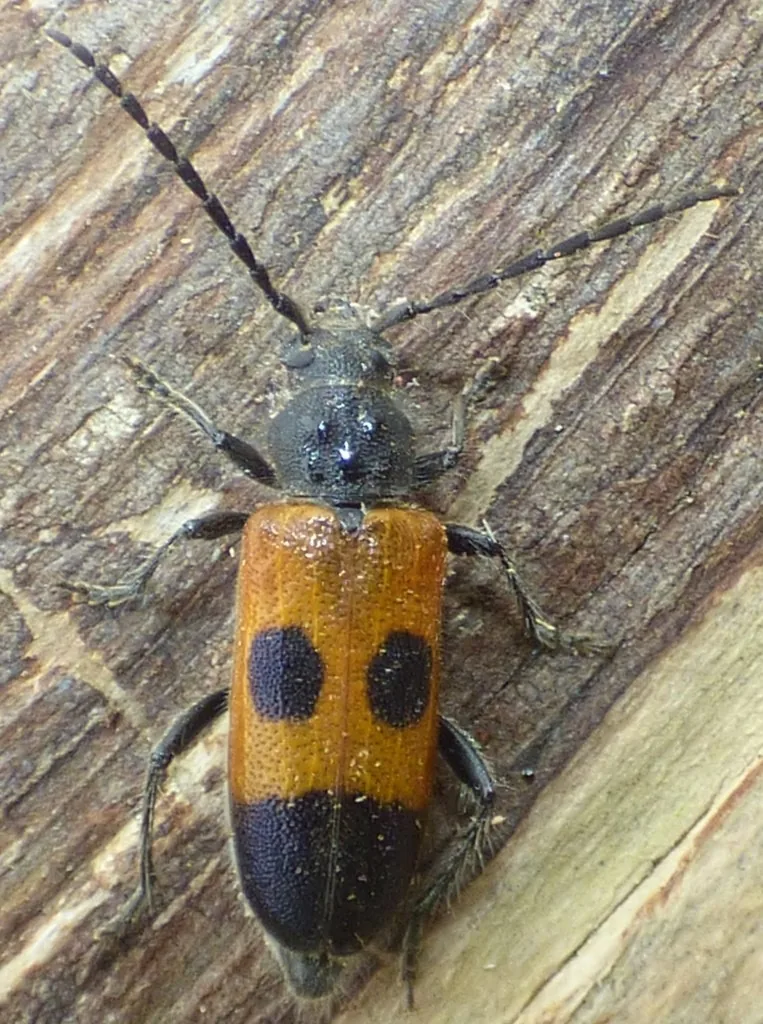
- A small longhorned beetle: Montana State University's collection gives a size of 8-12 mm, with antennae typical of longhorns.[2]
- Outdoors, look for round exit holes and adult beetles on stressed or declining junipers, cedars and arborvitae; adults have also been seen on pine and juniper flowers.[1]
- Indoors, a longhorned beetle walking toward a window or light in a room with stacked firewood may have come out of the logs; Kentucky entomologists say roundheaded borers sometimes emerge after logs are brought inside.[3]
Look-alikes
| Look-alike | How to tell them apart |
|---|---|
| Japanese cedar longhorned beetle | An Asian relative whose activity can be confused with the native cedar tree borer's. In Connecticut it emerged from arborvitae trunk sections from late March to mid-May and was active for 5-8 weeks between April and June, while the cedar tree borer flew for about 4 weeks in April.[1][4] |
| Old house borer | One of the few wood borers that can infest structural wood indoors; NPIC and Kentucky contrast those with firewood borers like the cedar tree borer, which are unlikely to infest house wood.[6][3] |
Where it lives
UMass Extension describes it as found in the northern United States and southern Canada, and Montana State's collection lists it among the wood borers of Montana. GBIF's U.S. records since 1990 are more widespread: 77 records from 27 states, the most from Texas (14) and Wisconsin (7), a spread that may partly reflect the older, broader use of the name before related beetles were split off as separate species.[1][2][7][5]
Biology and life cycle
Adults are active roughly from March through August, a flight period both UMass and Montana State give. In Connecticut trapping, adults came to sticky bands on eastern redcedar trap logs and dead trees for about 4 weeks in April.[1][2][4]
Larvae bore galleries in the wood of stressed, dying or dead hosts and leave round exit holes when the adults emerge. Much of its life cycle is still poorly known and many reports are anecdotal.[1]
The name has been used for a complex of beetles: a 2013 review of North American Semanotus raised several former subspecies to full species, such as S. amplus, S. conformis and S. terminatus, while keeping S. ligneus as a valid species.[5][1]
Damage and signs
- It is a secondary pest that follows other problems rather than causing a tree's decline.[1]
- Firewood borers rarely matter indoors: Kentucky says the chance of these insects infesting structural wood in a house is very low, because they usually attack only certain woods and need wood much moister than house framing.[3]
Health risk
It does not bite or sting people or pets in any of the sources; University of Kentucky entomologists describe the wood-boring beetles that emerge from firewood indoors as harmless.[3][1]
Control
Prevention
Keep junipers and cedars healthy with good site selection and planting. NPIC adds to plant trees adapted to your area and water them properly, since most wood borers look for damaged or stressed trees.[1][6]
Sanitation
Inspect firewood for signs of beetles before bringing it in, bring in only small amounts at a time, and shake or knock logs together sharply outdoors to dislodge insects. Do not move infested firewood to new areas.[6][3]
Traps and physical control
A beetle that turns up indoors can simply be picked up or vacuumed and put outside. Old, declining trees with heavy trunk damage may need to be removed; ask an expert first.[3][6]
Pesticides
Chemical treatment is not recommended, because the beetle only attacks trees that are already in decline. NPIC warns never to spray firewood with pesticides, since burning treated wood could create a health hazard.[1][6]
Common questions
- Why are beetles coming out of my firewood in winter?
- Wood borers that developed in the logs can finish growing in a warm room and crawl out; Kentucky says these beetles are harmless and gather at windows and lights. Keep firewood outside until you need it and bring in small amounts.[3][6]
- Will cedar tree borers infest my house or furniture?
- Very unlikely. Kentucky says firewood borers have a very low potential to infest structural wood, because they attack only certain kinds of wood and need it far moister than house wood. NPIC notes that only a few beetles, such as powderpost beetles, can infest furniture and structural wood indoors.[3][6]
- Do cedar tree borers kill healthy trees?
- No; they attack trees that are already stressed, dying or dead, and UMass calls them a secondary invader.[1]
- Should I spray firewood that has beetles in it?
- No. NPIC says not to apply pesticides to firewood, because the pesticide could become a health hazard once burned.[6]
Sources
- UMass Extension Landscape, Nursery and Urban Forestry Program (Landscape Insect & Mite Guide), “Semanotus ligneus (Cedar Longhorned Beetle, Native).” www.umass.edu/agriculture-food-environment/landscape/publications-resources/insect-mite-guide/semanotus-ligneus (accessed 2026-11-12)
- Montana State University, Montana Entomology Collection, “Semanotus ligneus (Wood Boring Insects of Montana).” www.mtent.org/projects/woodboring/semanotus_ligneus.html (accessed 2026-11-12)
- University of Kentucky Entomology, “Firewood Insects (ENTFACT-626).” entomology.mgcafe.uky.edu/ef626 (accessed 2026-11-12)
- J Econ Entomol 2008;101(2):430-7, via PubMed, “Emergence, trapping, and seasonal abundance of adult Cerambycidae (Coleoptera) associated with Cupressaceae in Connecticut.” pubmed.ncbi.nlm.nih.gov/18459408/ (accessed 2026-11-12)
- Zootaxa 2013;3670:101-36, via PubMed, “Casey's conundrum, a review of the genus Semanotus Mulsant (Coleoptera: Cerambycidae: Cerambycinae: Callidiini) in North America.” pubmed.ncbi.nlm.nih.gov/26438930/ (accessed 2026-11-12)
- National Pesticide Information Center, “Wood Boring Beetles.” www.npic.orst.edu/pest/woodborer.html (accessed 2026-11-12)
- Global Biodiversity Information Facility (GBIF), “Semanotus ligneus: U.S. occurrence records since 1990 by state (GBIF occurrence search).” api.gbif.org/v1/occurrence/search?taxonKey=5713323&country=US&hasGeospatialIssue=false&occurrenceStatus=PRESENT&year=1990%2C2026&facet=stateProvince&facetLimit=400&limit=0 (accessed 2026-11-12)
- iNaturalist, “Semanotus ligneus taxon page (order and family).” www.inaturalist.org/taxa/230791 (accessed 2026-10-06)