On this page
How to identify it
- Adults are small longhorned beetles, but sources give different sizes: about 5/8 inch (NC State), 1/4 to 1/2 inch (UMass), 6 to 13 mm or about 3/16 to 1/2 inch (Oregon), or 1/4 to 3/4 inch (Connecticut).[1][2][3][5]
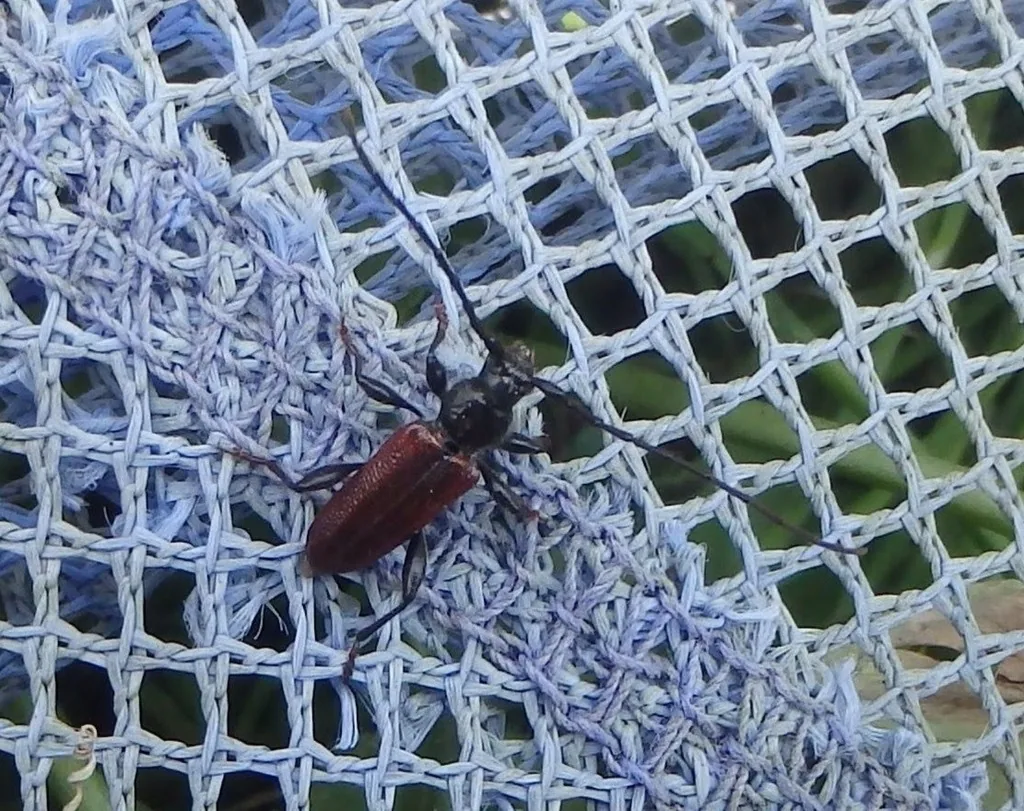
- Males are shiny blue-black with red at the shoulders, and their antennae are slightly longer than the body; females have reddish-brown wing covers and shorter antennae.[1][2][3]
- Grubs are pale and slender. NC State describes them as legless, while UMass says they have three pairs of legs on the thorax. Young grubs pack their tunnels with dark frass, and adults leave oval exit holes about 1/8 inch (4 mm) across.[1][2][3]
Where it lives
Native to Japan, Korea, Taiwan and eastern China. UMass says it was first detected in the United States in Washington state in 1954. Oregon dates the first established eastern population to North Carolina in 1997, Connecticut found it in 1998, and it has been recorded in coastal Massachusetts, Rhode Island, Connecticut, New York and New Jersey. In May 2023 it was found established in Portland, Oregon, the first established population in western North America.[5][2][3][7]
Biology and life cycle
There's one generation a year, though UMass says it can take two years in colder places. Adults spend the winter in the wood and chew out in early spring: March to May in Oregon, and late March to mid-May in a Connecticut study.[1][2][3][8]
Females live about 20 days and lay eggs in bark crevices, starting one to three days after emerging. UMass cites about 20 eggs per female, hatching within two weeks.[1][2]
Larvae feed under the bark, then bore into the sapwood in late summer to pupate in oval cells.[1][5]
Damage and signs
- Hosts are cypress-family trees: arborvitae, junipers including eastern redcedar, cypress and Chamaecyparis. In a Connecticut survey the most heavily infested was Atlantic white cedar, followed by common juniper, eastern arborvitae and eastern redcedar, and pines and other Pinaceae weren't hosts. Oregon adds Port Orford cedar and western red cedar as trees at risk and notes that firs and pines are listed as hosts in Asia.[1][2][7][3]
- Look for branch tips dying back (often not until the spring after attack), split or puckered bark, boring dust and oval exit holes.[2][3][5]
- Sources disagree on how much healthy trees are at risk. Connecticut says it usually attacks dead, weakened or freshly cut trees, CDFA's 2022 rating proposal quotes research saying it can't develop normally in a healthy tree, and a Connecticut study found it developed only in dead eastern redcedar. Oregon, though, says it can attack and kill arborvitae, cedars and junipers, and Connecticut's 1998 find was in live 'Emerald Green' arborvitae.[5][6][7][4]
Health risk
No cited source describes the beetle as a risk to people or pets. NC State says pyrethroid sprays used against it aren't particularly hazardous to people and pets when used as directed, but they're very toxic to fish.[1][3]
Control
Prevention
Pyrethroids are very toxic to fish, so keep them away from pools, ponds and streams.[1]
Avoid plant stress with good planting and site choice. Inspect arborvitae before buying and reject plants with borer holes, and don't move infested cedar or arborvitae wood, firewood or green waste.[2][3]
Traps and physical control
Prune out and destroy infested branches before adults emerge in spring. Oregon says infested wood should be burned, chipped or buried.[2][3]
Biological control
In Japan, about 53 percent of immature beetles die from disease or parasitoids, including the wasps Doryctes yogoi and Ischnoceros sapporensis (UMass, citing a 1994 study).[2]
Pesticides
Spraying infested trees is unlikely to kill grubs inside; to prevent new attacks, NC State suggests a pyrethroid on cypress-family plants in early March and again in early April.[1]
UMass lists systemic insecticides for landscape use, including acetamiprid, cyantraniliprole and imidacloprid. In Massachusetts, neonicotinoids for tree and shrub pests have been state restricted use since July 1, 2022.[2]
Spread and reporting
In May 2023 live adults turned up in cedar wood from a wood-chip drop in Portland. Oregon traced the beetle to four properties, trapped it in 2024 and found three more sites up to 6 miles north, all east of the Willamette River.[3][4]
Oregon thinks it likely arrived in infested arborvitae, and says the beetle first reached the United States in solid wood packing. It spreads in infested nursery trees, cedar firewood and green waste; how far adults fly is uncertain.[3]
CDFA's rating proposal says the beetle has been intercepted in wood packing many times but isn't established in California. It could establish in northern California, and its impacts there are highly uncertain.[6]
GBIF's taxonomy backbone gives the accepted name as Callidiellum rufipennis; the extension and agency sources here spell it rufipenne.[9][1][3]
Common questions
- What is boring into my arborvitae?
- One possibility is the Japanese cedar longhorned beetle, whose grubs tunnel under the bark of cypress-family trees and leave oval exit holes.[1][2][3]
- Can I spray to kill the grubs?
- Not reliably; grubs inside packed tunnels are protected, so sprays are used to prevent new egg laying in spring.[1]
- When are the beetles active?
- Adults chew out of trees in early spring and live only about three weeks. In Connecticut, adults were active on host trees for five to eight weeks between April and June.[1][8]
- Do I need to report it?
- In Oregon, yes: the Oregon Department of Agriculture asks people to report suspected beetles or damage to ODA or the Oregon invasive species hotline. In California, CDFA's 2022 proposal would give it an A rating because it isn't known to be established there. UMass asks people to watch for it, especially in Suffolk and Nantucket counties.[3][4][6][2]
Sources
- NC State Extension, “Japanese Cedar Longhorned Beetle (PDIC Factsheet).” content.ces.ncsu.edu/japanese-cedar-longhorned-beetle (accessed 2026-11-13)
- UMass Extension Landscape, Nursery and Urban Forestry Program (Landscape Insect & Mite Guide), “Callidiellum rufipenne (Japanese Cedar Longhorned Beetle).” www.umass.edu/agriculture-food-environment/landscape/publications-resources/insect-mite-guide/callidiellum-rufipenne (accessed 2026-11-13)
- Oregon Department of Agriculture, “Pest Alert: Japanese Cedar Longhorned Beetle (June 2024).” www.oregon.gov/oda/Documents/Publications/IPPM/JapaneseCedarLonghornBeetlePestAlert.pdf (accessed 2026-11-13)
- Oregon Department of Agriculture, “Japanese Cedar Longhorn Borer found in Oregon (bulletin, July 5, 2024).” content.govdelivery.com/accounts/ORODA/bulletins/3a6ed02 (accessed 2026-11-13)
- Connecticut Agricultural Experiment Station, “A Pest Alert: Smaller Japanese Cedar Longhorn Beetle.” portal.ct.gov/caes/a-pest-alert/pest-alert/a-pest-alert--smaller-japanese-cedar-longhorn-beetle (accessed 2026-11-13)
- California Department of Food and Agriculture, “California Pest Rating Proposal: Callidiellum rufipenne, cedar longhorn beetle (2022).” blogs.cdfa.ca.gov/Section3162/wp-content/uploads/2022/06/Callidiellum-rufipenne.pdf (accessed 2026-11-13)
- Journal of Economic Entomology, 2007 (via PubMed), “Distribution and hosts of Callidiellum rufipenne, an Asian cedar borer established in the eastern United States (abstract).” pubmed.ncbi.nlm.nih.gov/17849882/ (accessed 2026-11-13)
- Journal of Economic Entomology, 2008 (via PubMed), “Emergence, trapping, and seasonal abundance of adult Cerambycidae associated with Cupressaceae in Connecticut (abstract).” pubmed.ncbi.nlm.nih.gov/18459408/ (accessed 2026-11-13)
- Global Biodiversity Information Facility (GBIF), “Callidiellum rufipennis (Motschulsky, 1861) (GBIF Backbone Taxonomy).” api.gbif.org/v1/species/1152186 (accessed 2026-11-13)