On this page
How to identify it
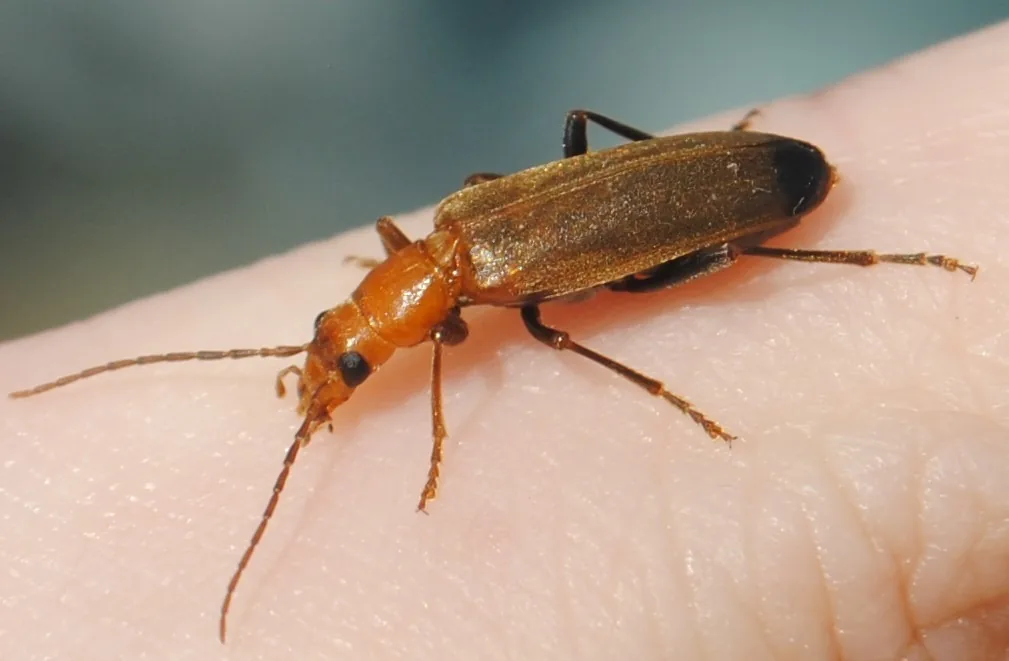
- Adults have a long, slender, parallel-sided body, dull yellow to reddish orange, and the tips of the wing covers are deep purple to black. Iowa State says about 1/2 inch long. The Smithsonian gives 9.5 to 13.5 mm and Ohio State 7 to 15 mm.[1][3][2]
- The antennae are long, about half the length of the body.[1]
- Larvae grow to slightly more than 1 inch long and make long, winding tunnels inside rotted wood.[1]
Look-alikes
Where it lives
Originally European and spread by commerce around the world; in North America it is most abundant along the coasts, especially the Northeast and the West Coast, but turns up wherever there is wet, rotting lumber.[3][1]
Biology and life cycle
Females lay their eggs on moist wood, and Ohio State says the eggs hatch in 5 to 7 days. Iowa State and the Smithsonian say the larvae take about a year to develop. Ohio State says the larval stage lasts anywhere from two months to two years, depending on temperature and food.[1][3][2]
Adults can emerge at any time of year but are most common from May through August in Iowa, while Ohio State gives March to July as typical for the Northern Hemisphere; the adults don't feed and live only about one to two weeks.[1][2][3]
Ohio State reports pupation lasts about 10 days. Citing Pitman and colleagues, it gives 20 to 30 C as the best range for egg development, with development stopping above 35 C and below 10 C.[2][6]
Larvae digest wood with their own enzymes: a 2003 study found cellulase, xylanase and other sugar-digesting enzymes in the guts of larvae tunneling in archaeological oak.[6][2]
Adults have emerged from pilings that were driven into the sea and then covered in concrete for many years.[3]
Damage and signs
- Larval feeding speeds the decay of wood that stays continuously wet; along waterfronts the beetle damages pilings, wooden boats and waterfront buildings.[1][3]
- Indoor emergences usually trace back to wet wood: timbers or posts in contact with moist soil, wood under leaking plumbing, or old lumber buried under a slab; wood soaked by dog urine is reported to be especially attractive.[1][2]
- In one Ohio case near Lake Erie, the beetles came from rotten timber from an earlier house left under the concrete, and they got indoors through the ventilation ducts; none were seen outside. Ohio State found no evidence that the beetle attacks living, healthy trees or hardwood timber.[2]
Health risk
The beetles are a nuisance indoors, and none of the extension sources reports bites. The wharf borer belongs to the false blister beetle family (Oedemeridae). A 2024 review notes that false blister beetles produce cantharidin, the blistering chemical of blister beetles, and a 2019 dermatology review lists Oedemeridae among the families that cause blistering dermatitis. Neither review reports a case involving the wharf borer itself.[1][2][8][7]
Control
Prevention
Fix the moisture problem and remove or replace the rotted wood, including decayed structural lumber and wood lying on or buried in the soil.[1]
Before building, Ohio State advises removing buried timber, logs, old stumps and roots from the site, especially near water.[2]
Keep them out
Cornell notes the breeding wood is often buried and impossible to reach. Its advice is to reduce the beetles with light traps and to seal the openings they use to get inside.[5]
Traps and physical control
Vacuum up or pick up and discard beetles that emerge indoors.[1]
Pesticides
Iowa State says insecticide sprays are not useful against this pest. Cornell adds that pesticide options are limited because label directions don't fit buried breeding sites.[1][5]
Common questions
- Why are long orange beetles appearing at my windows?
- Slender, half-inch yellow-to-orange beetles with dark wing tips gathering at windows and lights are likely wharf borers emerging from wet, rotting wood somewhere in or under the house.[1][2]
- Do I need to spray for wharf borers?
- No; sprays don't help. Find and fix the wet, rotting wood they breed in, and vacuum up the beetles.[1]
- Can wharf borers hurt me?
- No extension source reports bites. They belong to the false blister beetle family, whose members can produce the blistering chemical cantharidin, but the reviews cite no case involving this species.[1][8][7]
Sources
- Iowa State University Extension and Outreach, “Wharf Borer (Yard and Garden encyclopedia, last reviewed July 2020).” yardandgarden.extension.iastate.edu/encyclopedia/wharf-borer (accessed 2026-11-12)
- Ohio State University Extension (Buckeye Yard & Garden onLine), “Wharf Borer Beetle (Nacerdes melanura L., Coleoptera: Oedemeridae).” bygl.osu.edu/node/2359 (accessed 2026-11-12)
- Smithsonian Environmental Research Center (National Exotic Marine and Estuarine Species Information System), “Nacerdes melanura (Wharf Borer) species summary (NEMESIS).” invasions.si.edu/nemesis/species_summary/-305 (accessed 2026-11-12)
- iNaturalist, “Nacerdes melanura taxon page (order and family).” www.inaturalist.org/taxa/225433 (accessed 2026-11-12)
- Cornell University New York State Integrated Pest Management, “Wood destroying insects, What's Bugging You?.” cals.cornell.edu/integrated-pest-management/outreach-education/whats-bugging-you/wood-destroying-insects (accessed 2026-11-12)
- Biofouling, via PubMed, “An overview of the biology of the wharf borer beetle (Nacerdes melanura), a pest of wood in marine structures (Pitman et al. 2003).” pubmed.ncbi.nlm.nih.gov/14618726/ (accessed 2026-11-12). Cited from the PubMed abstract.
- Cutis, via PubMed, “What's eating you? Blister beetles revisited (2019).” pubmed.ncbi.nlm.nih.gov/31939928/ (accessed 2026-11-12). Cited from the PubMed abstract.
- Neotropical Entomology, via PubMed, “Cantharidin: a multipurpose beetlejuice (2024).” pubmed.ncbi.nlm.nih.gov/38750300/ (accessed 2026-11-12). Cited from the PubMed abstract.