On this page
How to identify it
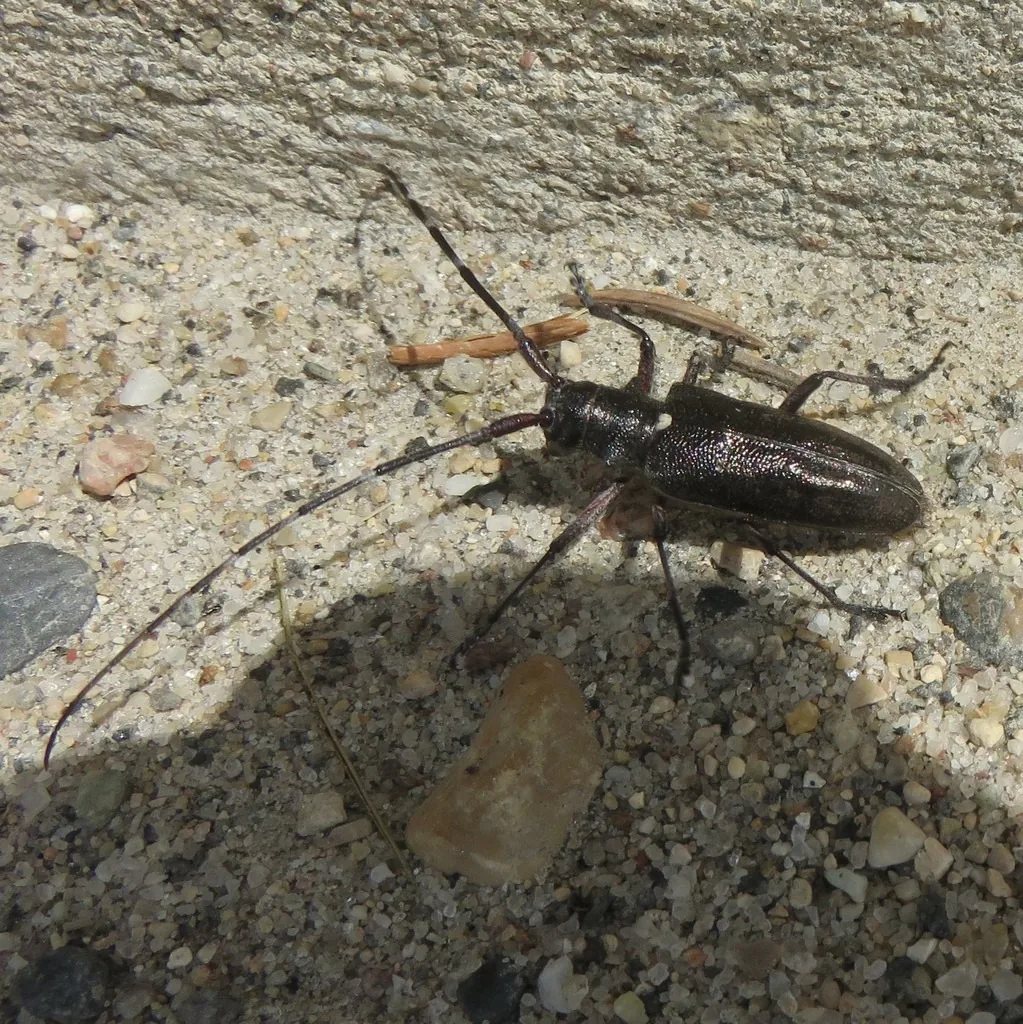
- Adults are long, cylindrical beetles. Sources give different sizes: Utah State says 5/8 to 1 inch, Colorado State 14 to 24 mm (about 1/2 to 1 inch) and University of Missouri Extension 3/4 to 1 1/2 inches, while UMaine puts the northeastern pine sawyer close to 2 inches in body length.[4][1][5][6]
- Adults are black or dark gray, with or without whitish-gray markings; the spotted pine sawyer's markings vary.[4][1]
- The whitespotted sawyer is dark with one distinctive white spot at the base of the wing covers, while the northeastern pine sawyer is drab gray and larger.[6][1]
- The larvae are white, legless, roundheaded grubs with brownish heads, growing to about 1 inch.[4][1]
- Antennae are one to three times the body length and much longer in males; females have larger bodies and shorter front legs.[4][1]
Look-alikes
| Look-alike | How to tell them apart |
|---|---|
| Old house borer | Antennae only about a third of the body length, with two shiny raised black knobs behind the head; it infests building lumber and can reinfest it, but not living trees, stumps or firewood.[7] |
| Powderpost beetles | Attack dry hardwoods indoors and leave flour-like powder; unlike forest borers such as sawyers, they can reinfest wood inside buildings.[2] |
| Asian longhorned beetle | Shiny black with about 20 white spots on each wing cover and boldly black-and-white banded antennae; it attacks healthy hardwoods such as maple, not conifers.[6] |
Where it lives
Hosts include pines, spruces, Douglas-fir and true firs. Maine's common species are the whitespotted sawyer and northeastern pine sawyer; in Colorado the whitespotted sawyer and the spotted pine sawyer (Monochamus clamator) are found.[1][4][6]
Biology and life cycle
Females chew niches in the bark of recently killed or felled trees, or trees in serious decline, and lay eggs in them. Sawyers often follow wildfires and mountain pine beetle outbreaks.[1][4]
Larvae first feed under the bark, packing their galleries with fibrous frass, then cut oval tunnels into the heartwood. Iowa State says larvae spend one to several years in the wood; Utah State says there is one generation a year, or one every two years in northern climates.[1][3][4]
Sawdust piles collect below infested trees and logs, and Colorado State says the munching of large larvae can be heard 50 feet or more from fire-killed trees or firewood piles.[1]
They overwinter as larvae and pupate in a chamber under the bark sealed with a plug, in midsummer according to Utah State. Adults chew out through a nearly circular exit hole and fly from July to September.[4][1]
Adults feed on needles and the tender bark of twigs, which does negligible harm beyond occasional twig dieback. Sawyers are secondary pests that use trees already weakened, dying or dead.[1][6]
Woodpeckers, including hairy and American three-toed woodpeckers, feed on the larvae and remove patches of bark to reach them; sawyer larvae in turn compete with and sometimes eat mountain pine beetle larvae.[1]
Damage and signs
- Indoors they are only a nuisance: adults may emerge from firewood brought into a warm house, and they don't infest structural wood.[3][2]
- They can also emerge from lumber milled from infested trees and used in a new house, but they can't reinfest the wood in the building.[2]
- Outdoors they are often misunderstood as tree killers, but they do not attack healthy trees; Colorado State says they are occasionally a problem on recently transplanted pines.[1]
- Pine sawyers carry the pinewood nematode that causes pine wilt, a fatal disease of exotic pines such as Scots pine (see below).[5][8]
Health risk
Pine sawyers that turn up indoors are a nuisance only; they won't harm the wood in your home and can be swept or vacuumed up. Colorado State notes adults can give a stiff pinch if handled.[3][2][1]
Control
Prevention
No control is recommended to protect trees from sawyers. Utah State advises pruning out infested wood and chipping or burning it, with no pesticide treatment.[4][1]
Where pine wilt is the concern, cut down dead pines promptly and burn, bury or chip the wood, and don't keep wilt-killed pines as firewood, since sawyers keep emerging from it.[5][8]
Sanitation
Stack firewood off the ground and away from the house, and bring it inside only a day or two before burning it.[3]
Traps and physical control
Sweep or vacuum up beetles that emerge indoors and discard them.[3]
Pesticides
Don't spray firewood; insecticides barely penetrate it, and burning treated wood indoors could put insecticide into the air of your home.[3]
Pine sawyers and pine wilt
Pine sawyers spread the pinewood nematode. University of Missouri Extension says an adult can carry up to tens of thousands of nematodes and fly several miles, and the nematodes enter healthy pines through wounds made when adults feed on twigs.[5]
Scots and Austrian pines are highly susceptible; eastern white, jack and pitch pines are moderately to highly resistant, and larch, fir, spruce and Douglas-fir are commonly recommended replacements.[8]
Sources differ on protecting trees. The Connecticut Agricultural Experiment Station says healthy, high-value pines may be protected by a certified arborist's trunk injection of abamectin or emamectin benzoate, though treatment is ineffective once a tree is infected; University of Missouri Extension calls insecticides and nematicides impractical or ineffective.[8][5]
Missouri Extension says pines found dead in late fall can wait until early spring to be removed.[5]
Common questions
- A big beetle with very long antennae came out of the wall of my new house. Is my house infested?
- Probably not. Forest borers sometimes emerge from lumber milled from infested trees, but they can't reinfest the wood in the structure.[2]
- Should I spray my firewood for beetles?
- No. Iowa State strongly advises against it: it does little good and burning treated wood indoors could be a health hazard.[3]
- Is a sawyer beetle the same as the Asian longhorned beetle?
- No. The invasive Asian longhorned beetle has many white spots, bold banded antennae and attacks healthy hardwoods, while sawyers use dying conifers.[6]
Sources
- Colorado State University, Department of Agricultural Biology, “Colorado Insects of Interest: Pine Sawyers.” webdoc.agsci.colostate.edu/bspm/Hexapoda%20(Insects)/Pine%20sawyers2.pdf (accessed 2026-11-12)
- University of California Statewide IPM Program, “Pest Notes: Wood-Boring Beetles in Homes, Publication 7418.” ipm.ucanr.edu/home-and-landscape/wood-boring-beetles-in-homes/ (accessed 2026-11-12)
- Iowa State University Extension and Outreach, “Firewood Insects (Yard and Garden, reviewed February 2020).” yardandgarden.extension.iastate.edu/encyclopedia/firewood-insects (accessed 2026-11-12)
- Utah State University Extension, “Pine Sawyers (IPM Ornamental Pest Guide).” extension.usu.edu/planthealth/ipm/ornamental-pest-guide/arthopods/wood-borers/pine-sawyers (accessed 2026-11-12)
- University of Missouri Extension, “Pine Wilt: A Fatal Disease of Exotic Pines in the Midwest (MX0858, SUL 9).” extension.missouri.edu/media/wysiwyg/Extensiondata/Pub/pdf/miscpubs/mx0858.pdf (accessed 2026-11-12)
- University of Maine Cooperative Extension, “Sawyer Beetles (Home and Garden IPM fact sheet).” extension.umaine.edu/home-and-garden-ipm/fact-sheets/common-name-listing/sawyer-beetles/ (accessed 2026-11-12)
- University of Kentucky Entomology, “ENTFACT-653: Old House Borer (revised March 2026).” entomology.mgcafe.uky.edu/ef653 (accessed 2026-11-12)
- Connecticut Agricultural Experiment Station, “Pine Wilt (fact sheet, 2023).” portal.ct.gov/-/media/caes/documents/publications/fact_sheets/plant_pathology_and_ecology/pine-wilt.pdf (accessed 2026-11-12)
- iNaturalist, “Monochamus scutellatus taxon page (order and family).” www.inaturalist.org/taxa/82043 (accessed 2026-11-12)