The short answer
- Nematodes are too small to see without a microscope, so look for the signs: knots and galls on roots, yellow-to-brown leaf patches bounded by the veins, or a pine that wilts and browns within months.[1][2][3][4]
- A lab test confirms most nematode problems.[1][4]
- Home gardeners have no nematicides to fall back on, so control is cultural: start with clean plants, grow resistant varieties, and lower soil numbers with rotation, fallow and summer solarization. These methods mostly clear the top foot of soil and need repeating.[1][2]
- If resistant tomatoes or sweetpotatoes still get galled roots, ask your county Extension office for a species test: a root-knot nematode called Meloidogyne enterolobii can overcome that resistance.[5]
Nematode profiles
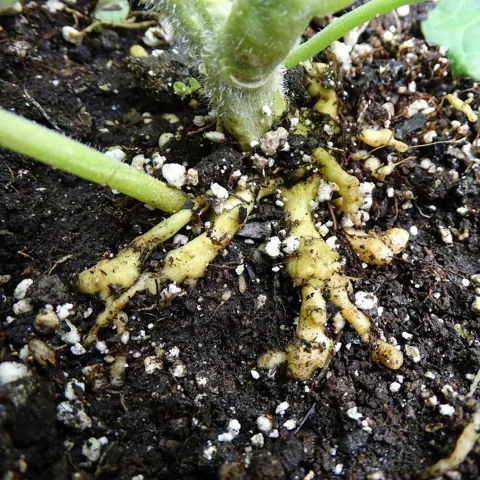 Root-Knot Nematodes
Meloidogyne spp. (most often M. incognita in South Carolina gardens)
Root-knot nematodes are microscopic roundworms in the soil that feed inside plant roots and make them swell into knots and galls, leaving tomatoes, okra, beans, squash and many other plants stunted and quick to wilt.
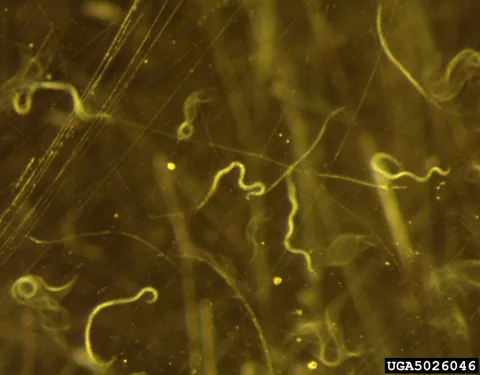 Foliar Nematodes
Aphelenchoides spp. (including A. fragariae and A. ritzemabosi)
Foliar nematodes are microscopic roundworms in the genus Aphelenchoides that live inside the leaves of hostas, ferns, anemones and hundreds of other plants, leaving yellow, then brown, patches and stripes bounded by the leaf veins.
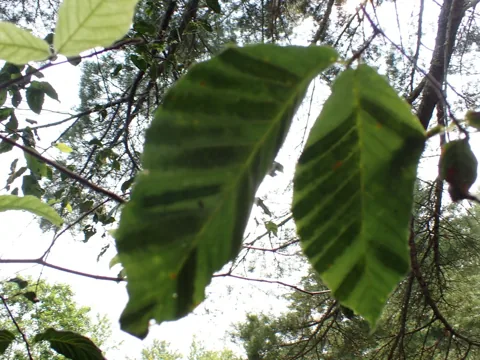 Beech Leaf Disease Nematode
Litylenchus crenatae subsp. mccannii
Beech leaf disease is caused by a microscopic, invasive leaf nematode, Litylenchus crenatae subsp. mccannii, that lives in the leaves and buds of beech trees, banding and distorting the leaves and killing buds until the tree declines.
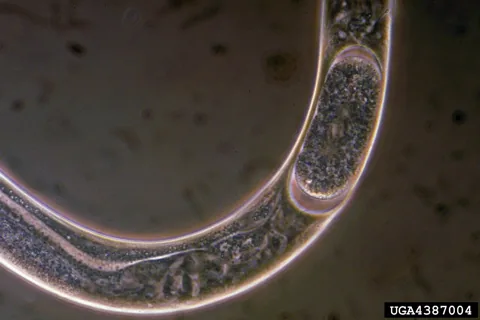 Pinewood Nematode
Bursaphelenchus xylophilus
The pinewood nematode is a microscopic worm, about 1 mm long, that causes pine wilt: carried into pines by pine sawyer beetles, it multiplies in the resin canals and water-conducting tissue and can kill a susceptible pine within weeks to a few months.
Root feeders: root-knot nematodes
Root-knot nematodes are the most damaging nematodes in gardens; the galls they cause on roots damage the roots' ability to carry water and nutrients, leaving plants stunted and quick to wilt.[1][2]
Above ground, infested plants look short of water or fertilizer: they wilt in the hottest part of the day even in moist soil, yellow, lose vigor and grow more slowly than healthy neighbors. Clemson warns not to rely on these symptoms alone. Damage is worst in warm, irrigated, sandy soils.[1][2]
Galls can reach an inch across on some plants but are usually much smaller, and they can crack open and let soil-borne disease organisms into the root. The whole root system may also be shallow, with dead or overly branched areas.[1][2]
Other root feeders, such as lesion, ring, cyst, citrus and stem and bulb nematodes, cause similar wilting above ground but leave roots shortened or deformed rather than galled, which is harder to spot.[1]
Nematodes rarely kill trees and shrubs. In woody plants they mostly slow growth and yields and can cause branch tip dieback and early leaf drop.[1]
Getting a diagnosis
For root-knot nematodes, dig up a few plants showing symptoms, wash or tap the soil off the roots and look for galls. Galled roots on last season's crop are often the first clue.[1]
A lab can name the species and count them. Collect soil and root samples and send them to a nematode lab; your county Extension office has sampling guidelines, and labs charge a small fee per sample.[1][2]
State labs such as North Carolina's run different tests: a predictive assay tells you whether nematodes will be a problem for a crop next season, and a diagnostic assay looks at a problem already in the ground.[6]
UC IPM describes a home check for root-knot nematodes: sow melon seeds in pots of moist garden soil and keep them at about 80°F. If root-knot nematodes are present, galls show on the roots in about 3 weeks; melons in heat-sterilized soil stay clean.[1]
Foliar nematodes can be seen with at least 10X magnification: tear a symptomatic leaf into small pieces in a drop of water, let it soak a few minutes and look for small worms moving in a snake-like way.[8]
Pine wilt is confirmed only by extracting the nematode from wood. Nebraska Extension asks for wood from the lower trunk or the base of large lower limbs, bagged and kept cool. Illinois Extension cautions that finding the nematode doesn't prove it killed the tree, since other, harmless nematodes live in pine wood too.[12][11][4]
Resistant varieties and rootstocks
Tomato varieties labeled VFN (or with an N on the seed packet) resist the common root-knot nematodes. They may still show some galls when numbers are high but usually keep their yield, and soil nematode levels fall rather than rise under them. In UC garden-style trials, resistant tomatoes yielded almost 6 times more than a similar susceptible variety.[1]
Clemson's list of root-knot resistant vegetables includes varieties of southernpeas, lima beans, hot and bell peppers, sweetpotatoes and tomatoes; UC IPM adds some blackeye, lima and snap bean varieties.[2][1]
Among bedding plants, Clemson lists zinnia, salvia and marigold as resistant, while begonias, coleus and impatiens are the most likely to be damaged.[2]
For fruit trees and grapes, UC IPM recommends nematode-resistant rootstocks for stone fruit, almonds and grapes, and citrus rootstocks resistant to the citrus nematode. Resistant varieties don't exist for many crops and ornamentals.[1]
Resistance is bred against the common species. Meloidogyne enterolobii, introduced into Florida, North Carolina and South Carolina, can overcome the resistance in tomatoes and sweetpotatoes.[5]
Rotation, fallow and timing
Rotation is harder for root-knot nematodes than for most pests, because so many vegetables and weeds are hosts. UC IPM suggests small grains such as wheat and barley, sudangrass, and resistant tomato and bean varieties in a rotation.[1]
Clemson says three years of non-host plants in a spot is usually needed and names asparagus, corn, onions, garlic and strawberries. UC IPM's California host table, though, lists strawberry and corn among the plants that root-knot or lesion nematodes attack, so check local advice before counting on those.[2][1]
Fallowing for one year lowers root-knot nematodes enough to grow a susceptible annual crop. Keep the bare soil moist so eggs hatch and keep weeds out so the young nematodes starve. Splitting the garden into thirds and fallowing one section every year or two on a rotating basis is UC's suggested way to run a fallow program; it also suggests a four-year fallow before planting woody plants in infested ground.[1]
Clemson adds a hot-weather fallow: tilling every 10 days through a hot, dry summer brings nematodes up to dry out in the sun and can cut numbers sharply in one season.[2]
Most nematodes can't get into roots when soil is below 64°F, so plant fall crops such as carrots, lettuce, spinach and peas after the soil cools, and set out summer crops as early as you can in spring.[1]
Pull annual vegetables, roots and all, as soon as harvest ends so nematodes can't keep feeding and breeding on them.[1][2]
- Marigolds: a solid planting of French marigolds grown for a full season lowers root-knot and lesion nematodes. UC IPM says to avoid signet marigolds, which nematodes feed on, and notes marigolds don't work well against the northern root-knot nematode.[1][2]
- Clemson's marigold method: plant no more than 7 inches apart, grow at least two months, keep them weed-free, turn them under, then plant susceptible vegetables there the next spring. Nematodes climb back as soon as susceptible crops return.[2][1]
Soil solarization
Solarizing means moistening the soil and covering it with clear plastic during the hottest part of summer. Root-knot nematodes and their eggs die when soil stays above 125°F for 30 minutes or 130°F for 5 minutes.[1][7]
Sources disagree on how long to leave the plastic: UC IPM says 4 to 6 weeks, Clemson 6 to 12 weeks. Solarization works less well where summers commonly stay below 80°F, such as cool coastal areas.[1][7][2]
It is a short-term fix. Control is best in the top 12 inches, nematodes can move deeper to escape the heat and come back quickly, so it suits shallow-rooted annual crops and helps young woody plants get started but won't protect fruit trees, vines or woody ornamentals for long. Our soil solarization guide has the step-by-step method.[1][7]
Leaf and bud feeders: foliar nematodes and beech leaf disease
Foliar nematodes live inside the leaves of hostas, ferns and many other plants, causing patches that start yellowish and turn brown, bounded by the leaf veins; they move in films of water and splashing rain or irrigation.[3]
They have been found on more than 450 plant species. On most ornamentals the damage is cosmetic, though on strawberries and other very susceptible hosts they can strip leaves and limit flowering. The angular blotches often don't show until late summer.[3]
Foliar nematodes usually arrive on infested plants and then spread by splashing water and by cuttings taken from infested plants. They can survive in dry leaves, dormant buds and soil, but not in roots.[3][8]
Getting rid of them on a plant is close to impossible. Dig up, bag and remove infested plants as soon as you see symptoms, then wash your hands and wipe tools and pots for 30 seconds with 70% alcohol or 10% bleach. Water at the base instead of overhead and space plants so leaves dry quickly.[3][8]
Penn State notes that some insecticides suppress foliar nematodes but none are known to eliminate them, and the rate needed can injure the plant.[8]
- Beech leaf disease is caused by a leaf nematode that darkens the leaf tissue between the veins in bands, distorts the leaves and kills buds; it was first found along Lake Erie in northeastern Ohio in 2012 and has since spread across much of the eastern United States.[9][10]
- There is no known cure for beech leaf disease. Cornell suggests thinning the affected tree and shading trees nearby to let in light and air, pruning only when foliage is dry, preferably late in the dormant season.[10]
- Treatments that have reduced symptoms in research trials include fluopyram sprays in May and early June, phosphite products, and thiabendazole injections. UMass notes sprays may do little where many untreated beech grow nearby.[9][10]
Wood feeders: the pinewood nematode
The pinewood nematode causes pine wilt: pine sawyer beetles carry it from infected trees to other pines in spring, and susceptible pines such as Scots pine can be killed quickly.[4]
Nebraska Extension says pine wilt typically kills Scotch pine within a few weeks to a few months; needles go grayish green, then tan, then brown, and stay on the dead tree for a year or more. Illinois Extension notes that large trees may take two years to die.[12][11][4]
Remove and destroy infected pines before the beetles emerge. Trees dying between May 1 and October 1 should be cut promptly and burned, buried or chipped; trees found after October 1 must be gone by the end of April. Don't keep the wood for firewood, because beetles can still come out of it.[12][4][11]
Don't replace a lost Scotch pine with another. Nebraska lists spruces, firs, red cedar, junipers and white and ponderosa pine as facing little threat from pine wilt.[12]
High-value pines can be partly protected by trunk injections of abamectin, given by professional arborists; Nebraska reports about 70 percent protection each year for about three years per application.[12]
What gardeners can do
Prevention matters most, because nematodes are hard to get rid of once they are established.[1][3]
UC IPM says no chemical nematicides or soil fumigants are currently available to home gardeners for backyard gardens and landscapes.[1]
Where nematodes are already present, help plants tolerate them. Compost, manure and other organic matter raise the soil's water-holding capacity, and more frequent irrigation reduces damage; nematode numbers stay the same, but stressed plants suffer more.[1][2]
- Start with clean plants, and avoid moving soil, infested plants or plant debris between gardens.[1][3]
- Wisconsin's plant disease clinic notes that no chemical products are available for foliar nematode control in home gardens.[3]
- Have a dying pine tested to confirm pine wilt, and remove infected pines promptly.[4]
- Don't let irrigation water run off from around infested plants, and clean soil from tools and equipment used elsewhere before bringing them into your garden.[1]
Common questions
- Can I see plant nematodes?
- Not without a microscope; they are usually recognized from the damage and confirmed by a lab test.[1][4]
- How do nematodes spread between gardens?
- In soil carried on tools, tillers and boots, and on infested plants.[1]
- Do marigolds get rid of root-knot nematodes?
- They lower numbers only when grown as a solid planting for a whole season (Clemson says at least two months) and then followed by vegetables. Interplanted marigolds give poor control, and signet marigolds can feed the nematodes.[1][2]
- How long does solarization keep nematodes down?
- About a year. Solarization, fallow and rotation mainly clear the top foot or so of soil, so plan to repeat them when root galls come back.[1]
- Are these the same as the beneficial nematodes sold for grubs?
- No. Beneficial nematodes are insect parasites applied to soil to kill grubs and caterpillars, and they don't harm plants. See our beneficial nematodes guide.[13][14]
Photo credits
- Root-Knot Nematodes: Plant pests and diseases, public domain (CC0), via Wikimedia Commons
- Foliar Nematodes: Aphelenchoides ritzemabosi by Jody Fetzer, Maryland National Capital Park and Planning Commission, Bugwood.org — via Wikimedia Commons, CC BY 3.0
- Beech Leaf Disease Nematode: (c) Steven Lamonde, some rights reserved (CC BY) — via iNaturalist, CC BY 4.0
- Pinewood Nematode: Bursaphelenchus xylophilus by L.D. Dwinell, USDA Forest Service, Bugwood.org — via Wikimedia Commons, CC BY 3.0
Sources
- University of California Statewide IPM Program, “Nematodes (Pest Notes, Home and Landscape).” ipm.ucanr.edu/home-and-landscape/nematodes/ (accessed 2026-11-10)
- Clemson Cooperative Extension, Home & Garden Information Center, “Root-Knot Nematodes in the Vegetable Garden (HGIC factsheet).” hgic.clemson.edu/factsheet/root-knot-nematodes-in-the-vegetable-garden/ (accessed 2026-11-10)
- University of Wisconsin-Madison Plant Disease Diagnostics Clinic, “Foliar Nematodes (UW Plant Disease Facts).” pddc.wisc.edu/wp-content/blogs.dir/39/files/Fact_Sheets/FC_PDF/Foliar_Nematodes.pdf (accessed 2026-11-10)
- Penn State Extension, “Pine Wilt Disease.” extension.psu.edu/pine-wilt-disease (accessed 2026-11-10)
- Clemson Cooperative Extension, Home & Garden Information Center, “Meloidogyne enterolobii (M.e.) and the Challenge for Home Gardeners.” hgic.clemson.edu/meloidogyne-enterolobii-m-e-and-the-challenge-for-home-gardeners/ (accessed 2026-11-10)
- North Carolina Department of Agriculture and Consumer Services, “Agronomic Services: Nematode Assay.” www.ncagr.gov/divisions/agronomic-services/nematode-assay (accessed 2026-11-10)
- University of California Statewide IPM Program, “Soil Solarization for Gardens and Landscapes (Pest Notes).” ipm.ucanr.edu/home-and-landscape/soil-solarization-for-gardens-landscapes/ (accessed 2026-11-10)
- Penn State Extension, “Foliar Nematodes.” extension.psu.edu/foliar-nematodes (accessed 2026-11-10)
- UMass Extension, Center for Agriculture, Food, and the Environment, “Beech Leaf Disease.” www.umass.edu/agriculture-food-environment/landscape/fact-sheets/beech-leaf-disease (accessed 2026-11-10)
- New York State Integrated Pest Management, Cornell University, “Beech Leaf Disease (Cornell IPM fact sheet).” cals.cornell.edu/integrated-pest-management/outreach-education/fact-sheets/beech-leaf-disease (accessed 2026-11-10)
- University of Illinois Extension, “Pine Wilt (Plant Problems).” extension.illinois.edu/plant-problems/pine-wilt (accessed 2026-11-10)
- University of Nebraska-Lincoln Extension, “Pine Wilt in Nebraska (G1899).” extensionpubs.unl.edu/publication/g1899/2008/html/view (accessed 2026-11-10)
- University of California Statewide IPM Program, “The UC Guide to Healthy Lawns: Beneficial nematodes.” ipm.ucanr.edu/TOOLS/TURF/PESTS/innem.html (accessed 2026-11-10)
- New York State Integrated Pest Management, Cornell University, “Heterorhabditis bacteriophora (beneficial Hb nematode).” cals.cornell.edu/integrated-pest-management/outreach-education/fact-sheets/heterorhabditis-bacteriophora-beneficial-hb-nematode (accessed 2026-11-10)