On this page
How to identify it
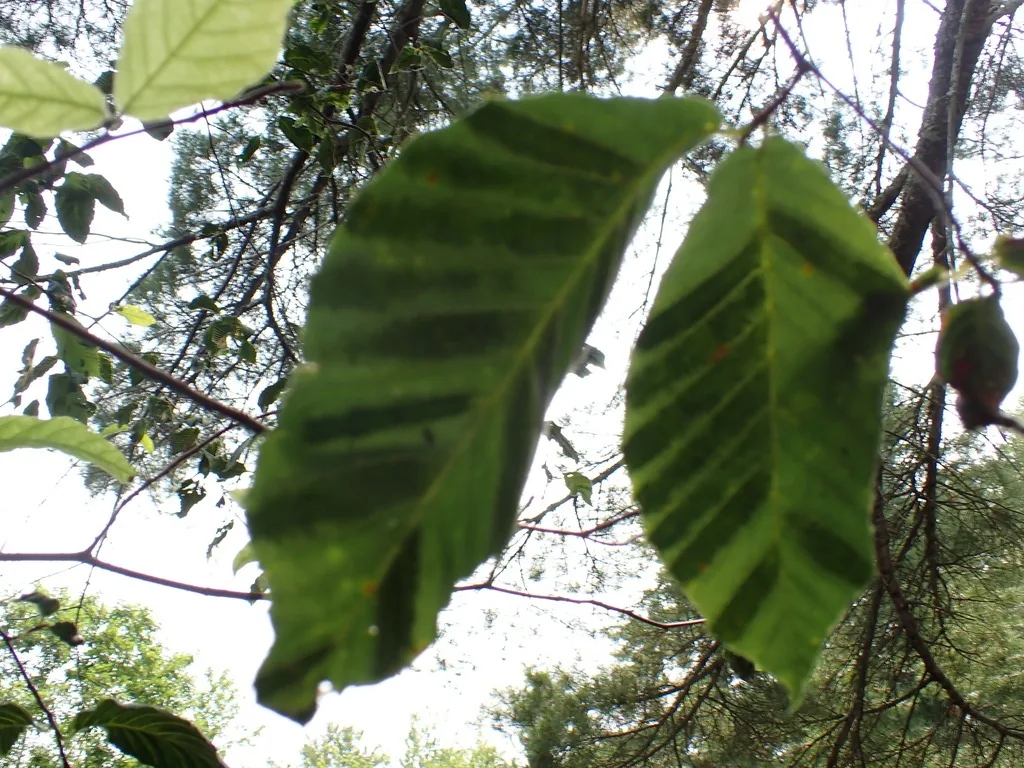
- The giveaway is dark green bands between the veins of the leaves; held up to the sky or sun, the bands look opaque against the clearer healthy tissue. Cornell says lower branches are often hit harder than the upper canopy.[1][2][3]
- As the disease progresses, leaves become thickened, leathery, curled, smaller and distorted, and buds are stunted or die, leaving a thin canopy.[1][2]
- Leaf loss usually starts in the lower canopy and moves upward.[1]
- The nematode is a microscopic roundworm living inside leaf and bud tissue, so it can't be seen without magnification.[1]
Where it lives
First found near Cleveland, Ohio, in 2012; by December 2024 it had spread from Michigan into Canada, east to Maine and south to Virginia. UMass says it was first found in New England in 2019 in Connecticut, is now widespread in Connecticut, Rhode Island and Massachusetts, and is moving north through Maine, New Hampshire and Vermont. The National Park Service confirmed it in several National Capital Region parks as of August 2025.[1][2][4]
Biology and life cycle
It infects only beech (Fagus species) and lives in leaves and buds, not in the roots or wood; it overwinters in infected buds.[1][2]
Eggs are laid in infested tissue in late winter or early spring and carried along as the leaves expand; juveniles appear by midsummer, populations build in the leaves into fall, and adults move into next year's buds, mostly from midsummer to early fall.[1][2]
Wind, rain and humidity can spread the nematodes at least 38 feet from infected trees; they have also been found on beech blight aphids, in the droppings of caterpillars that fed on beech, and in spider webs, and infected nursery stock can carry them farther. UMass says birds and insects are likely the main carriers.[1][2]
Damage and signs
- Infected leaves lose photosynthetic ability, which slowly starves the tree; crowns thin and branches die back, and trees can die within a few years (see where the sources disagree on how fast).[1][3][2]
- It attacks American beech as well as European and Asian beech species, including ornamental European beech cultivars.[3][2]
Health risk
We found no CDC, MedlinePlus, state health department or peer-reviewed source on beech leaf disease and people or pets, so this page makes no health claim; Rutgers, UMass and Cornell describe it only as a disease of beech trees.[1][2][3]
Control
Prevention
There is no cure yet. Watch beech trees for banding in spring and don't move beech nursery stock or debris from infested areas; UMass says the disease can travel on nursery stock and doesn't recommend new beech plantings for now. Cornell asks people to report beech trees that seem resistant through the TreeSnap app.[3][1][2]
Rutgers advises giving beech ample water during drought and, in woods where beech is declining, underplanting native trees to replace it; see where the sources disagree on mulch and pruning.[1]
Traps and physical control
Pruning early-infected leaves and small branches may slightly slow the disease, but trees can be reinfected, and pruning large branches on older beech is not recommended; raking up fallen leaves isn't considered effective because the nematode isn't thought to survive in leaf litter.[1]
When to call a professional
Treatments are still experimental, Rutgers says. Rutgers calls thiabendazole (Arbotect 20-S), injected at the root flare by certified applicators, the most effective current option, and Cornell and UMass say it's applied every two years. Fluopyram (in Broadform) reduced nematode numbers and improved canopy density in trials; Cornell notes it is highly toxic to fish and aquatic invertebrates, and UMass says drift and nearby wells or waterways rule it out at many homes. Phosphite results vary. A certified arborist can advise whether treatment fits your tree.[1][3][2]
Current regulatory status (checked November 2026)
Treatment labels: the National Park Service reported in 2025 (page last updated November 25, 2025) that 24 states, including Maryland and Virginia, have issued Section 24(c) Special Local Need labels allowing Arbotect 20-S (thiabendazole) to be used against beech leaf disease.[4]
Quarantines: we found no federal or state agency page stating that a beech leaf disease quarantine is in place. Rutgers and UMass Extension say there are no known quarantines or quarantine zones for beech nursery stock or debris, but they are not regulatory agencies.[1][2]
Where the sources disagree
Origin: UMass says the nematode is suspected to be native to Japan; Rutgers says it is assumed to be non-native and is closely related to a Japanese subspecies, with its origin still being studied.[2][1]
How fast trees die: Rutgers says within 1 to 2 years for small saplings and 6 to 10 years for mature trees; Cornell gives 2 to 10 years, sooner for smaller trees.[1][3]
Cultural care: Cornell recommends mulch about 3 inches deep, watering without wetting the leaves, and thinning the canopy when foliage is dry at the end of dormancy; Rutgers says to keep mulch under 2 inches, that pruning only slightly slows the disease and large-branch pruning isn't recommended; UMass says no cultural practice limits its spread or severity.[3][1][2]
Phosphites: Rutgers reports phosphite soil drenches improved infected saplings over five years in Cleveland Metroparks and Davey Tree trials; Cornell says phosphites may enhance tree defenses; UMass says phosphite alone gave limited control on Massachusetts landscape trees.[1][3][2]
Fluopyram timing: Rutgers cites research starting sprays in late July; UMass says May and early June may work best, with successful treatments from May to September.[1][2]
Common questions
- Why do my beech leaves have dark stripes between the veins?
- Dark bands between the veins, most obvious when the leaf is held up to the light, are the hallmark of beech leaf disease, caused by a microscopic leaf nematode.[1][2][3]
- Can beech leaf disease be cured?
- Not yet; some treatments reduced the nematode and symptoms in trials, so ask a certified arborist about options for valuable trees.[3][1]
Sources
- Rutgers Cooperative Extension (NJAES), “Beech Leaf Disease & Management Options (Cooperative Extension Bulletin E376).” njaes.rutgers.edu/E376/ (accessed 2026-11-13)
- UMass Extension Landscape, Nursery and Urban Forestry Program, “Beech Leaf Disease (Landscape fact sheet).” www.umass.edu/agriculture-food-environment/landscape/fact-sheets/beech-leaf-disease (accessed 2026-11-13)
- Cornell Cooperative Extension (New York State Integrated Pest Management), “Beech Leaf Disease (Invasive Species Fact Sheet).” cals.cornell.edu/integrated-pest-management/outreach-education/fact-sheets/beech-leaf-disease (accessed 2026-11-13)
- National Park Service, “Treating Beech Leaf Disease (National Capital Region; last updated November 25, 2025).” www.nps.gov/articles/000/treating-beech-leaf-disease.htm (accessed 2026-11-13)
- Global Biodiversity Information Facility (GBIF), “Litylenchus crenatae mccannii Carta, 2020 (GBIF Backbone Taxonomy).” api.gbif.org/v1/species/11216637 (accessed 2026-11-13)
- iNaturalist, “Litylenchus crenatae taxon page (order and family).” www.inaturalist.org/taxa/1103716 (accessed 2026-10-06)