On this page
How to identify it
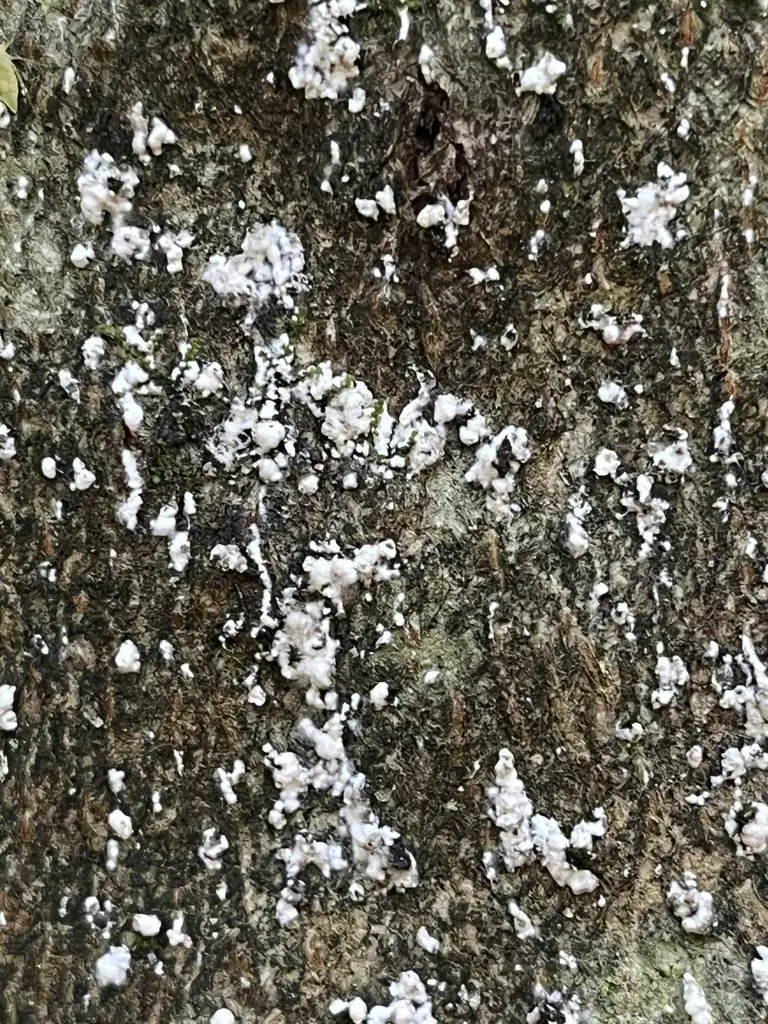
- Adult females are tiny, light yellow and wingless, hidden under a white woolly wax covering, and they never move once settled. UMass puts them at less than 1 mm long and Ohio State at about 0.5 to 1.0 mm.[1][3]
- The white wool shows first in bark cracks and crevices and can spread until it coats the whole trunk.[1][2][3]
- Tarry black spots, red-brown ooze from cankers and, in late summer and fall, tiny bright red fungal fruiting bodies on the bark mean the fungus has followed.[1][2][3]
Where it lives
Introduced from Europe to Nova Scotia; NC State gives 1890, and the Forest Service says the late 1890s, on an ornamental European beech in Halifax. NC State says it has spread into New England, New York, Pennsylvania, Michigan, Tennessee, West Virginia and North Carolina, and it reached Ohio by 1984. GBIF's US records since 1990 come mostly from Vermont, New Hampshire and Michigan.[2][4][5][7]
Biology and life cycle
In North America every beech scale is a female that reproduces without mating, with one brood of eggs a year.[1][3]
NC State says females lay eggs on the bark in summer and then die; Ohio State puts egg-laying in June or July and hatching in August or September. The crawlers that hatch are the only mobile stage: they move to a new spot on the same tree or are carried to new trees by wind, and Ohio State and the Forest Service add birds and other animals.[2][3][4][1]
Within a few days crawlers settle into a feeding spot, insert their mouthparts into the bark, cover themselves with wax and never move again; they spend the winter as second-stage nymphs.[2][1][3]
How fast numbers build up varies. UMass says a huge population can develop on a tree in 2 to 3 years, while Ohio State says the increase can be slow, taking up to 10 years, though densities can reach 270 scales per square centimeter.[1][3]
Ohio State says the scales seem to prefer rough bark and that heavy rains can wash crawlers off trees. The Forest Service warns that moving infested firewood between midsummer and early winter could carry crawlers to new areas.[3][4]
Damage and signs
- The scale alone does little: Ohio State says trees where only the scale has arrived die no faster than before. The damage starts when Neonectria fungi enter the scale-damaged bark, which is why beech bark disease is called a two-part disease complex.[3][5][2]
- The fungi kill the inner bark, forming cankers that keep enlarging until the tree is girdled and killed; infected trunks look swollen and lumpy.[1][3]
- Losses are heavy. The Forest Service says about 50% of beech trees were typically killed as the disease moved through New England, and Ohio State says mature trees can reach 50 percent mortality within 10 years, with up to 90 percent eventually succumbing.[4][3]
- American beech is the preferred host; European beech is also susceptible, though UMass notes it is not thought to be as heavily attacked.[1][2]
- The fungus can lag well behind the scale. In Ohio the scale was found at the Holden Arboretum in 1984, but the disease fungus was not found there until 2003, 19 years later.[5]
- A fun fact with a sad side: Ohio State notes that American beech is one of the few nut (mast) trees in northeastern forests, a significant food source for wildlife, especially black bears.[3]
Health risk
None of these sources reports any harm to people or pets; they treat beech scale only as a tree pest.[1][2][3]
Control
Prevention
Because the disease is widespread in Massachusetts, UMass suggests planting European rather than American beech in landscapes.[1]
In forests, insecticides are often not practical. Managers instead remove diseased beech and keep disease-free trees, which the Forest Service estimates at 1 to 5% of American beech; NC State asks that suspected cases in North Carolina be reported to the North Carolina Forest Service.[2][4][3]
Traps and physical control
On a single landscape tree, scales can be scrubbed off with a soft brush or washed off with a blast of water, though this may not be practical on large trees and Ohio State says control must be kept up every year.[1][3]
Biological control
The twicestabbed lady beetle eats beech scale, but UMass says research suggests it cannot control the population, and Ohio State says biological control does not appear to be a viable option.[1][3]
Pesticides
Insecticides work best when the crawlers are out, before they form their waxy cover; the Forest Service calls this a window of only a few weeks. UMass lists options for crawlers including horticultural oil, azadirachtin, acetamiprid, buprofezin, carbaryl and dinotefuran, and notes that since July 1, 2022 neonicotinoids are state restricted use on trees and shrubs in Massachusetts. Follow the label.[2][1][3][4]
Common questions
- What is the white fuzz on my beech tree's bark?
- Usually beech scale, the insect that starts beech bark disease.[1][2][3]
- Can beech bark disease be stopped in the woods?
- Not practically. A small share of beech trees resist the scale, and researchers are breeding them; a 2017 study found a single gene region of major effect on resistance that could help breeding and restoration.[3][4][6][2]
- Can I move beech firewood?
- The Forest Service warns that infested firewood moved between midsummer and early winter could carry crawlers to new areas.[4]
Sources
- UMass Extension Landscape, Nursery and Urban Forestry Program (Landscape Insect & Mite Guide), “Cryptococcus fagisuga (Beech Scale).” www.umass.edu/agriculture-food-environment/landscape/publications-resources/insect-mite-guide/cryptococcus-fagisuga (accessed 2026-11-12)
- NC State Extension, “Beech Bark Disease (Invasive Forest Pests).” content.ces.ncsu.edu/beech-bark-disease (accessed 2026-11-12)
- The Ohio State University Extension, Ohioline, “Beech Bark Disease (PLPATH-TREE-09).” ohioline.osu.edu/factsheet/plpath-tree-09 (accessed 2026-11-12)
- USDA Forest Service, Northern Research Station, “Beech bark disease: the oldest "new" threat to American beech in the United States (Outlooks on Pest Management, 2010).” www.nrs.fs.usda.gov/pubs/jrnl/2010/nrs_2010_koch_002.pdf (accessed 2026-11-12)
- Plant Dis 2005, via PubMed, “The First Report of Beech Bark Disease in Ohio Comes Nineteen Years After the First Report of the Initiating Scale.” pubmed.ncbi.nlm.nih.gov/30795225/ (accessed 2026-11-12)
- BMC Genomics 2017;18:574, via PubMed, “Genome-wide association study identifies a major gene for beech bark disease resistance in American beech (Fagus grandifolia Ehrh.).” pubmed.ncbi.nlm.nih.gov/28728575/ (accessed 2026-11-12)
- Global Biodiversity Information Facility (GBIF), “Cryptococcus fagisuga: U.S. occurrence records since 1990 by state (GBIF occurrence search).” api.gbif.org/v1/occurrence/search?taxonKey=5160450&country=US&hasGeospatialIssue=false&occurrenceStatus=PRESENT&year=1990%2C2026&facet=stateProvince&facetLimit=400&limit=0 (accessed 2026-11-12)
- iNaturalist, “Cryptococcus fagisuga taxon page (order and family).” www.inaturalist.org/taxa/54061 (accessed 2026-10-06)