On this page
How to identify it
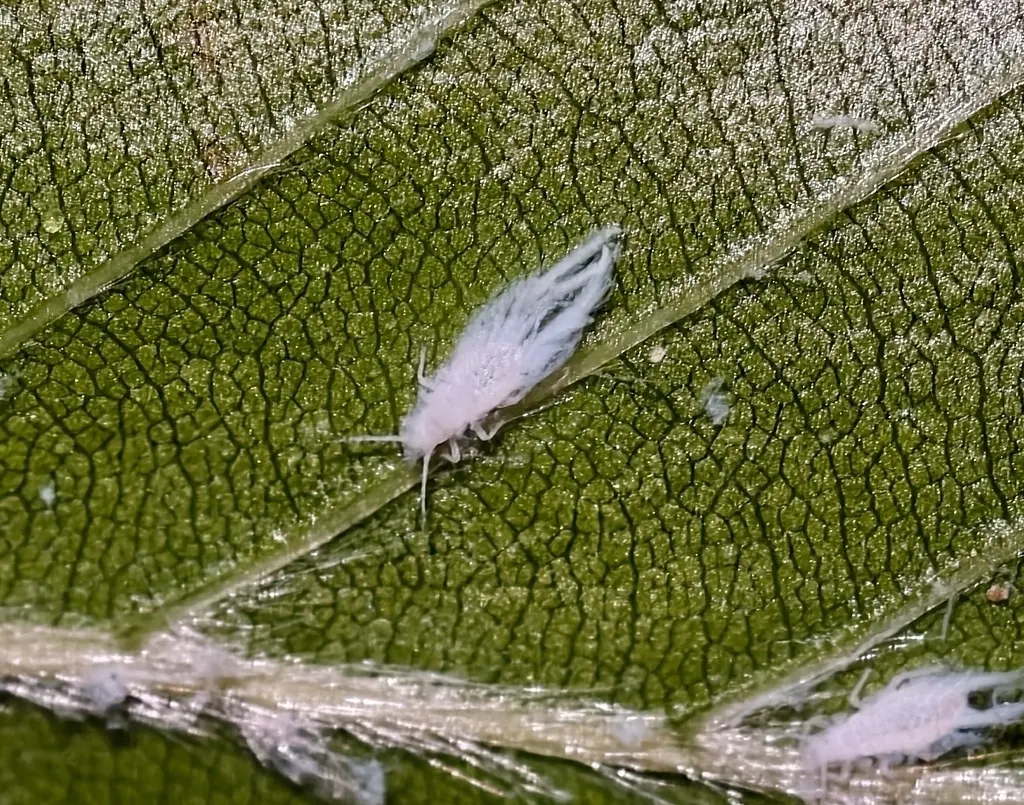
- The aphids hide under white waxy wool. Sources differ on color and size: UMass says wingless females are pale green and 2.0 to 3.2 mm long, while the RHS says pale yellow and up to 2 mm. Winged forms appear in midsummer.[1][3]
- Colonies crowd the undersides of leaves among many shed skins, and sometimes the leaf stalks, fruit and fruit stems. Honeydew makes the leaves and anything below them sticky, and black sooty mold may follow.[1][2][3]
Look-alikes
| Look-alike | How to tell them apart |
|---|---|
| Beech blight aphid | Beech blight aphids infest only American beech, usually later in the season, and colonies wave their rear ends in unison when disturbed; woolly beech aphids infest only European beech and don't.[1][2] |
| Woolly apple aphid | The RHS says woolly beech aphid occurs only on beech, so white waxy insects on apple, pyracantha or other plants are something else, such as woolly apple aphid, scale egg masses or mealybugs.[3] |
Where it lives
Native to Europe and introduced to North America, New Zealand, Australia, China and Korea. UMass says it's found throughout the Northeast wherever European beech is grown, and Ohio State reports it in southwest Ohio.[1][2]
Biology and life cycle
Eggs spend the winter in bark crevices around buds. Sources differ on hatch: UMass says around budbreak, Ohio State about when the leaves fully expand and the RHS a few weeks after new foliage appears.[1][2][3]
Wingless females give birth to live young through spring and summer; up to 10 in a season have been seen in Danish nurseries, so Ohio State says outbreaks can happen any time in the growing season. UMass puts peak activity around mid-June.[3][2][1]
Colonies excrete honeydew that grows sooty mold and draws ants, bees and wasps.[1][2][3]
Damage and signs
- Leaves cup downward on either side of the midrib around the colonies, and heavily affected leaves may be distorted.[1][3]
- It feeds only on European beech and its cultivars; it does not infest American beech.[1][2]
- In the northeastern United States even large populations in back-to-back years do little harm, and the RHS says it causes no long-term harm in the UK. UMass notes that beeches in Europe are reportedly more severely affected. The main problems are looks and honeydew on sidewalks and decks below.[1][3][2]
Health risk
It feeds on beech leaves. UMass, Ohio State and the RHS describe honeydew and leaf damage only and don't mention any risk to people or pets.[1][2][3]
Control
Prevention
Check twigs for overwintering eggs in bark crevices near buds, especially in forked shoots, and keep beeches well sited and maintained to reduce stress.[1]
Traps and physical control
A strong stream of water from a hose can wash colonies off the leaves without harming the natural enemies that keep them in check.[1]
Biological control
Lady beetles and other natural enemies likely feed on it in North America. The RHS suggests encouraging ladybirds, hoverflies, parasitoid wasps and earwigs, but notes that in spring aphids often build up before predators catch up.[1][3]
Pesticides
Sources differ on spraying. UMass says sprays are seldom warranted, and the RHS says control is not required. Utah State lists a spring systemic neonicotinoid where treatment is wanted, and notes that the wax and curled leaves make cover sprays less effective.[1][3][4]
Common questions
- What is the white fuzz under my beech leaves?
- On European beech, most likely woolly beech aphids. The RHS says they occur only on beech.[1][3]
- Does the woolly beech aphid attack American beech?
- No. It feeds on European beech and its cultivars only. White, woolly aphids on American beech are more likely beech blight aphids.[1][2]
- Will woolly beech aphids hurt my beech tree?
- Usually not. UMass, Ohio State and the RHS all say they cause little or no lasting harm, though the honeydew can be a nuisance.[1][2][3]
Sources
- UMass Extension Landscape, Nursery and Urban Forestry Program (Landscape Insect & Mite Guide), “Phyllaphis fagi (Woolly Beech Leaf Aphid).” www.umass.edu/agriculture-food-environment/landscape/publications-resources/insect-mite-guide/phyllaphis-fagi (accessed 2026-11-13)
- Ohio State University Extension, Buckeye Yard & Garden onLine (BYGL), “Sticky, Dripping European Beech (Joe Boggs, May 15, 2023).” bygl.osu.edu/node/2143 (accessed 2026-11-13)
- Royal Horticultural Society (UK), “Woolly beech aphid (RHS Advice Guide).” www.rhs.org.uk/biodiversity/woolly-beech-aphid (accessed 2026-11-13)
- Utah State University Extension (Integrated Pest Management), “Leafcurl Ash, Woolly Apple and Woolly Beech Aphids (Ornamental Pest Guide).” extension.usu.edu/planthealth/ipm/ornamental-pest-guide/arthopods/aphids-adelgids/leafcurl-ash-woolly-apple-woolly-beech-aphids.php (accessed 2026-11-13)
- Global Biodiversity Information Facility (GBIF), “Phyllaphis fagi (Linnaeus, 1761) (GBIF Backbone Taxonomy).” api.gbif.org/v1/species/2070275 (accessed 2026-11-13)
- iNaturalist, “Phyllaphis fagi taxon page (order and family).” www.inaturalist.org/taxa/142754 (accessed 2026-10-06)