On this page
How to identify it
Look-alikes
| Look-alike | How to tell them apart |
|---|---|
| Woolly alder aphid | Its colonies look remarkably like beech blight aphid colonies, but it feeds on alders rather than American beech.[3] |
Where it lives
UMass Extension gives its natural range as Maine to Florida, though it is seldom seen in Massachusetts; NC State and Clemson report it on American beech in the Carolinas. It alternates between American beech and the roots of bald cypress, and NC State says perhaps Cryptomeria as well.[3][1][2]
Biology and life cycle
It spends the winter on bald cypress roots. Clemson says adults leave beech in fall for bald cypress and return in late winter to lay eggs that hatch the next spring; NC State says aphids fly from bald cypress to beech during the winter to lay those eggs.[1][2]
Colonies persist on beech from April through November in North Carolina; winged aphids leave in summer and fall for bald cypress.[1]
Nymphs can use their mouthparts to jab predators, and may even jab a person who lets them touch bare skin.[1]
Colonies can be obvious as early as July and are most striking in September and October. UMass says populations usually stay high for 2 to 3 years before parasites bring them down.[3]
At one stage of development the aphids attack beneficial insects inside the colony. Ants, which tend many aphids, are usually not found within these dense colonies, likely because so much honeydew falls to the ground and nearby surfaces.[3]
Damage and signs
- Damage to the beech itself is minimal, according to Clemson. UMass says there is no consensus on its effect on tree health: some suspect heavy colonies kill small limbs or cause smaller, distorted leaves, but there is no sign of serious harm beyond the sooty mold. Drought and other beech pests, such as beech scale, can add to the stress.[2][3]
- The sooty mold, Scorias spongiosa, forms an unusually thick, spongy mass that starts honey-colored and turns black, blanketing plants below.[1][2]
- Sooty mold grows on the honeydew without infecting the plant, but it is unsightly and blocks some of the sunlight leaves need. In a Smithsonian study, moldy honeydew under heavily colonized beech lowered the survival of seedlings growing beneath by impairing their leaves.[2][3][4]
- The same study found that the aphids colonized the same large beech trees again and again, so patches with few seedlings may form beneath them.[4]
Health risk
No cited source describes it spreading disease to people or pets. NC State notes that nymphs can jab with their mouthparts and may even jab a person who lets them touch bare skin.[1]
Control
Biological control
An insect-infecting fungus sometimes wipes out colonies, and parasites and predators attack them. UMass says these natural enemies eventually cut numbers sharply.[1][3]
Pesticides
Where control is wanted, NC State and UMass list pyrethroids, horticultural oil (weather permitting) and insecticidal soap. Keep pyrethroids away from pools, ponds and streams because they are toxic to fish. Both also mention soil-applied imidacloprid, which works well on aphids but takes weeks to reach the branches overhead.[1][3]
Common questions
- What is the white fuzz on my beech tree branches?
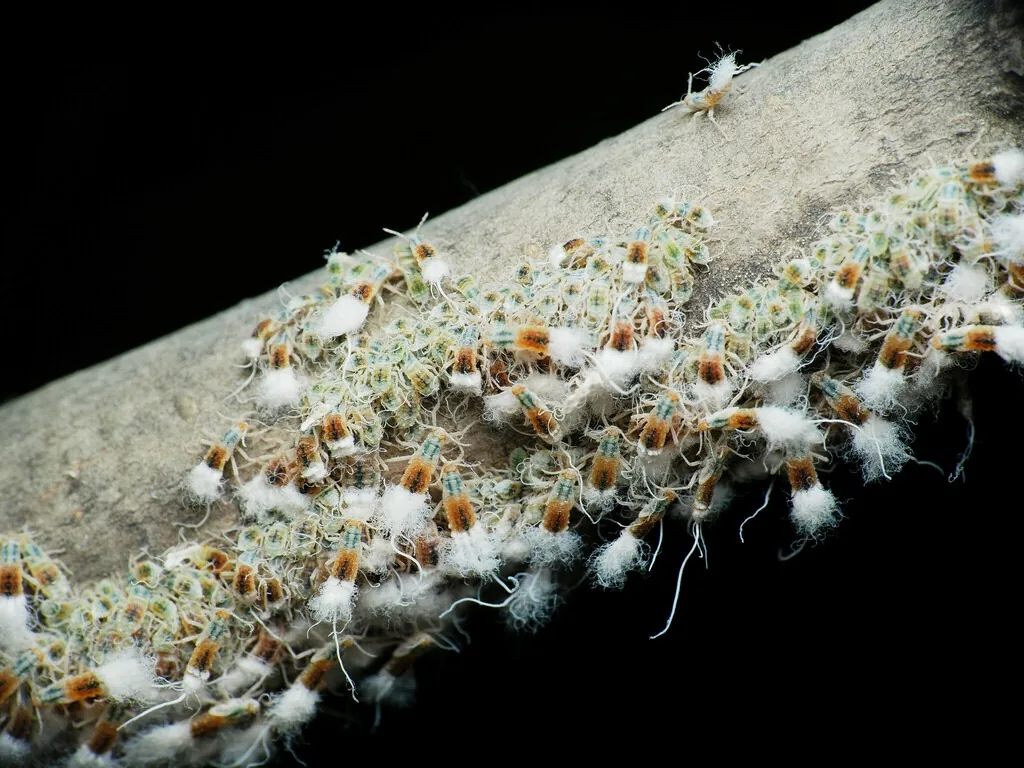
- Usually colonies of beech blight aphid nymphs covered in white waxy filaments.[1][2]
- Will beech blight aphids kill my tree?
- Unlikely. Clemson calls the damage to beech minimal and UMass sees no sign of serious harm beyond sooty mold, though heavy colonies may add stress to trees already hit by drought or other pests.[2][3]
- Why do the aphids dance?
- Disturbed nymphs raise and wave their abdomens together, apparently as a warning to predators.[1][2]
- Is the black mold hurting plants under my beech?
- Sooty mold grows on honeydew rather than infecting plants, but thick layers block light. A Smithsonian study found it lowered the survival of seedlings growing beneath colonized beech trees.[2][4]
- Will the aphids come back next year?
- Often. UMass says populations typically stay high for two to three years before natural enemies bring them down, and the Smithsonian study saw the aphids return to the same large trees repeatedly.[3][4]
Sources
- NC State Extension, “Beech Blight Aphid (PDIC Factsheet).” content.ces.ncsu.edu/beech-blight-aphid (accessed 2026-11-13)
- Clemson Cooperative Extension, Home & Garden Information Center, “The Beech Blight Aphid Nymphs.” hgic.clemson.edu/the-beech-blight-aphid-nymphs/ (accessed 2026-11-13)
- UMass Amherst Extension Landscape, Nursery and Urban Forestry Program, “Beech Blight Aphid (fact sheet).” www.umass.edu/agriculture-food-environment/landscape/fact-sheets/beech-blight-aphid (accessed 2026-11-13)
- PeerJ (via PubMed), “Cascading effects of a highly specialized beech-aphid-fungus interaction on forest regeneration (Cook-Patton SC et al., PeerJ, 2014) (abstract).” pubmed.ncbi.nlm.nih.gov/25024911/ (accessed 2026-11-13)
- Global Biodiversity Information Facility (GBIF), “Grylloprociphilus imbricator (Fitch, 1851) (GBIF Backbone Taxonomy).” api.gbif.org/v1/species/2078356 (accessed 2026-11-13)