On this page
How to identify it
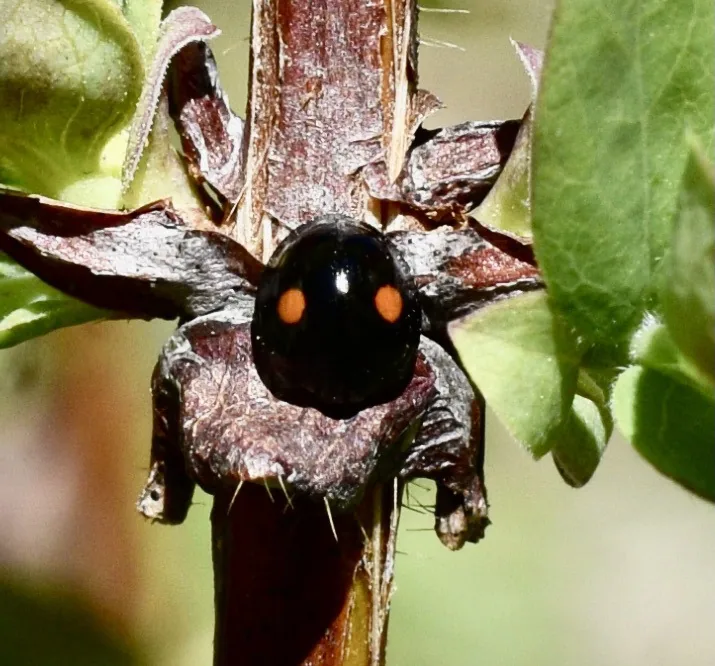
- Adults are shiny black with two red spots, about 1/5 inch (5 mm) long, dome-shaped on top and flat underneath. UC IPM's twicestabbed lady beetle page describes the California species, Chilocorus orbus, and says at least three other U.S. Chilocorus species closely resemble it.[1][2]
- Larvae are active and elongate, like tiny alligators, blackish and gray with many fleshy spines. Ohio State says twicestabbed larvae are covered in small spikes, not white wax.[1][2]
- Eggs are oblong, yellowish and about 1 mm long, laid singly on plants near prey.[1]
- Pupae are oblong and blackish and sit inside the split, spiny skin of the last larval stage.[1]
Look-alikes
| Look-alike | How to tell them apart |
|---|---|
| Other black lady beetles with two red spots | Several black lady beetles have two red spots. In California, UC IPM lists Axion plagiatum, Chilocorus cacti, Chilocorus kuwanae and a black-and-red form of Olla v-nigrum, and says telling them apart for certain takes expert dissection.[1] |
| Sigil lady beetles (Hyperaspis) | Ohio State says Hyperaspis conviva, H. signata and H. binotata have two red spots and look almost identical as adults, but their larvae are covered in white wax; it thinks they're behind the mistaken belief that twicestabbed larvae are waxy.[2] |
Where it lives
Studies have recorded it as a common scale predator in Michigan Christmas tree plantations, South Carolina landscapes and Louisiana crapemyrtles, and Ohio State reports it in Ohio. In California, UC IPM covers the similar Chilocorus orbus, one of the most common scale-feeding lady beetles on trees and shrubs there.[6][5][7][3][1]
Biology and life cycle
It develops through egg, larva, pupa and adult. UC IPM says the California species has several generations a year.[1]
In a South Carolina study, the main predators of Parthenolecanium scales, including the twicestabbed lady beetle, were active from late April to late October.[5]
Damage and signs
- It eats mainly scale insects; UC IPM says adults and larvae also take aphids, mealybugs and other soft-bodied insects. Studies found it on Chionaspis heterophyllae scale on Christmas trees, Parthenolecanium soft scales and crapemyrtle bark scale, and Ohio State reports it with cryptomeria scale and magnolia scale.[1][6][5][7][3][4]
- Sources differ on how much it controls. In a Michigan study where it and Microweisia misella were common predators, predators killed an average of 70% of the scale in unsprayed Christmas tree fields in 1999. Ohio State says it and other natural enemies appear to have a limited effect on heavy magnolia scale populations, especially on non-native magnolias.[6][4]
Health risk
It's a predator of insects, and no cited source describes any risk to people or pets.[1][2]
Control
Biological control
This is a beneficial insect, not a pest. Ohio State says spotting these beetles was its first clue to a cryptomeria scale infestation.[3][4]
Fungal biopesticides can hurt it. In lab tests, BotaniGard (Beauveria bassiana GHA) cut survival of Chilocorus and Hyperaspis adults and larvae by at least 57%, and BioCeres cut Chilocorus adult survival by 40%; fungal spores were also found on beetles in Louisiana fields.[7]
Pesticides
To spare it, Ohio State relays research that a dinotefuran treatment (e.g. Safari) aimed at first-generation cryptomeria scale crawlers won't affect natural enemies such as this beetle, while rescue sprays of the pyrethroid bifenthrin (e.g. Sniper, Talstar) are notorious for also suppressing beneficial insects. Follow the label.[3]
In Michigan Christmas tree trials, horticultural oil gave 66 to 80% scale mortality, similar to conventional insecticides.[6]
Common questions
- Is a black ladybug with two red spots a pest?
- Usually not. The twicestabbed lady beetle is a predator, mostly of scale insects, and UC IPM notes several look-alikes with the same pattern.[1][2]
- Does it eat aphids?
- Sometimes. Scales are its main food, but UC IPM says adults and larvae also eat aphids, mealybugs and other soft-bodied insects.[1]
- How effective is it on scale?
- Reports differ. In Michigan Christmas tree fields where it was a common predator, predators killed an average of 70% of the scale in unsprayed fields in 1999, but Ohio State says it and other natural enemies have a limited effect on heavy magnolia scale.[6][4]
- Are white, waxy lady beetle larvae on scale twicestabbed lady beetles?
- Probably not. Ohio State says twicestabbed larvae are covered in small spikes, and white waxy larvae on scale are more likely sigil lady beetles (Hyperaspis), whose adults look almost the same.[2]
Sources
- University of California Statewide IPM Program, “Twicestabbed Lady Beetle (Natural Enemies Gallery).” ipm.ucanr.edu/natural-enemies/twicestabbed-lady-beetle/ (accessed 2026-11-13)
- Ohio State University Extension (BYGL), “Wolves in Sheep's Clothing (Buckeye Yard & Garden onLine, June 1, 2018).” bygl.osu.edu/node/1051 (accessed 2026-11-13)
- Ohio State University Extension (BYGL), “Cryptomeria Scale (Fried-Egg Scale) Found in Southwest Ohio (Buckeye Yard & Garden onLine, August 28, 2016).” bygl.osu.edu/node/533 (accessed 2026-11-13)
- Ohio State University Extension (BYGL), “Magnolia Scale is Pumping-Out Honeydew (Buckeye Yard & Garden onLine, June 16, 2017).” bygl.osu.edu/node/787 (accessed 2026-11-13)
- Journal of Economic Entomology (via PubMed), “Natural Enemy Communities and Biological Control of Parthenolecanium spp. (Hemiptera: Coccidae) in the Southeastern United States. Robayo Camacho et al. 2018 (abstract).” pubmed.ncbi.nlm.nih.gov/29912368/ (accessed 2026-11-13)
- Journal of Economic Entomology (via PubMed), “Phenology, natural enemies, and efficacy of horticultural oil for control of Chionaspis heterophyllae (Homoptera: Diaspididae) on Christmas tree plantations. Fondren & McCullough 2005 (abstract).” pubmed.ncbi.nlm.nih.gov/16334330/ (accessed 2026-11-13)
- Journal of Invertebrate Pathology (via PubMed), “Will the application of biocontrol fungi disrupt predation of Acanthococcus lagerstroemiae by coccinellids? Matos Franco et al. 2022 (abstract).” pubmed.ncbi.nlm.nih.gov/35772489/ (accessed 2026-11-13)
- Global Biodiversity Information Facility (GBIF), “Chilocorus stigma (Say, 1835) (GBIF Backbone Taxonomy).” api.gbif.org/v1/species/1043494 (accessed 2026-11-13)