On this page
How to identify it
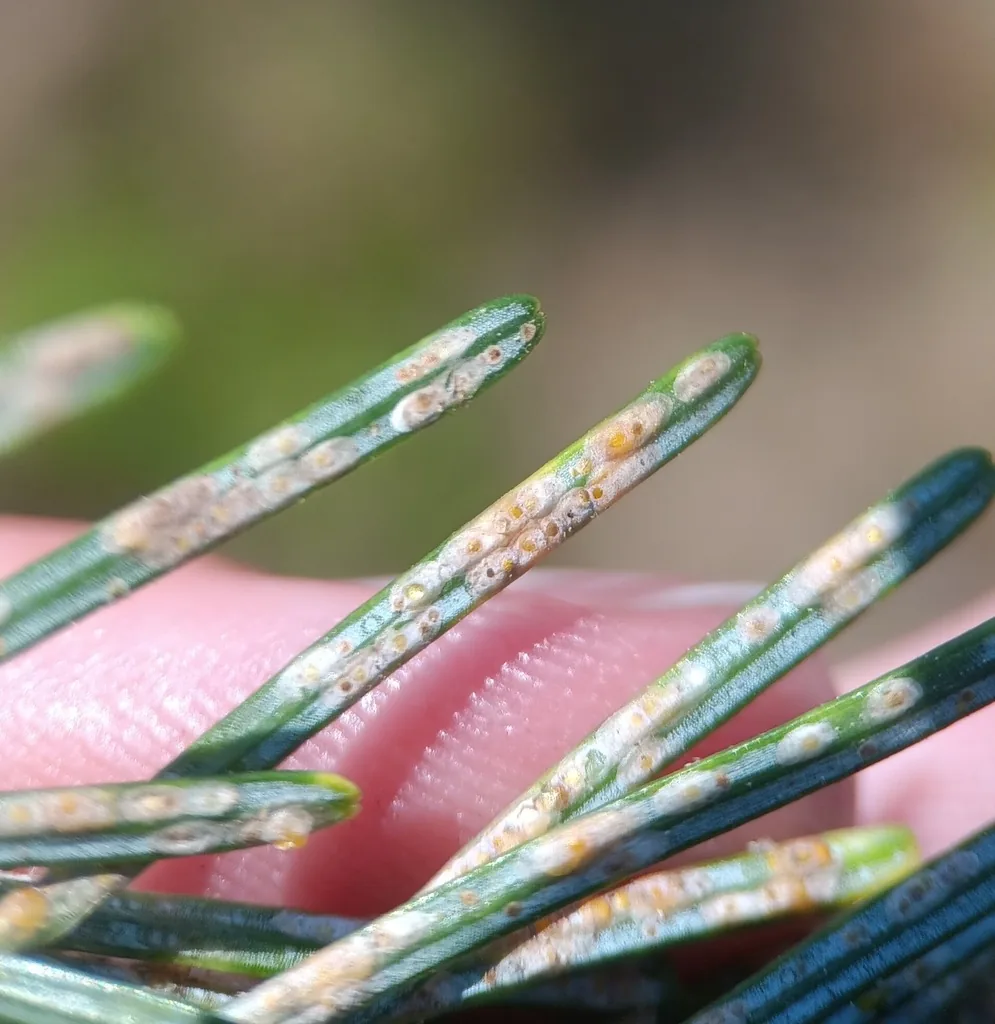
- Look on the undersides of the needles. The scales often sit in two long rows, one up each side of the needle.[1]
- UMass describes them as looking like a fried egg: the feeding nymphs and adult females are yellow, and each one makes a dense, oval, white wax cover around itself.[1]
- Old shed skins pile up under the cover as the nymphs grow, which adds to the fried-egg look.[1]
- Adult males have wings but live a very short time, so they are seldom seen.[1]
- To tell it from elongate hemlock scale, Penn State says look at shape and color with a hand lens: cryptomeria scale is round to oval and white to cream with mottled, patchy yellowing of the needles, while elongate hemlock scale is narrow, brown to tan and lined up lengthwise on the needle. At high numbers cryptomeria scales settle on top of each other.[5][3]
Look-alikes
| Look-alike | How to tell them apart |
|---|---|
| Elongate hemlock scale | Elongate hemlock scale (Fiorinia externa) causes very similar needle yellowing and is far more widespread. The two armored scales damage Christmas tree plantings in southern New England together, so the needle symptoms alone won't tell you which one you have.[1][2] |
Where it lives
Introduced to North America from Asia, it is a serious pest from southern New England to the Southeast. NC State says it is established in many east coast states including Virginia, New Jersey, Pennsylvania, Connecticut and Massachusetts but is not yet widespread in North Carolina; in Massachusetts it is still uncommon and found only in the southeastern part of the state. GBIF holds only 11 U.S. records since 1990, from New Jersey, Pennsylvania, Ohio, Rhode Island and Virginia.[1][3][7]
Biology and life cycle
It feeds on many conifers but is most common on true firs (Abies) and hemlocks (Tsuga).[1]
It spends the winter as immature nymphs under their wax covers and starts feeding again in early spring. Males go through a pupal stage and fly off as winged adults to find females, then die after mating.[1]
In late May to early June each female lays about 40 eggs under her cover. The crawlers that hatch can spread to other branches or nearby trees, but they are fragile and must settle within a day, so many feed right beneath the dead mother.[1]
A second generation of crawlers appears in late August; Penn State scouts recorded it at about 1,750-2,130 growing degree days (base 50 F). The sources differ on how cleanly the two generations separate: UMass says not all nymphs mature at the same pace, so the generations overlap and treatments are hard to time, while Penn State's 2026 scouting report says cryptomeria scale has two distinct generations, unlike the staggered generations of elongate hemlock scale, with each crawler emergence spread over about 2-3 weeks.[1][6][4]
Damage and signs
- Feeding causes yellow mottling of needles and early needle drop, starting on the lower and inner branches.[1]
- Just a few scales per needle can cause economic damage on Christmas trees, and infestations can build fast and spread across individual trees and through whole plantings.[1][2]
- It can also cost growers sales: NC State warns that states with established cryptomeria scale have rejected North Carolina tree shipments carrying live scales, even though the pest already occurs in the receiving state.[3]
Health risk
UMass, Penn State, NC State and the research literature treat it only as a pest of conifers; none mentions bites, stings or any risk to people or pets.[1][5][3][2]
Control
Prevention
Check nursery stock for cryptomeria scale before planting. NC State adds to avoid interplanting new trees into a field with a scale problem, since scale in larger infested trees is much harder to control, and to avoid over-fertilizing: fields with lower inputs seem to resist the scale better.[1][3]
Sanitation
Remove and discard heavily infested trees, or prune out badly infested branches if the scale is still confined to the lower part of the tree. Clean pruning tools and mowers after working in infested areas so you don't carry crawlers to clean trees. NC State says to cull infested trees and leave them in the field to dry out, waiting a week or two after cutting before dragging them to a burn pile; butt pruning is another cultural step that lowers pressure.[1][3]
Traps and physical control
Start scouting in late winter to early spring by turning over needles on the inner parts of lower branches and watching for trees with yellow-mottled needles. Yellow sticky cards hung on infested branches catch the winged males; egg hatch follows their flight by two to three weeks, at about 600 to 800 growing degree days, and the second crawler generation comes after about 1,750 to 2,130 growing degree days.[1]
Keep scouting through the season. Penn State recommends tape traps and branch inspections, checking for crawlers again about a week after a first treatment, and continuing to monitor through August and September in blocks with a history of the scale, because the second generation can bring renewed crawler activity.[4][6]
Biological control
The twice-stabbed lady beetle (Chilocorus stigma) eats armored scales, this one included, and helps hold numbers down, which is why UMass advises against broad-spectrum insecticides. Research in Christmas tree plantings also names the predator Cybocephalus nipponicus and the parasitoid Encarsia citrina as natural enemies of these scales.[1][2]
Pesticides
If overwintered scales are present in spring, dormant oil can be applied before bud break, with thorough coverage of the lower needles. Dinotefuran is labeled for cryptomeria scale: applied as a spray or drench to the lower trunk, it is absorbed through the bark and carried to the needles, and in field trials on Christmas tree farms it worked well without significantly harming the scales' predators. Banding it on the soil gave poor control, the bark spray worked less well on taller trees, and spraying from late April (before bud break) to mid-June was effective, with earlier sprays letting fewer crawlers discolor the new growth.[1][2]
Penn State says the crawler stage is the most vulnerable period and the best chance for control. In advice shared through Penn State, Connecticut scientist Richard Cowles explains that dinotefuran (Safari) works reliably as a basal bark spray because it only moves upward in the tree, while acetamiprid (Tristar/Quasar) is more active as a foliar spray; growers with heavy overwintering populations may also look at his research on Talstar (bifenthrin) early in the season. NC State notes insect growth regulators are not good rescue treatments for a heavy infestation. Follow the label.[4][5][3]
Common questions
- Why are the lower branches of my fir or hemlock turning yellow?
- Cryptomeria scale is one possible cause: it yellows and mottles needles on the lower and inner branches and makes them drop early. Turn the needles over and look for rows of small oval white covers with a yellow center. Elongate hemlock scale causes similar symptoms.[1]
- Does cryptomeria scale only attack Japanese cedar (Cryptomeria)?
- No. Despite the name, UMass says it occurs on many conifers and is most common on true firs and hemlocks.[1]
- When is the best time to treat cryptomeria scale?
- Dormant oil goes on before bud break if overwintered scales are present. For the crawlers, use sticky cards to spot the males' flight and expect egg hatch two to three weeks later; in field trials, basal bark sprays of dinotefuran applied from late April to mid-June were effective.[1][2]
- Is cryptomeria scale harmful to people or pets?
- No. It is a conifer pest; none of the sources reports bites, stings or other harm to people or pets.[1][5][3]
- How do I tell cryptomeria scale from elongate hemlock scale?
- Use a hand lens on the needle undersides: cryptomeria scale is round to oval and white to cream, while elongate hemlock scale is narrow, brown to tan and lined up lengthwise along the needle.[5]
Sources
- UMass Extension Landscape, Nursery and Urban Forestry Program, “Cryptomeria Scale (S. Scheufele and N. Brazee, fact sheet, revised 2014).” www.umass.edu/agriculture-food-environment/landscape/fact-sheets/cryptomeria-scale (accessed 2026-11-12)
- J Econ Entomol 2010;103(5):1735-43, via PubMed, “Optimizing a basal bark spray of dinotefuran to manage armored scales (Hemiptera: Diaspididae) in Christmas tree plantations.” pubmed.ncbi.nlm.nih.gov/21061974/ (accessed 2026-11-12)
- NC State Extension, Christmas Trees, “Fall 2024 Christmas Tree Update: IPM Christmas Tree Notes.” christmastrees.ces.ncsu.edu/news/fall-2024-christmas-tree-update-ipm-christmas-tree-notes/ (accessed 2026-11-12)
- Penn State Extension, “2026 Christmas Tree Scouting Report, June 18, 2026.” extension.psu.edu/2026-christmas-tree-scouting-report-june-18-2026 (accessed 2026-11-12)
- Penn State Extension, “2026 Christmas Tree Scouting Report, April 2, 2026.” extension.psu.edu/2026-christmas-tree-scouting-report-april-2-2026 (accessed 2026-11-12)
- Penn State Extension, “2026 Christmas Tree Scouting Report, June 25, 2026.” extension.psu.edu/2026-christmas-tree-scouting-report-june-25-2026 (accessed 2026-11-12)
- Global Biodiversity Information Facility (GBIF), “Aspidiotus cryptomeriae: U.S. occurrence records since 1990 by state (GBIF occurrence search).” api.gbif.org/v1/occurrence/search?taxonKey=5161706&country=US&hasGeospatialIssue=false&occurrenceStatus=PRESENT&year=1990%2C2026&facet=stateProvince&facetLimit=400&limit=0 (accessed 2026-11-12)
- iNaturalist, “Aspidiotus cryptomeriae taxon page (order and family).” www.inaturalist.org/taxa/1188356 (accessed 2026-11-09)