On this page
How to identify it
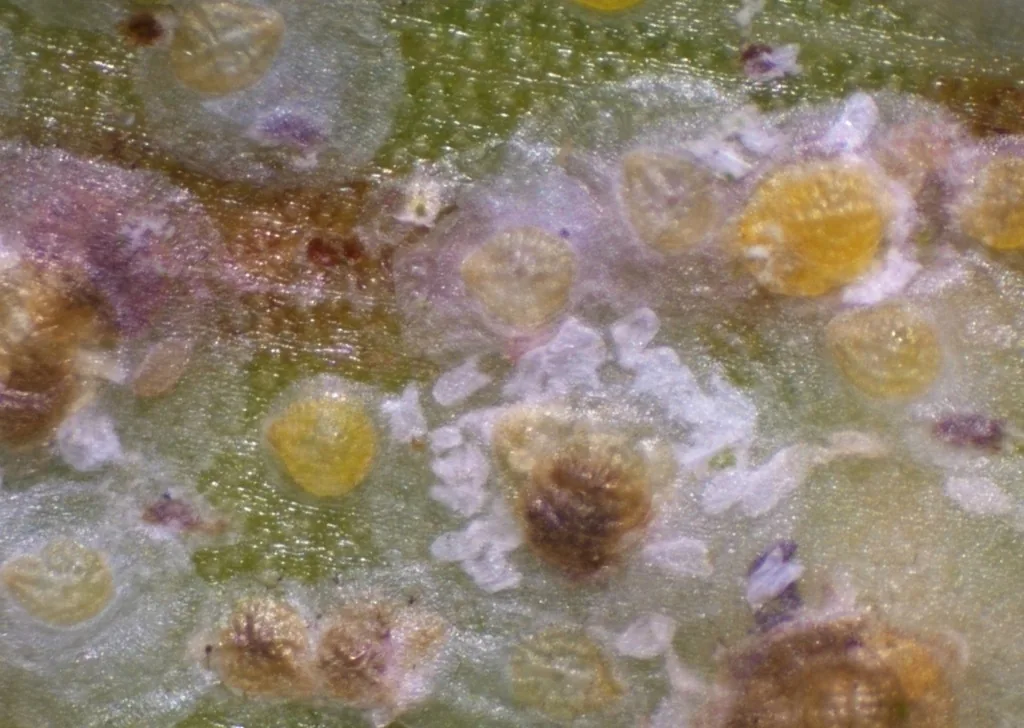
- The female's cover is round to broadly oval, 1.5 to 2.0 mm across, fairly flat, very thin and translucent, with pale yellow cast skins near the center.[1]
- Through the cover you can see the yellow, pear-shaped body of the female, and her eggs are laid under the cover.[1][3]
- Male covers are like the female's but smaller and oval. Adult males have wings but no mouthparts, so they do not feed. UF/IFAS adds that male covers turn reddish brown and more elliptical, and that adult males are small, two-winged, reddish, gnat-like insects that are short-lived.[1][3][4]
- Look for yellow or brown patches on leaves with the scales on the underside; during an outbreak virtually the entire lower leaf surface can be covered.[1][3]
- Infestations show up as closely packed colonies that resemble miniature fried eggs. Positive identification requires slide-mounting adult females and examining them at high magnification.[4]
Look-alikes
| Look-alike | How to tell them apart |
|---|---|
| Aspidiotus excisus | A closely related armored scale also recorded in Florida that looks very similar in life; telling the two apart takes a slide-mounted adult female under a microscope.[1] |
| Other armored scales | Many armored scales look alike in the field. Aspidiotus species are told apart by fine details at the tip of the abdomen, such as the lobes, wax ducts and setae, checked on slide-mounted adult females under a microscope.[1] |
Where it lives
Coconut scale is found in tropical and subtropical regions worldwide, in nearly all countries where coconuts are grown, and apparently originated in the Pacific islands. U.S. records include Florida, Georgia, Pennsylvania, Hawaii, Puerto Rico and the U.S. Virgin Islands, and Connecticut under glass; in the northern parts of its range it is found only under glass. UF/IFAS says it appears to be native to South Asia and lists U.S. records from Connecticut, Florida, Georgia, Hawaii, Pennsylvania and Puerto Rico; in more northern regions it is found only in greenhouses or other enclosed areas.[1][4]
Biology and life cycle
Females lay their eggs under the scale cover: 20 to 50 eggs over a few days by one account, about 90 over nine days by another. The crawlers that hatch settle on the plant within about 12 hours, and from then on the female stays fixed in place. UF/IFAS gives 28 to 65 eggs laid in concentric circles over 11 to 13 days, with 3 or 4 batches in a female's lifetime, and says crawlers move over the leaf for 2 to 48 hours before settling.[1][3][4]
Crawlers can walk up to about a meter, and they are carried much farther by wind, flying insects, birds, people's clothing and the movement of infested plants. UF/IFAS also lists bats among the carriers and calls crawlers the main dispersal stage within and between trees.[1][3][4]
The life cycle takes about a month: 32 to 35 days in the Pacific islands, and 44 days for females and 38 for males at room temperature in China. It breeds continuously in tropical Trinidad, has three generations a year in China and only one on tea in Japan. In a study on mango in Pakistan cited by UF/IFAS, egg to adult took 35.5 days for females and 28.5 days for males at 30°C (86°F) and 65% relative humidity, with 3 or 4 generations from July to December.[1][3][4]
It has been recorded from 75 plant genera in 44 families, and its host range is wider than that. Coconut is its favorite host; others include other palms, pandanus, banana, mango, papaya, avocado, guava, breadfruit, cacao, citrus and tea. UF/IFAS cites several hundred hosts from over 60 plant families, adding camellia, ginger, bird of paradise, sugarcane, ficus, apple, plumeria and grape.[1][3][4]
Damage and signs
- It feeds mostly on the undersides of leaves but also on frond stalks, flower clusters and young fruit. Yellow spots form under the scales, and whole leaves may yellow, brown and drop; badly affected coconut palms turn a bright yellow visible from a distance. Heavy infestations stunt new coconut leaves and can stop nut production.[1][3]
- In extreme cases on coconut, fronds drop off and the crown dies. Older palms and trees on well-drained soil are seldom seriously infested.[1]
- On many fruits it is a cosmetic pest whose blemishes lower quality. On mango it favors grafted varieties, feeding on tender shoots of nursery plants and hurting fruit set in older trees. UF/IFAS says it preferentially infests older mango leaves and blemishes the fruit skin, lowering its value, and it also reduces fruit quality on oil palm and banana.[1][4]
- It was first reported in Hawaii in 1968 on papaya, banana and apple, and UF/IFAS says it remains a pest of concern there.[4]
Health risk
The sources treat it only as a plant pest; none mentions bites or any risk to people or pets.[1][3]
Control
Prevention
Check leaf undersides with a hand lens for flat, translucent scales over yellow or brown patches, and avoid moving infested plants, which spreads the scale to new areas.[1]
Sanitation
Prune and train fruit trees and dispose of infested leaves, branches and twigs. UF/IFAS says excessive fertilizer use contributes to scale outbreaks.[4]
Biological control
Lady beetles are the most important natural enemies; Chilocorus and Cryptognatha lady beetles and Aphytis and Comperiella wasps all attack it. In Fiji, Mauritius and the New Hebrides (now Vanuatu), outbreaks on coconut continued unchecked until natural enemies were introduced. UF/IFAS counts over 40 species of parasitoids and predators, plus several fungal pathogens, and says population explosions can occur without them; Aphytis melinus and Comperiella bifasciata were introduced into Hawaii, California and other regions against it.[1][3][4]
Pesticides
University of Guam extension calls biological control the best way to control coconut scale and notes that spraying large palms or trees is impractical. For any insecticide use, ask your local extension office for current recommendations.[3]
Crawlers are the most susceptible stage. Contact insecticides, including horticultural oils, become progressively less effective once the waxy cover forms, and insect growth regulators work only when immature stages are present. UF/IFAS says a heavy infestation may need several sprays at 15 to 20 day intervals, and that the toxicity to parasitoids and other beneficial insects should be weighed before any spray program.[4]
Where the sources disagree
Origin: Diaspididae of the World says coconut scale apparently originated in the Pacific islands, while UF/IFAS says it appears to be native to South Asia.[1][4]
Eggs: Diaspididae of the World gives 20 to 50 eggs over a few days and University of Guam extension about 90 over nine days, while UF/IFAS gives 28 to 65 eggs over 11 to 13 days, in 3 or 4 batches.[1][3][4]
Crawler settling: University of Guam extension says crawlers settle within about 12 hours, while UF/IFAS says they move over the leaf for 2 to 48 hours.[3][4]
Host range: Diaspididae of the World cites a record of 75 plant genera in 44 families, while UF/IFAS cites several hundred hosts in over 60 plant families.[1][4]
Common questions
- What are the tiny see-through scales under my palm leaves?
- Coconut scale forms flat, translucent covers about 1.5 to 2 mm across with a yellowish center, often crowded on leaf undersides over yellow or brown patches.[1]
- Why are my palm's leaves turning yellow?
- Coconut scale injects toxic saliva as it feeds, causing yellow spots beneath the scales and, in heavy infestations, whole leaves that yellow, brown and drop.[1]
- Does coconut scale only attack coconut?
- No. It has been recorded from 75 plant genera in 44 families, including banana, mango, papaya, avocado, guava, breadfruit and citrus, though coconut is its favorite host.[1][3]
- Is coconut scale a quarantine pest?
- Yes, in many areas. UF/IFAS notes that gamma irradiation has been developed as a potential phytosanitary treatment for it.[4]
Sources
- Naturalis Biodiversity Center (Diaspididae of the World, with USDA scale insect data), “Diaspididae of the World 2.0: Aspidiotus destructor.” diaspididae.linnaeus.naturalis.nl/linnaeus_ng/app/views/species/taxon.php?id=113049 (accessed 2026-11-12)
- iNaturalist, “Aspidiotus destructor taxon page (order and family).” www.inaturalist.org/taxa/330219 (accessed 2026-11-09)
- University of Guam Cooperative Extension (ADAP Project), “Coconut Scale (Aspidiotus destructor Signoret), Agricultural Pests of the Pacific ADAP 2000-5.” uog.edu/_resources/files/extension/pest-management/2000-5-adap-coconut-scale.pdf (accessed 2026-11-12)
- University of Florida IFAS Extension, EDIS (Featured Creatures), “Coconut Scale, Aspidiotus destructor Signoret, EENY622/IN1084 (Featured Creatures).” ask.ifas.ufl.edu/publication/IN1084 (accessed 2026-11-14)