On this page
How to identify it
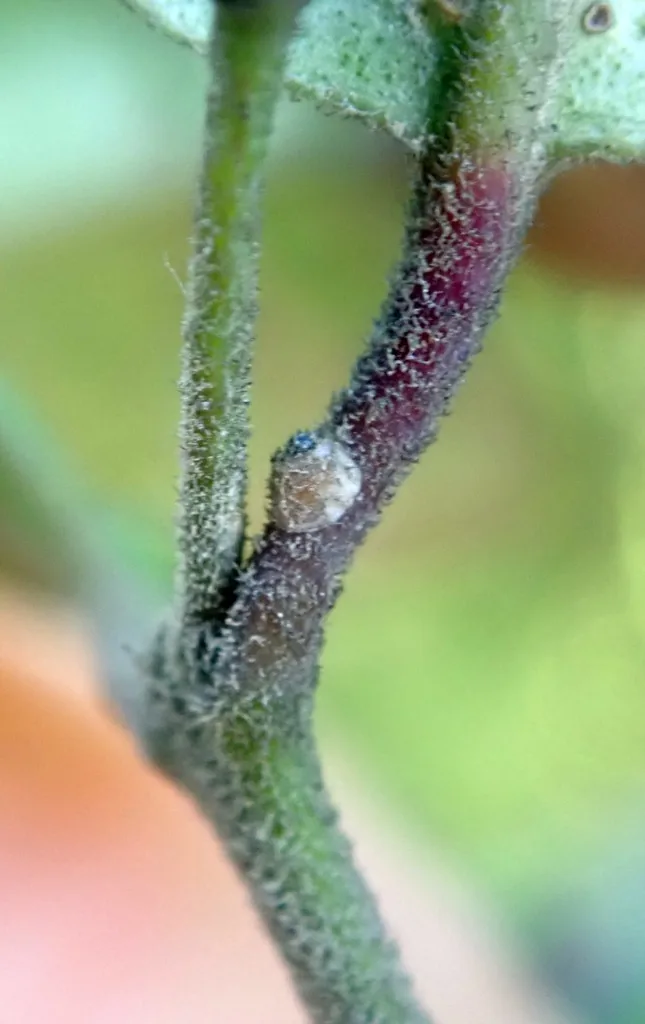
- The female's cover is circular, convex and papery, gray to tan, about 1/25 to 1/12 inch across, often with concentric rings; see where the sources disagree on where the small first-stage cover sits.[1][2]
- Once a young scale settles it never moves again, so all you see is the cover slowly getting bigger.[1]
- It usually occurs on branches and twigs, and as an infestation builds it may also be found on leaves and even fruit.[1][2]
Look-alikes
| Look-alike | How to tell them apart |
|---|---|
| Greedy scale | Greedy scale looks the same and can't be told apart from latania scale in the field; both have the same raised, round gray covers.[2] |
| Oleander scale | UC IPM says oleander scale has a flatter cover with its small darker spot near the center, while latania and greedy scales have more globular or raised covers with the spot to one side.[2][3] |
Where it lives
NC State reports it on over 160 host plants, including hollies, canna lilies and even gladiolus corms. UC IPM says it prefers broadleaved evergreens and may be more common than greedy scale in California.[1][2]
Biology and life cycle
Yellow eggs hatch within a few hours of being laid, and the crawlers stay close to the parent, settle within about eight hours, and start secreting the wax that becomes their armor.[1]
NC State says scales mature and start laying eggs in about two months. UC IPM says they overwinter as mature females that begin producing crawlers in late winter, with two or more generations a year; in California males are rarely seen and reproduction is mostly or entirely without mating.[1][2]
A Septobasidium fungus sometimes grows over colonies; it shields the scales from parasites and predators, though infected scales may be stunted.[1]
Damage and signs
- Heavy populations give plants a crusty look, and NC State says a heavy infestation can kill smaller branches.[2][1]
- UC IPM says even abundant populations have no apparent effect on plant health, except on kiwifruit, where heavy infestations reduce vine vigor and scales on the fruit get it downgraded.[2][3]
Health risk
NC State and UC IPM describe plant feeding only and don't mention any risk to people or pets.[1][2]
Control
Biological control
Natural enemies usually keep latania scale in check: NC State credits the parasitic wasp Aphytis diaspidis and the twicestabbed lady beetle, and UC IPM adds lacewings, minute pirate bugs and other lady beetles. To help them, UC IPM says to control ants, hose off dust and avoid persistent broad-spectrum insecticides.[1][2]
Pesticides
Where natural enemies fail, horticultural oil gives control. NC State advises a second application two weeks after the first to catch scales that were still eggs, and notes oil can help loosen the Septobasidium fungus; UC IPM says to spray infested foliage and shoots thoroughly when crawlers are active in late winter or spring.[1][2]
Where the sources disagree
First-stage cover: NC State says it stays more or less in the center of the mature cover; UC IPM says the small, darker raised spot sits to one side.[1][2]
Harm to plants: NC State says heavy infestations can kill smaller branches; UC IPM says even abundant populations have no apparent effect on plant health except on kiwifruit.[1][2]
Common questions
- What are the small gray bumps crusting my holly twigs?
- They may be latania scale or another armored scale; the round, gray to tan covers stay put, and each hides a scale feeding on the plant's sap.[1][2]
- Do I need to spray latania scale?
- Often not. Parasitic wasps and lady beetles usually keep it in check, and UC IPM says even large populations rarely harm plant health outside kiwifruit; if you do treat, horticultural oil works when timed to active crawlers.[2][1]
Sources
- NC State Extension, “Latania Scale Insect (PDIC Factsheet).” content.ces.ncsu.edu/latania-scale-insect (accessed 2026-11-13)
- University of California Statewide IPM Program, “Greedy scale and latania scale (Home and Landscape).” ipm.ucanr.edu/home-and-landscape/greedy-scale/ (accessed 2026-11-13)
- University of California Statewide IPM Program, “Kiwifruit Pest Management Guidelines: Armored Scales (UC ANR Publication 3449).” ipm.ucanr.edu/agriculture/kiwifruit/armored-scales (accessed 2026-11-13)
- Global Biodiversity Information Facility (GBIF), “Hemiberlesia lataniae (Signoret, 1869) (GBIF Backbone Taxonomy).” api.gbif.org/v1/species/2083970 (accessed 2026-11-13)
- iNaturalist, “Hemiberlesia lataniae taxon page (order and family).” www.inaturalist.org/taxa/330222 (accessed 2026-10-06)