On this page
How to identify it
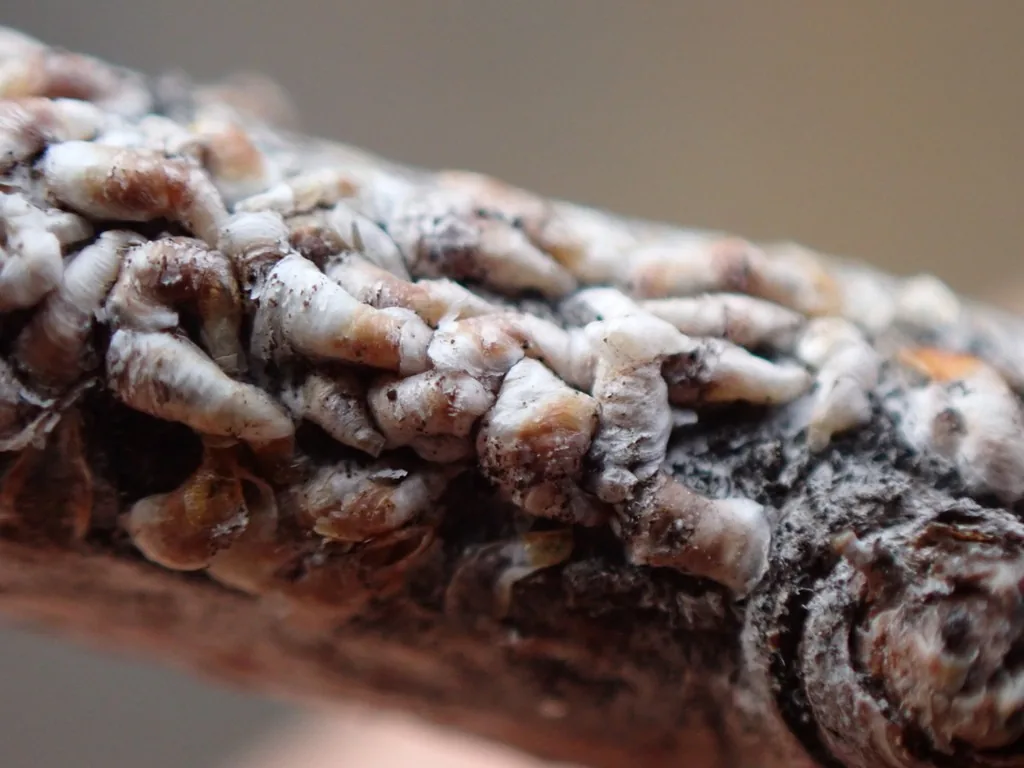
- The covers look like miniature oyster shells. Minnesota Extension describes them as purplish-gray and about 1/8 inch (3 mm) long; Penn State says grayish brown and about 2.5 mm.[2][1]
- As armored scales, they match the bark color and produce no honeydew.[2]
- Tiny white eggs sit under the female's cover. Crawlers are pale yellow and less than 1 mm long, and the small winged males are often mistaken for parasitic wasps as they walk over twigs.[1]
Look-alikes
| Look-alike | How to tell them apart |
|---|---|
| Other scale insects | Scale species differ in timing, so identify the species to know when crawlers are active.[2] |
Where it lives
First described in Europe in 1758, it occurs throughout the United States and is more common in northern states. Lilac, ash, dogwood, maple, poplar and willow are usual hosts, along with apple, birch and cotoneaster, and it has been reported on more than 130 host plants.[1][2]
Biology and life cycle
Eggs overwinter under the dead mother's cover; Penn State cites 20 to 100 eggs per female. Crawlers hatch in late May to early June, wander briefly, then settle on branches and trunks to feed.[2][1]
Minnesota says nymphs mature in midsummer and Penn State in late summer or early fall; males are active from late June through early July, and new eggs are laid in late summer to early fall. Both describe one generation a year.[2][1]
A study on aspen in northern Arizona found two waves of crawlers, one through the summer and another in midwinter; the authors say the second wave might be a second generation.[3]
Damage and signs
Health risk
Scales feed only on plants; neither Minnesota nor Penn State Extension describes a risk to people.[2][1]
Control
Prevention
Check for crawlers by tapping branches over white paper or wrapping double-sided tape around twigs.[2]
Sanitation
Prune out and destroy heavily infested twigs and branches.[1]
Biological control
Many tiny parasitic wasps, some lady beetles and predatory mites feed on oystershell scale, though their work is usually more noticeable once a heavy infestation has developed.[1]
Pesticides
Spray insecticidal soap or horticultural oil when crawlers are active, in late May and early June in Minnesota and Pennsylvania. Penn State notes that oil aimed at the crawlers during the growing season conserves natural enemies.[2][1]
Dormant oil doesn't work on species that overwinter as eggs, like this one.[2]
A threat to aspen in the Southwest
Researchers describe oystershell scale as an invasive insect threatening aspen in the southwestern United States. In infested aspen stands in northern Arizona, about 10% of trees died each year, and the scale spread to 10 to 12% more trees a year.[3]
Common questions
- What are the tiny gray shells crusting my lilac?
- Probably oystershell scale, shaped like miniature oyster shells.[2]
- When should I spray?
- When crawlers hatch, typically late May to early June in Minnesota and Pennsylvania. Check for them by tapping branches over white paper or wrapping double-sided tape around twigs.[2][1]
Sources
- Penn State Extension, “Oystershell Scale.” extension.psu.edu/oystershell-scale (accessed 2026-11-13)
- University of Minnesota Extension, “Scale insects (Yard and garden insects).” extension.umn.edu/garden-and-home/yard-and-garden/yard-and-garden-insects/scale-insects (accessed 2026-11-13)
- Environ Entomol 2024;53(2):293-304, via PubMed, “Oystershell scale (Hemiptera: Diaspididae) population growth, spread, and phenology on aspen in Arizona, USA (2024).” pubmed.ncbi.nlm.nih.gov/38306466/ (accessed 2026-11-13)
- Global Biodiversity Information Facility (GBIF), “Lepidosaphes ulmi (Linnaeus, 1758) (GBIF Backbone Taxonomy).” api.gbif.org/v1/species/8387962 (accessed 2026-11-13)
- iNaturalist, “Lepidosaphes ulmi taxon page (order and family).” www.inaturalist.org/taxa/391478 (accessed 2026-10-06)