On this page
How to identify it
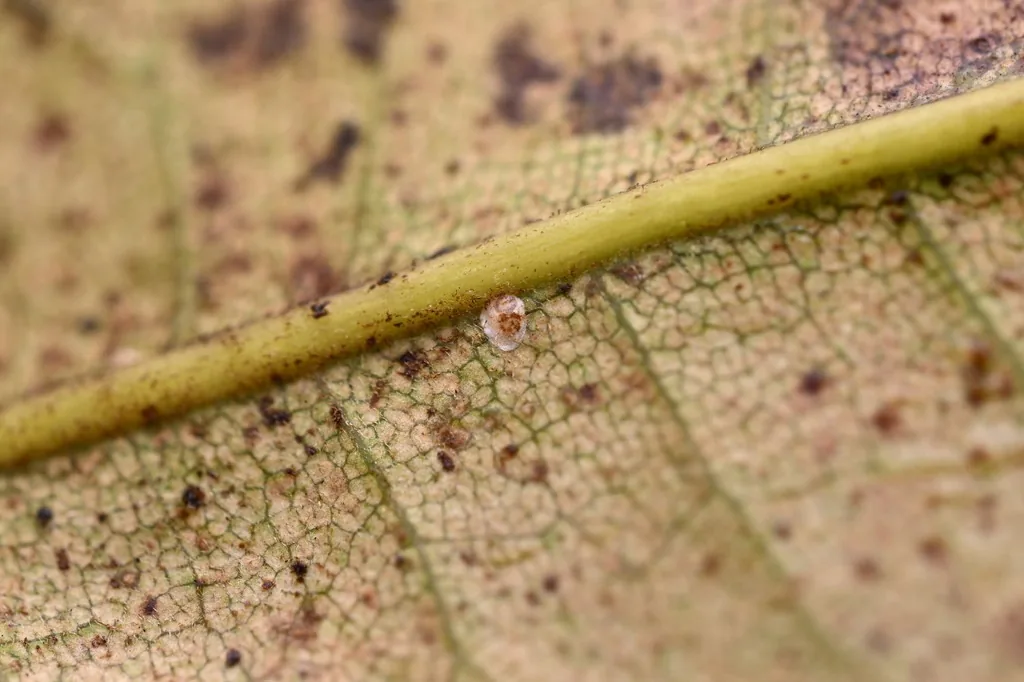
- The adult female's cover is about 1 to 2 mm across, round to somewhat elongate and domed, and gray to white or brown.[2][1]
- The cover shows concentric rings from the shed skins of earlier stages, with a yellow-brown spot (the old skins) usually slightly off center.[1][2]
- Lift a cover and the female underneath is a bright yellow blob about 1/16 inch long, with long, very slender mouthparts set into the plant.[1][2]
- Male covers are similar but smaller and more oval.[2]
- Look first on the bark of the trunk and limbs; in heavy infestations the scales spread to leaf axils and fruit. Like other armored scales it makes no sticky honeydew.[2][3]
Look-alikes
| Look-alike | How to tell them apart |
|---|---|
| Latania scale | Very hard to tell from greedy scale in the field. Separating the two, and the similar diffinis scale, takes a slide-mounted female under a microscope.[2] |
| Putnam scale (Diaspidiotus ancylus) | Often confused with greedy scale, but its shed skins are paler; greedy scale's are darker.[2] |
| Oleander scale (Aspidiotus nerii) | Looks similar on the plant, but its cover is flatter than greedy scale's.[2] |
Where it lives
Greedy scale is found worldwide and is a major pest mainly in tropical and subtropical regions. In the United States it is a frequent pest of pecan in Florida and an occasional pest of ornamentals in California, and it has at least two generations a year in North Carolina.[1][2]
Biology and life cycle
Each female lays a cluster of 30 to 50 yellow eggs under her cover.[1][2]
Newly hatched crawlers are the only mobile stage besides adult males. Wind blows them around, and insects and birds carry them from plant to plant; once a crawler settles and starts feeding, it never moves again.[1][2]
Settled scales and eggs travel long distances on infested plants moved by people.[2]
Outdoors there are two or more generations a year, at least two in North Carolina, and in greenhouses the scale breeds continuously. Some populations, such as those in California, reproduce without males, while others have both sexes.[1][2]
It has been recorded on hosts in 117 genera in 60 plant families. NC State lists hosts including Abelia, azalea, bays, burning bush, camellia, chinaberry, Elaeagnus, fig, geranium, hollies, honeysuckle, mulberry, junipers, oak, pear, pecan, persimmon, privet, rhododendron, rose, wax myrtle and yew; UC IPM adds acacia, boxwood, ceanothus, ivy, magnolia, manzanita, palm, pittosporum, pyracantha, redbud, willow and others.[2][1][3]
Damage and signs
- The scales suck juice from stems and leaves. Heavy infestations cause yellowing leaves, dead patches, early leaf drop, dieback of stems and growing tips, and discolored fruit that drops early.[1][2]
- How much it matters depends on where you are: UC IPM rates greedy scale as generally not damaging in California landscapes, while NC State describes it as a pest of woody ornamentals and fruits.[3][1]
- Because scale insects are quarantine pests, infested fruit such as kiwifruit and blueberries can be refused for export. In a 2007 survey of New Zealand kiwifruit, 43% of 3,418 armored scales identified were greedy scale.[2][4]
Health risk
It feeds on plant sap, and no cited source describes any risk to people or pets.[1][2][3]
Control
Prevention
Inspect the bark of trunks and limbs, and the leaf axils, closely in strong light to find the small covers, and check new plants before bringing them home, since settled scales travel on nursery stock.[2]
If a plant keeps getting badly infested, UC IPM suggests replacing it with a pest-resistant species better suited to the site.[3]
Biological control
Encarsia citrina and other tiny parasitic wasps help keep greedy scale in check, except where bad weather or insecticides applied for other pests wipe the wasps out, so sprays aimed at other pests can undo this natural control. UC IPM advises checking whether many scales are already dead or parasitized before deciding to spray.[1][3]
Pesticides
NC State calls horticultural oils appropriate for armored scales and says they leave little toxic residue to threaten the beneficial insects and mites that prey on scales; UC IPM says these oils have relatively little adverse impact on pollinators and natural enemies.[1][3]
Timing and coverage matter: spray thoroughly during the dormant season or soon after crawlers become active, wetting all the infested bark, because armored scales are less susceptible to pesticides than other scales. UC IPM notes soil-applied imidacloprid is not effective against armored scales.[3]
Where the sources disagree
How much it matters: UC IPM rates it generally not damaging in California, NC State calls it a pest of woody ornamentals and fruits, and Diaspididae of the World calls it a major pest mainly in tropical and subtropical regions while noting it is of little economic importance in Italy.[3][1][2]
Cover color: NC State says brown or grayish to white, Diaspididae of the World gray to white.[1][2]
Origin: Diaspididae of the World says it is thought to be native to Europe, though it was originally described from North America.[2]
Males: Diaspididae of the World notes that males were not known in California, where it reproduces without them, while other authors described both sexes.[2]
Kiwifruit: greedy scale was the dominant armored scale on Hayward kiwifruit in New Zealand's North Island in a 1988 survey, but by 2007 latania scale had displaced it.[4]
Common questions
- What are the tiny gray dots crusting my holly or camellia stems?
- They may be greedy scale, an armored scale with small, round, gray to white covers marked by a yellow-brown off-center spot. It infests hollies, camellias and hundreds of other woody plants.[1][2]
- How do greedy scales spread to new plants?
- The tiny crawlers blow in the wind or ride on insects and birds, and settled scales travel on infested plants that people move.[1][2]
- Can I tell greedy scale from latania scale myself?
- Not reliably. The two look nearly the same, and an expert needs a slide-mounted female under a microscope to separate them; New Zealand researchers built a DNA test partly because immature stages can't be told apart by eye.[2][4]
- Will a systemic insecticide drench kill greedy scale?
- UC IPM says soil-applied imidacloprid is not effective against armored scales such as this one; a well-timed horticultural oil spray is the usual choice.[3]
Sources
- NC State Extension, “Greedy Scale Insect (PDIC Factsheet).” content.ces.ncsu.edu/greedy-scale-insect (accessed 2026-11-13)
- Naturalis Biodiversity Center (Diaspididae of the World, with USDA scale insect data), “Diaspididae of the World 2.0: Hemiberlesia rapax.” diaspididae.linnaeus.naturalis.nl/linnaeus_ng/app/views/species/taxon.php?id=113086 (accessed 2026-11-13)
- University of California Statewide IPM Program, “Pest Notes: Scales.” ipm.ucanr.edu/home-and-landscape/scales/ (accessed 2026-11-13)
- Journal of Economic Entomology 101(6), 2008, via PubMed, “DNA diagnostics of three armored scale species on kiwifruit in New Zealand.” pubmed.ncbi.nlm.nih.gov/19133478/ (accessed 2026-11-13)
- Global Biodiversity Information Facility (GBIF), “Hemiberlesia rapax (Comstock, 1881) (GBIF Backbone Taxonomy).” api.gbif.org/v1/species/7936811 (accessed 2026-11-13)