On this page
How to identify it
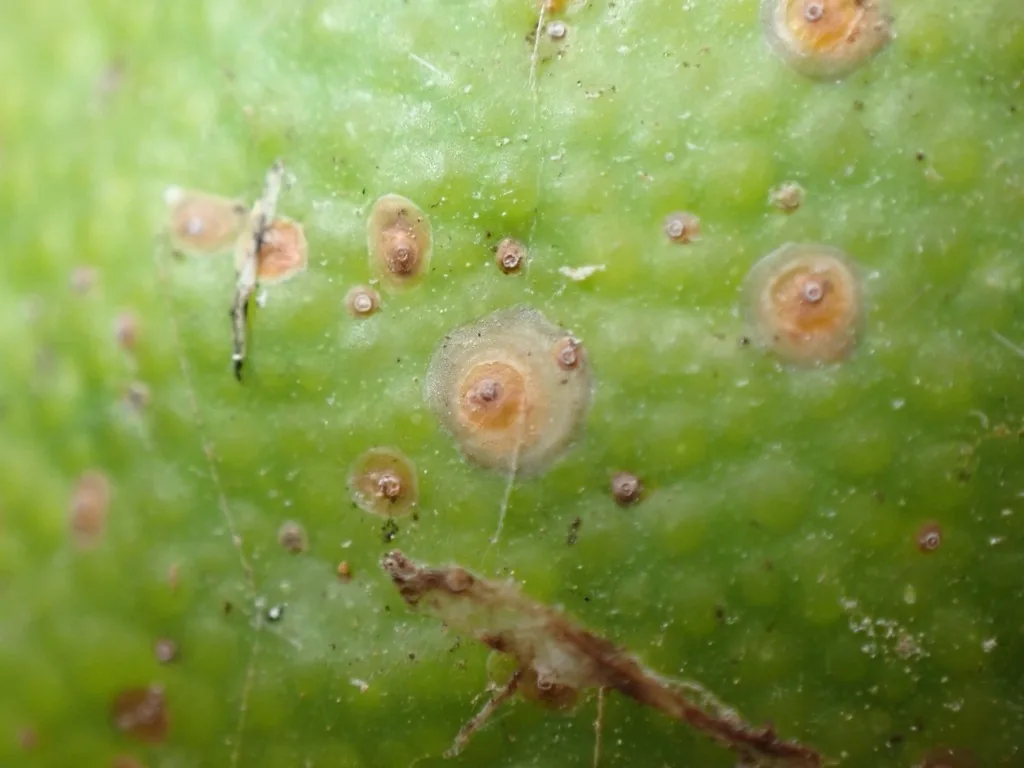
- Adult females look like reddish-brown spots or scabs about 1/10 inch across on fruit, stems and leaves. UC IPM compares the round cover to the blunt end of a nail. UF/IFAS describes the female as wingless, 0.06 to 0.08 inch long, under a red-brown to red-gray roundish cover attached to the leaf, which she stays under for life.[1][2][7]
- Each time the female molts, a concentric ring forms in the center of her waxy cover. Male covers are elongated instead of round. After the female dies the cover stays in place, which UF/IFAS says is why scales may still be present after an insecticide application.[2][7]
- Crawlers are yellow. They settle in small depressions on twigs, fruit or leaves, start feeding, and soon form a circular waxy cover.[1][2]
Look-alikes
| Look-alike | How to tell them apart |
|---|---|
| Yellow scale | The two are hard to tell apart by appearance, but yellow scale is rarely found on mature wood, while California red scale also infests wood. UC IPM says yellow scale has not been seen in California in recent years.[2] |
| Purple scale | Purple scale is elongate, slightly curved and purple to dark brown, 1/12 to 1/8 inch long, rather than round and reddish.[1] |
| Florida red scale | Florida red scale has a circular cover of three concentric rings, dark reddish-brown with a conspicuous light brown center, about 1/12 inch across.[1] |
Where it lives
ScaleNet lists it from 135 countries. U.S. records include Alabama, California, Florida, Georgia, Mississippi and Texas, and it is found throughout California's citrus regions except parts of the Coachella Valley, where it is under eradication. Clemson HGIC covers it on citrus grown in South Carolina, and it is a citrus pest in Australia as well.[3][2][1][4]
Biology and life cycle
Females give birth to live young: each produces 100 to 150 crawlers, which emerge two to three a day. Crawlers can be carried by wind, birds or picking crews before they settle.[2][1][3]
Adult males are tiny two-winged insects that emerge from their elongated covers after four molts and live about 6 hours, only to mate. California sees about four male flights a year, though the number of generations varies with region and weather. UF/IFAS describes adult males as small, fragile and short-lived.[2][7]
Hot summers add a generation, and a warmer climate plus pesticide resistance have raised the number of generations and population densities in central California.[2][5]
ScaleNet lists hosts in 91 plant families and 209 genera.[3]
Damage and signs
- Severe infestations cause leaf yellowing and drop, dieback of twigs and limbs, and occasionally the death of the tree. Damage is most likely in late summer and early fall, when scale numbers are highest and the tree is most moisture-stressed. UF/IFAS says it feeds on twigs, leaves, branches and fruit, and that damage to fruit is mainly cosmetic.[1][2][7]
- Heavily infested fruit may be downgraded at the packinghouse.[2]
Health risk
It feeds only on plants; none of these sources reports any risk to people or pets.[1][2]
Control
Prevention
Help natural enemies by controlling ants, cutting down dust on leaves, and pruning the inside of the tree open so parasites can reach the scales.[2]
Biological control
Parasitic wasps, especially Aphytis melinus, A. lingnanensis and Comperiella bifasciata, and lady beetles such as Rhyzobius lophanthae and Chilocorus species attack it. In Australia six primary parasitoids of red scale have been identified.[2][4]
Pesticides
Horticultural oil kills all scale stages present and spares most beneficials because it leaves little residue. Clemson advises an oil spray before new growth in late winter or early spring when it's above 45 °F, or sprays any time temperatures are between 45 and 85 °F, with a weaker mix when fruit is on the tree; follow the label. UC IPM calls oil the most selective pesticide for armored scales.[1][2]
Ordinary contact insecticides kill only the crawlers, because they can't get through the hard cover on adults, and they also kill natural enemies; use them only when crawlers are present. UF/IFAS says crawlers, the only mobile stage of females, are the stage most susceptible to contact insecticides.[1][7]
When to call a professional
In commercial orchards, pheromone mating disruption cut male trap catches by an average of 90% and twig and leaf infestations by 95% in central California trials, and it is compatible with biological control. Some San Joaquin Valley populations resist organophosphates, carbamates and pyriproxyfen.[5][2]
Where sources disagree
Natural enemies: Clemson HGIC says naturally occurring parasites may help control some scales outdoors in South Carolina, while UC IPM says natural enemies can give good control in every California region except the Coachella Valley. UF/IFAS says California red scale is usually well controlled by natural enemies and that broad-spectrum insecticides are therefore not recommended.[1][2][7]
Size: Clemson and UC IPM describe adult females about 1/10 inch across; UF/IFAS gives 0.06 to 0.08 inch long.[1][2][7]
Crawlers per female: UC IPM gives 100 to 150; UF/IFAS gives 150 to 200.[2][7]
Common questions
- What are the reddish scabs on my citrus fruit?
- They may be California red scale, which shows as small reddish-brown spots or scabs about 1/10 inch across on fruit, stems and leaves.[1][2]
- When is California red scale damage worst?
- Late summer and early fall, when scale numbers and moisture stress on the tree are highest.[1][2]
- Why are scales still on my citrus after spraying?
- The female's cover stays attached after she dies, so dead scales can remain on the tree. UF/IFAS adds that contact insecticides work best on crawlers, the only mobile stage of females.[7]
Sources
- Clemson Cooperative Extension, Home & Garden Information Center, “Citrus Insects & Related Pests (HGIC 2221).” hgic.clemson.edu/factsheet/citrus-insects-related-pests/ (accessed 2026-11-11)
- University of California Statewide IPM Program, “California Red Scale and Yellow Scale (Citrus: Agriculture Pest Management Guidelines).” ipm.ucanr.edu/agriculture/citrus/california-red-scale-and-yellow-scale/ (accessed 2026-11-11)
- ScaleNet, USDA ARS Systematic Entomology Laboratory and collaborators, “Aonidiella aurantii (ScaleNet catalogue: distribution, hosts, biology).” scalenet.info/catalogue/Aonidiella%20aurantii/ (accessed 2026-11-11)
- Insect Science, via PubMed, “Primary parasitoids of red scale (Aonidiella aurantii) in Australia and a review of their introductions from Asia (Dao et al. 2017).” pubmed.ncbi.nlm.nih.gov/26350302/ (accessed 2026-11-11)
- Journal of Economic Entomology, via PubMed, “Mating Disruption of the California Red Scale, Aonidiella aurantii, in Central California Citrus (Grafton-Cardwell et al. 2021).” pubmed.ncbi.nlm.nih.gov/34608491/ (accessed 2026-11-11)
- iNaturalist, “Aonidiella aurantii taxon page (order and family).” www.inaturalist.org/taxa/60926 (accessed 2026-10-06)
- University of Florida IFAS Extension, EDIS, “Citrus Pest Quick Guide: California Red Scale (Aonidiella aurantii), ENY2092/IN1384.” ask.ifas.ufl.edu/publication/IN1384 (accessed 2026-11-14)