On this page
How to identify it
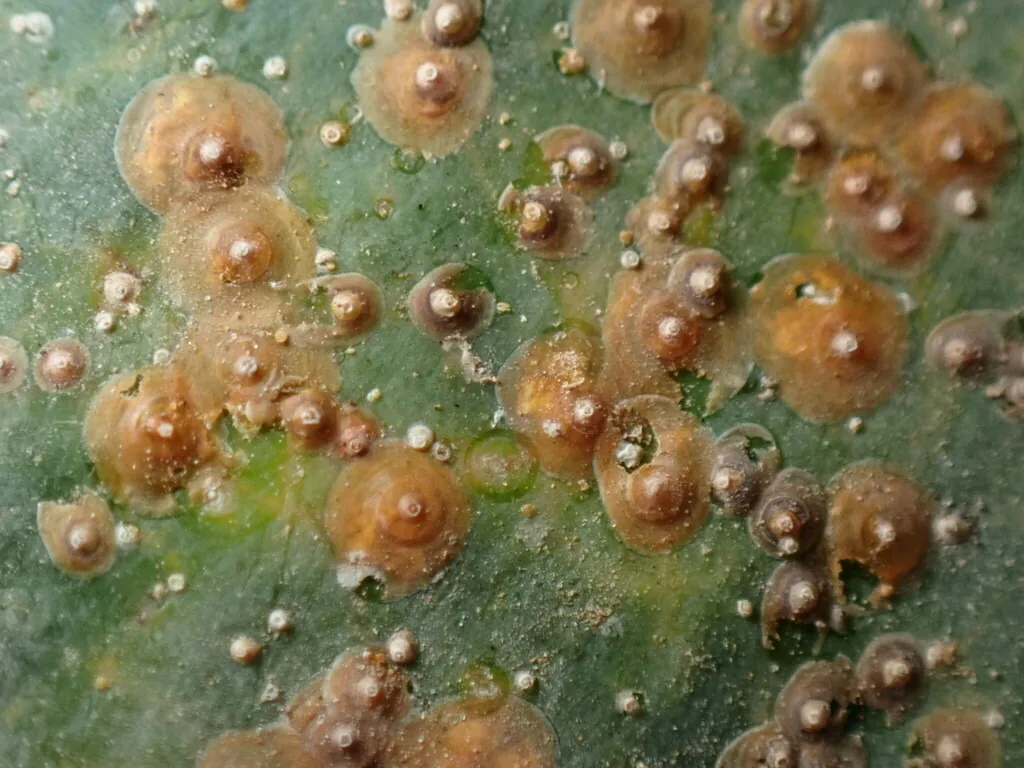
- The female's cover is nearly circular, flat and 1.5 to 2.0 mm across, grayish or reddish-brown and often with a coppery tinge, with a yellow or white spot in the center.[1]
- Male covers look similar but are elongate-oval, with the pale spot near one end.[1]
- The living female under the cover is yellow.[1]
- It is found mostly on leaves, sometimes on fruit and occasionally on branches.[1]
Look-alikes
| Look-alike | How to tell them apart |
|---|---|
| California red scale (Aonidiella aurantii) | Can be confused with dictyospermum scale in the field; a sure identification requires a slide-mounted adult female examined under a microscope.[1] |
Where it lives
Probably native to southern China, it is now widespread in tropical and subtropical regions and lives under glass in temperate areas. In the United States it has been recorded from Florida and Hawaii to many northern states, and in California it is found only in greenhouses or indoors. It also occurs in Mexico, South America (including Peru) and the Mediterranean.[1][2][4]
Biology and life cycle
Males and females mate, and in the tropics reproduction is continuous. California populations have 3 or 4 overlapping generations a year; in Egypt there are only two.[1]
Crawlers move to new parts of the plant or are carried by wind or animals, and many die at this stage. Settled adults and eggs travel to new places on infested plants moved by people.[1]
It is very polyphagous. Diaspididae of the World gives a host list spanning 73 plant families, and ScaleNet records hosts in 85 families and 213 genera. Palms, dracaena and citrus are favorites; other hosts include agave, aloe, anthurium, camellia, papaya, cycads, crotons, orchids, mango and avocado.[1][2]
ScaleNet notes populations in the USA reported to reproduce both with and without males. On avocado in Mexico it was most common on branches, though also on leaves (both surfaces) and fruit.[2]
Other common names include Spanish red scale and Morgan's scale.[2]
UF/IFAS lists dictyospermum scale among the armored and soft scales that infest mango in Florida, found on the upper or lower surfaces of leaves and also on fruit.[5]
Damage and signs
- Its toxic saliva yellows the leaves, and heavy infestations can cover a tree and cause branches to dry out and die.[1]
- It is known mainly as a serious citrus pest. It is a minor pest of citrus, palms and young avocado trees in Mexico and South America, a pest of olive in parts of southern Europe and Turkey, and it could become a serious pest of palms in U.S. greenhouses.[1]
- In southern coastal Peru intense infestations have occurred on avocado trees, and a 2025 survey found it on avocados and grapes. In Egypt it was among the armored scales found on ornamental plants in public gardens in Alexandria.[4][6]
Health risk
The sources treat it only as a plant pest; none mentions bites or any risk to people or pets.[1][3]
Control
Prevention
Examine the leaves of host plants, especially new ones, for flat, round, grayish or coppery covers with a pale center; the scale spreads mostly on infested plants.[1]
Traps and physical control
On small plants, prune off heavily infested twigs and branches if the infestation is limited to a few parts.[3]
Biological control
Many natural enemies attack it, including Aphytis wasps (such as Aphytis chrysomphali), Comperiella and Encarsia parasitoids and the lady beetle Rhyzobius lophanthae. Conserve them by avoiding persistent broad-spectrum insecticides, and check whether many scales are already dead or parasitized before treating. On mango, UF/IFAS notes, scales are frequently parasitized by small wasps.[1][2][3][5]
Pesticides
A thorough horticultural oil spray during the dormant season or when crawlers are active controls most scales. The systemic insecticide imidacloprid does not control armored scales like this one.[3]
Where sources disagree
Where it settles: Diaspididae of the World says it is found mostly on leaves, sometimes on fruit; on avocado in Mexico ScaleNet reports it most common on branches.[1][2]
Host range: Diaspididae of the World gives 73 plant families; ScaleNet lists 85 families.[1][2]
Common questions
- What are the round, coppery scales on my palm or dracaena?
- Dictyospermum scale forms flat, nearly circular, grayish to reddish-brown covers about 1.5 to 2 mm across, often with a coppery tinge and a pale center, mostly on leaves.[1]
- Does dictyospermum scale make honeydew?
- No. It is an armored scale, and armored scales do not produce sticky honeydew.[3]
- Why didn't my imidacloprid treatment work on this scale?
- Imidacloprid controls soft scales but not armored scales such as dictyospermum scale; well-timed horticultural oil sprays are the usual option.[3]
- Does dictyospermum scale attack mango?
- Yes. UF/IFAS lists it among the scales that infest mango in Florida, on the upper or lower leaf surfaces and on the fruit, and notes that scales on mango are frequently parasitized by small wasps.[5]
Sources
- Naturalis Biodiversity Center (Diaspididae of the World, with USDA scale insect data), “Diaspididae of the World 2.0: Chrysomphalus dictyospermi.” diaspididae.linnaeus.naturalis.nl/linnaeus_ng/app/views/species/taxon.php?id=113063 (accessed 2026-11-14)
- ScaleNet (Garcia Morales et al., scale insect database), “ScaleNet catalogue: Chrysomphalus dictyospermi (Morgan).” scalenet.info/catalogue/Chrysomphalus%20dictyospermi/ (accessed 2026-11-14)
- University of California Statewide IPM Program, “Pest Notes: Scales (UC ANR Publication 7408).” ipm.ucanr.edu/home-and-landscape/scales/ (accessed 2026-11-14)
- ZooKeys (2025), via PubMed Central, “A survey of scale insects (Hemiptera, Coccoidea) on avocados, olives, and grapes in the Peruvian region of Arequipa.” pmc.ncbi.nlm.nih.gov/articles/PMC12587173/ (accessed 2026-11-14)
- University of Florida/IFAS Extension (EDIS), “Mango Pests and Beneficial Insects, ENY-413/IG073 (D. Carrillo, R. Duncan and J. Peña).” ask.ifas.ufl.edu/publication/IG073 (accessed 2026-11-14)
- Mededelingen Rijksuniversiteit Gent (2001), via PubMed, “Survey of scale insects of ornamental plants in Alexandria Governorate, Egypt.” pubmed.ncbi.nlm.nih.gov/12425080/ (accessed 2026-11-14). Cited from the PubMed abstract.
- iNaturalist, “Chrysomphalus dictyospermi taxon page (order and family).” www.inaturalist.org/taxa/917295 (accessed 2026-11-14)