On this page
How to identify it
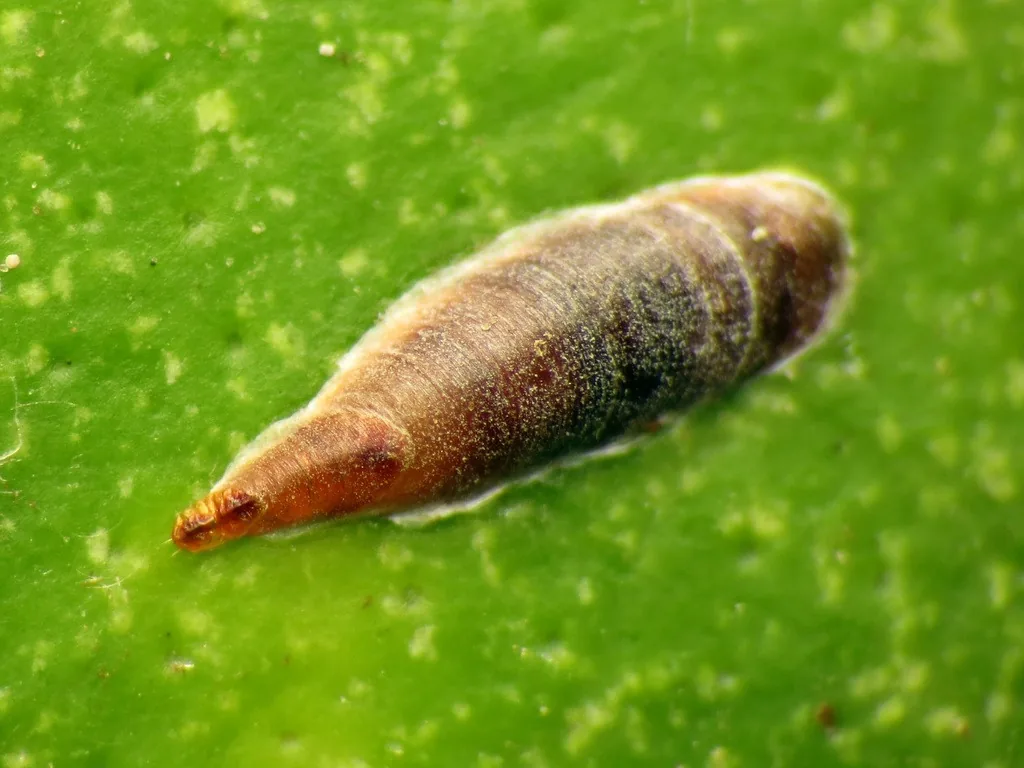
- Adult females are small, elongate, 1/12 to 1/8 inch long, purple to dark brown and slightly curved. Adult males are smaller.[1]
- Fruit shows green spots that don't color properly, and leaves get yellow spots.[1]
- Like other armored scales, it makes no honeydew, so there is no sticky residue or sooty mold. The insect lives under a hard cover and stays on the plant if the cover is lifted off.[2]
- A round hole in the cover means a parasitic wasp has emerged. Lifting such a cover shows the shriveled skin of the dead scale.[3]
Look-alikes
| Look-alike | How to tell them apart |
|---|---|
| California red scale | California red scale appears as round, reddish-brown spots or scabs about 1/10 inch across, rather than elongate, curved purple scales.[1] |
| Citrus snow scale | Female snow scales are brownish purple and oyster-shell shaped too, but heavy infestations cover bark and larger limbs with white winged males, giving a snowy look.[1] |
Where it lives
UC Riverside's Legner describes it as a destructive citrus pest worldwide, apparently of Asian origin, with past problems in Central and South America, the Mediterranean, South Africa, Australia, Hawaii, Florida, Texas and California. Clemson covers it on citrus in South Carolina.[4][1]
Biology and life cycle
Mobile immatures (crawlers) are tiny and white. Clemson says there may be two generations a year in South Carolina; UC IPM notes that most armored scales have several generations a year.[1][2]
It prefers shady, protected parts of the tree, so numbers are highest toward the center, where the dense canopy shelters it from parasites.[1]
Sources differ on hosts. UC IPM says it has hosts in at least 56 plant genera, mostly woody plants, while Legner's UC Riverside account calls it highly specific to citrus and rarely found on other plants.[3][4]
Damage and signs
- It causes leaf yellowing and drop, spotted or deformed fruit and shoot malformation, and heavy infestations can kill plants.[1]
Health risk
It feeds on citrus. None of the cited sources describes any risk to people or pets.[1][2]
Control
Biological control
The parasitic wasp Aphytis lepidosaphes, native to China and Taiwan, was introduced to California in 1948 and later to Florida, Louisiana, Texas and other places. Legner reports complete biological control in most places it was moved to; Clemson says these parasites may not yet be present in South Carolina.[3][4][1]
Protect natural enemies: control ants, which attack them, hose dust off small plants, and avoid broad-spectrum, persistent insecticides.[3]
Pesticides
Horticultural oil kills the scale stages it covers. Clemson advises spraying before new growth in late winter or early spring when it is above 45°F; UC IPM says late spring and summer, soon after most crawlers have emerged, is the time to spray citrus and other broadleaf evergreens. Don't spray oil when it is freezing, over 90°F or very humid.[1][2]
Soil-applied imidacloprid, a systemic sometimes used on large plants for scales, is not effective against armored scales such as this one, UC IPM notes, and may cause cottony cushion scale outbreaks.[2]
Monitoring
Before spraying, check whether many scales are already dead or parasitized (they don't ooze fluid when squished). If so, hold off and check again later.[2]
Common questions
- Why does my citrus fruit have green spots that won't color?
- Purple scale feeding causes green spots on fruit that don't color correctly.[1]
- Where should I look for purple scale?
- Toward the shady center of the tree, where it hides from parasites.[1]
- Does purple scale need spraying?
- Often not where its parasitic wasp is established; UC IPM rates it not damaging in California for that reason. Where it builds up, horticultural oil is the usual spray.[2][1]
Sources
- Clemson Cooperative Extension, Home & Garden Information Center, “Citrus Insects & Related Pests (HGIC 2221).” hgic.clemson.edu/factsheet/citrus-insects-related-pests/ (accessed 2026-11-13)
- University of California Statewide IPM Program, “Pest Notes: Scales (Home and Landscape).” ipm.ucanr.edu/home-and-landscape/scales/ (accessed 2026-11-13)
- University of California Statewide IPM Program, “Purple Scale Aphytis Parasitoid (Natural Enemies Gallery).” ipm.ucanr.edu/natural-enemies/purple-scale-aphytis-parasitoid/ (accessed 2026-11-13)
- University of California, Riverside, “Biological Control of Purple Scale (E. F. Legner, Biological Control course pages).” faculty.ucr.edu/~legneref/biotact/ch-89.htm (accessed 2026-11-13)
- Global Biodiversity Information Facility (GBIF), “Lepidosaphes beckii (Newman, 1869) (GBIF Backbone Taxonomy).” api.gbif.org/v1/species/2089006 (accessed 2026-11-13)