On this page
How to identify it
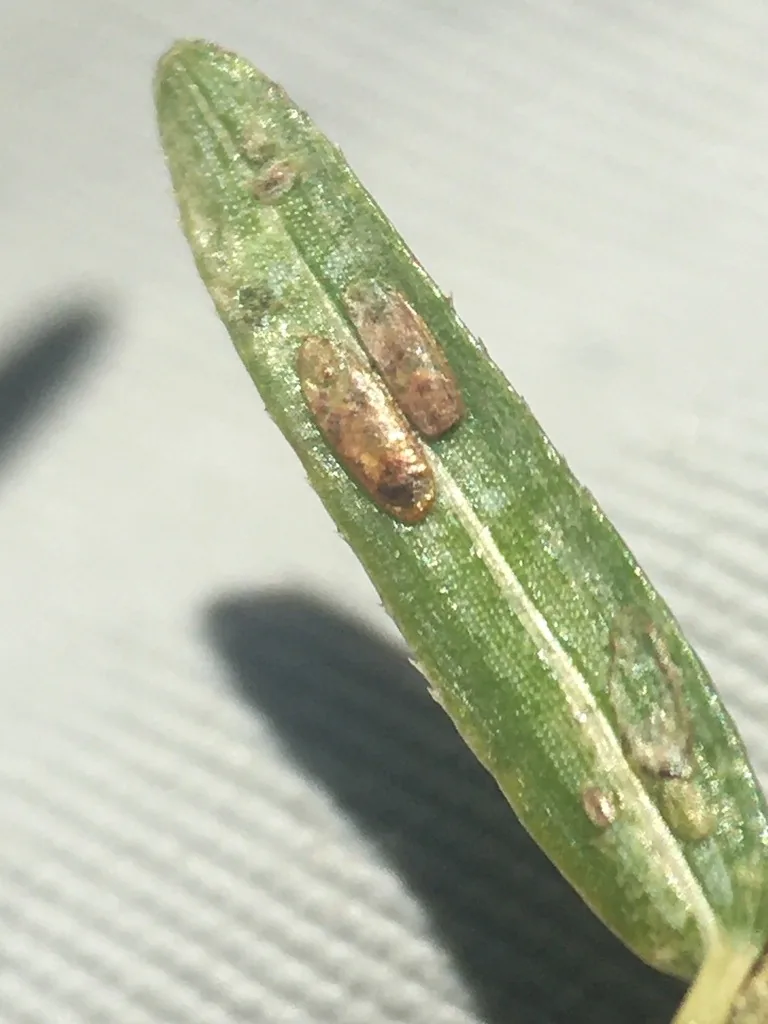
- Females are about 1/20 inch with an oblong orange-brown to brown cover; males are smaller with white covers.[1]
- Peel back a female's cover and the insect underneath is small and yellow; her eggs and the mobile crawlers are yellow too.[1][2][3]
- Scales sit on needle undersides, and heavy infestations can make branches look gray.[1]
- Immature males and settled crawlers give off white wax threads, and so much wax can build up that the needle undersides look white. Both Penn State and UMass warn that this is easily mistaken for hemlock woolly adelgid.[2][3]
- Adult males are tiny, winged insects; Penn State notes that crawling across the needles they can look like tiny parasitic wasps.[2][1]
Look-alikes
| Look-alike | How to tell them apart |
|---|---|
| Hemlock woolly adelgid | The adelgid makes white woolly masses. White wax from elongate hemlock scale males can look similar, so check needle undersides for the brown, elongate covers of female scales. The two pests are often found on the same tree.[3][2] |
Where it lives
It's an invasive species best known on hemlocks and also feeds on firs, spruces, pines, cedars and yews.[1]
Biology and life cycle
It overwinters as fertilized females or eggs, and crawlers hatch over a long period starting around May.[1]
Because of that long hatch, all life stages can be on a tree at once.[1]
A female lays her eggs under her waxy cover over a long stretch, from early spring into early summer, and Penn State puts her lifetime total at about 20 eggs. Eggs hatch in three to four weeks.[2]
Crawlers move to new needles on the same plant and settle on the undersides. Wind, and the feet or feathers of birds, carry them farther, to new trees.[2]
UMass says there is one generation a year in the Northeast and may be two in warmer parts of the Southeast.[3]
Its main hosts are eastern, Carolina and northern Japanese hemlock, plus firs and spruces. Cedar, Douglas-fir, pine and yew are fed on mostly when they grow next to infested hemlocks.[2][3][1]
Cold doesn't stop it. In lab tests, overwintering females held at 37°F (3°C) kept above 75% survival, and at -4°F (-20°C) half died within 1 to 27 days. The researchers found recent winters have not stayed that cold long enough to keep the scale from spreading across the ranges of eastern hemlock and its other hosts in the U.S. and Canada.[5]
On Fraser fir Christmas trees in western North Carolina, researchers found every life stage present at every site all year, with most scales on the two newest years of needles.[6]
Damage and signs
- Needles show yellow spots or bands, then yellow entirely and drop; canopies thin and branches die back.[1]
- The scales feed on the contents of needle cells, not the sap-carrying vessels. UMass says branch dieback often starts once there are about 10 scales per needle.[3][2]
- Weakened trees are easier targets for hemlock borer and Armillaria root rot, and the scale often shares trees with hemlock woolly adelgid.[2][3]
- It can affect the production of firs for the Christmas tree market. Cut Fraser firs carrying the scale have been intercepted in states beyond where it is known to be established.[1][5][6]
Health risk
It feeds on trees; UK Extension mentions no risk to people.[1]
Control
Prevention
Keep trees healthy and water them during drought. Don't feed infested trees nitrogen fertilizer: added nitrogen has been shown to increase scale populations.[3][2]
Check your work after any treatment: look at the scales with a hand lens to see whether live insects remain.[3]
Traps and physical control
Heavily infested landscape trees can be removed and disposed of away from healthy hosts, an option for owners who don't want to spray.[3]
Biological control
Lady beetles such as Chilocorus stigma, lacewings and small parasitic wasps attack it but give only partial control. One parasitic wasp, Encarsia citrina, regularly kills about 90% of the scales in Japan and is considered established in the U.S.[2][3]
Pesticides
Horticultural oil works on smaller plants if it gives complete coverage. UMass gives two windows: a dormant oil from late March to early April, and a horticultural oil from late May to early June when crawlers are out. Insecticidal soap and other contact insecticides also target crawlers.[3][1]
Systemic dinotefuran works; imidacloprid won't. Crawlers can be treated with horticultural oil or contact insecticides, usually several times.[1]
Kentucky says dinotefuran can go on as a foliar or basal trunk spray from May into the fall, and the growth regulator buprofezin works best when crawler numbers peak, from May into July. On large landscape trees UMass says homeowners will need a licensed applicator for systemic treatments, which may have to be repeated each year.[1][3]
More from Penn State Extension
Also called fiorinia scale, it's a serious armored scale of ornamental and forest hemlocks in Pennsylvania, including eastern and Carolina hemlock.[2]
How to scout for it
Look for yellow bands or blotches on needles, early needle drop and dieback, then turn branches over and check the undersides of several years of needles for the brown female covers.[3][1]
Crawlers are most abundant from late May through early June, the time Penn State recommends a first crawler spray, with a second in early July if needed.[2][3]
Where sources disagree
Tree death: Kentucky says high populations can kill trees and UMass says the scale may contribute to tree death, while a 2024 review of the research found evidence of its tree-killing potential to be remarkably scant.[1][3][4]
Cedars, yews and other hosts: Kentucky lists cedars, pines and yews among the trees it feeds on, but the same review concluded that members of the cypress and yew families seem unable to support growing populations; its real hosts are in the pine family, which includes hemlock, fir and spruce.[1][4]
Systemic insecticides: Kentucky and UMass say dinotefuran works and imidacloprid doesn't. Penn State's older fact sheet says the soil-injected systemics used for hemlock woolly adelgid don't work against this scale, without naming dinotefuran.[1][3][2]
Egg hatch: Kentucky says hatch usually starts in May, while UMass says it generally happens by the end of May or the beginning of June.[1][3]
Common questions
- Why are my hemlock needles yellow underneath?
- Elongate hemlock scale on needle undersides is a common cause.[1]
- Does imidacloprid control it?
- No; UK Extension says imidacloprid won't be effective against this scale.[1]
- Is the white fuzz under my hemlock needles woolly adelgid?
- Not necessarily. Male elongate hemlock scales give off white wax threads that can look like adelgid wool. Look for the brown, oblong female scale covers on the needle undersides.[3][2]
- Should I fertilize an infested hemlock?
- Not with nitrogen. Penn State and UMass both say nitrogen fertilizer can boost scale populations; watering during drought is the better help.[2][3]
Sources
- University of Kentucky Entomology (ENTFACT), “Dealing with Elongate Hemlock Scale (ENTFACT-471).” entomology.mgcafe.uky.edu/ef471 (accessed 2026-11-11)
- Penn State Extension, “Elongate Hemlock Scale.” extension.psu.edu/elongate-hemlock-scale (accessed 2026-11-11)
- UMass Extension Landscape, Nursery and Urban Forestry Program, “Elongate Hemlock Scale (Landscape fact sheet).” ag.umass.edu/landscape/fact-sheets/elongate-hemlock-scale (accessed 2026-11-11)
- Frontiers in Insect Science, via PubMed, “Hosts and impacts of elongate hemlock scale (Hemiptera: Diaspididae): a critical review (Venette et al. 2024).” pubmed.ncbi.nlm.nih.gov/38469337/ (accessed 2026-11-11)
- Environmental Entomology, via PubMed, “Survival of elongate hemlock scale with prolonged cold exposure: overwintering mortality risk across North America (Moore et al. 2025).” pubmed.ncbi.nlm.nih.gov/41059537/ (accessed 2026-11-11)
- Journal of Economic Entomology, via PubMed, “Phenology of the elongate hemlock scale on Fraser fir Christmas trees in western North Carolina (Manz et al. 2026).” pubmed.ncbi.nlm.nih.gov/42024788/ (accessed 2026-11-11)
- iNaturalist, “Fiorinia externa taxon page (order and family).” www.inaturalist.org/taxa/447063 (accessed 2026-11-11)