On this page
How to identify it
- Above ground, plants look stunted and discolored, wilt easily in hot, dry weather and may seem short of nutrients, so the symptoms alone aren't proof.[1]
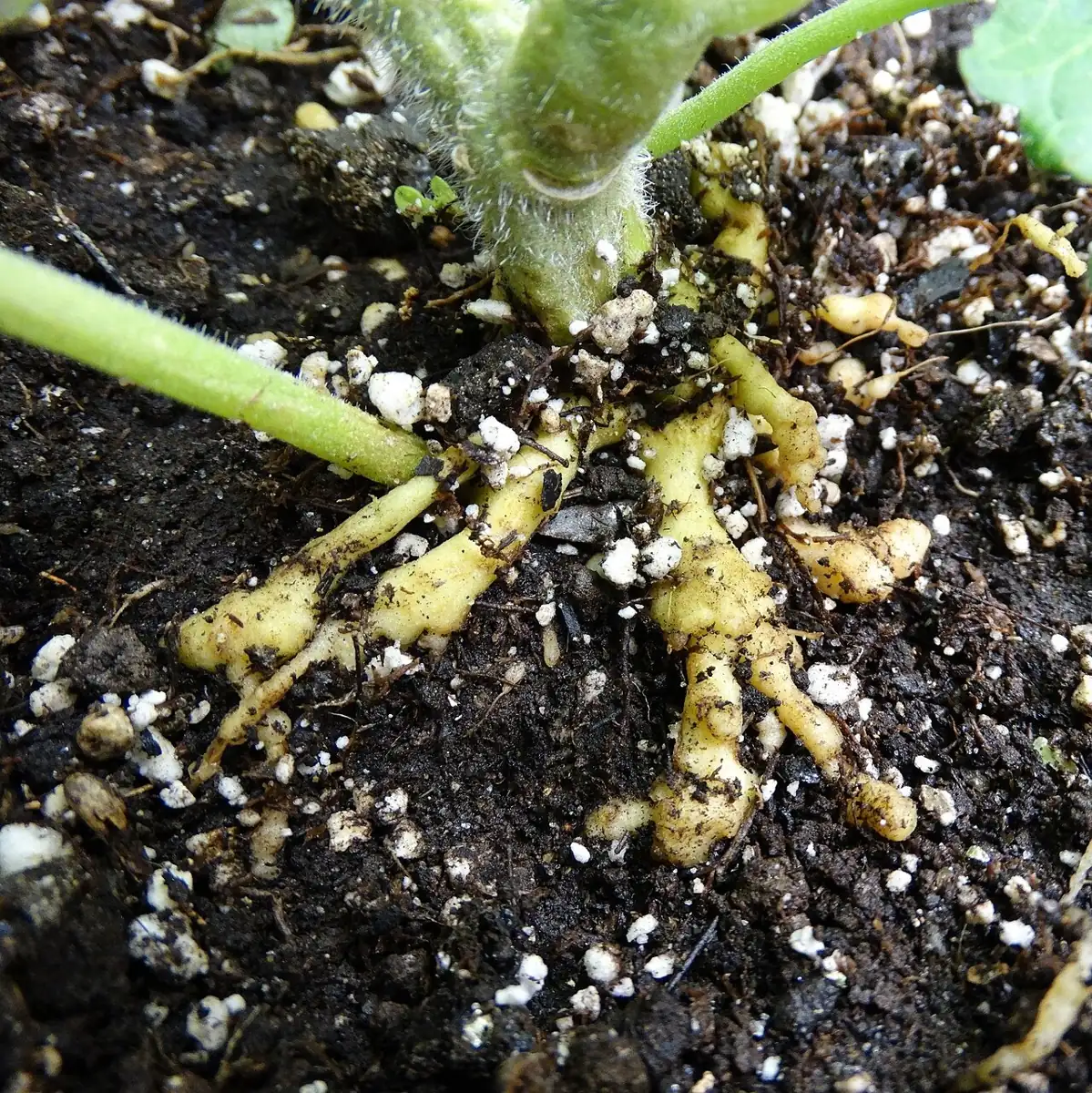
- Dig up a plant and check the roots: large and small roots carry round swellings (knots or galls), and the root system may be shallow, with dead areas or too much branching.[1][2]
- True galls are swellings of the root itself and can't be rubbed off, unlike the nitrogen-fixing nodules on bean and pea roots, which are normal.[2]
- The nematodes are too small to see without a microscope; a lab test confirms them, or a simple bioassay: melons sown in pots of moist garden soil kept near 80 °F develop visible root galls in about 3 weeks if root-knot nematodes are present.[2][1]
Look-alikes
| Look-alike | How to tell them apart |
|---|---|
| Nitrogen-fixing nodules on legumes | Normal nodules on bean and pea roots sit on the surface and rub off; root-knot galls are swellings inside the root.[2] |
Where it lives
Widespread, especially in sandy soils such as South Carolina's Coastal Plain and river deltas, and the most damaging garden nematodes in California; a newer species, Meloidogyne enterolobii, has been introduced into Florida, North Carolina and South Carolina, and a 2025 first report found it on tomato in Texas.[1][2][3][5]
Biology and life cycle
Plant-feeding nematodes pass through an egg stage, four immature stages and an adult stage, and can go from egg to egg-laying adult in 21 to 28 days in warm summer weather; root-knot females swell into a pearlike shape inside the gall.[2]
They survive between seasons mainly as eggs in the soil; the second-stage juveniles invade roots, usually at the tips, and the plant forms a gall where they feed. Females stay in the root and lay eggs into a jellylike mass that reaches the soil.[2]
Most nematodes are active in warm months and can't get into roots when the soil is below 64 °F, so fall crops such as carrots, lettuce, spinach and peas planted after the soil cools suffer less.[2]
They spread easily from garden to garden in soil on tools, tillers and boots and on infested plants, and in water running off from around infested plants.[2][1]
Damage and signs
- Galls damage the roots' ability to carry water and nutrients and can crack open, letting in soil-borne disease organisms; heavily infested plants may die.[2][1]
- Hosts include tomatoes, okra, beans, sweet potatoes, cucumbers, melons, squash, peppers, carrots and lettuce, plus many fruit trees and ornamentals; begonias, coleus and impatiens are among the bedding plants most likely to be damaged.[2][1][3]
Health risk
They attack plant roots only; none of the sources reports any risk to people or pets.[1][2]
Control
Prevention
Plant resistant varieties: tomatoes marked 'N' (as in VFN) resist common root-knot species, Clemson lists resistant southernpeas, lima beans, peppers, sweet potatoes and tomatoes, and zinnia, salvia and marigold are resistant bedding plants. Resistant tomatoes may still gall when nematode numbers are high but usually keep their yield.[2][1]
Rotate: about three years of non-host crops in a bed reduces the population; Clemson suggests asparagus, corn, onions, garlic and strawberries, and UC suggests small grains such as wheat and barley, sudangrass and resistant tomato and bean varieties.[1][2]
Sanitation
Clean soil off tools, tillers and boots before moving between gardens, and check every transplant's roots for tiny knots before planting; skip any that look suspicious.[2][1][5]
Traps and physical control
Solarize moist, tilled soil under clear plastic in the hottest part of summer; root-knot nematodes and their eggs die when the soil passes 125 °F for 30 minutes. Solarizing works poorly in cool coastal areas and won't protect fruit trees and other woody plants for long.[1][2]
Clemson suggests tilling every 10 days through a hot, dry summer so the sun dries out the nematodes; UC suggests a year of bare, moist, weed-free fallow so the eggs hatch and the young nematodes starve.[1][2]
Guava root-knot nematode (Meloidogyne enterolobii)
This introduced species can overcome the root-knot resistance bred into tomatoes and sweetpotatoes; the Mi resistance genes in tomatoes don't control it.[3][6]
Clemson's 2021 note listed Florida, North Carolina and South Carolina. A 2025 report lists confirmed finds in Florida, Georgia, Louisiana and the Carolinas, and adds Texas.[3][5]
The Texas find started in a backyard: in 2024 a root-knot-resistant tomato bought from a national retailer and grown in potting mix had root galls before it was transplanted. It was planted anyway, declined, and a second resistant tomato set in the same spot galled too; DNA tests confirmed the guava root-knot nematode.[5]
If resistant varieties still have galled roots, contact your county Extension office.[3][1]
California's Department of Food and Agriculture has published proposed regulation text (section 3591.34, 2026) that would make the whole state an eradication area for this nematode, covering soil and potting media, plants with roots, rooted cuttings and soil on equipment.[4]
Where sources disagree
Solarization time: Clemson says 6 to 12 weeks under clear plastic; UC says 4 to 6 weeks in the hottest part of summer.[1][2]
Strawberries in a rotation: Clemson lists them as a non-host crop for rotation; UC's host table lists strawberry among root-knot hosts.[1][2]
Common questions
- Why are there knots on my tomato roots?
- Round swellings that are part of the root, on both large and small roots, are the classic sign of root-knot nematodes.[1][2]
- My resistant tomatoes still have galls. Why?
- Even resistant tomatoes can show some galling when nematode numbers are high. Heavy galling on resistant varieties in the South may point to Meloidogyne enterolobii, an introduced species that resistance doesn't stop; it has been confirmed in Florida, Georgia, Louisiana, the Carolinas and, in a backyard garden, Texas.[2][3][5]
- Can I bring root-knot nematodes home on a store-bought plant?
- Yes. Nematodes travel in soil and on infested plants, and the Texas guava root-knot find came from a store-bought tomato. Check the roots before planting.[2][5][1]
Sources
- Clemson Cooperative Extension, Home & Garden Information Center, “Root-Knot Nematodes in the Vegetable Garden (HGIC factsheet).” hgic.clemson.edu/factsheet/root-knot-nematodes-in-the-vegetable-garden/ (accessed 2026-11-11)
- University of California Statewide IPM Program, “Nematodes (Pest Notes, Home and Landscape).” ipm.ucanr.edu/home-and-landscape/nematodes/ (accessed 2026-11-11)
- Clemson Cooperative Extension, Home & Garden Information Center, “Meloidogyne enterolobii (M.e.) and the Challenge for Home Gardeners.” hgic.clemson.edu/meloidogyne-enterolobii-m-e-and-the-challenge-for-home-gardeners/ (accessed 2026-11-11)
- California Department of Food and Agriculture, “Proposed text: section 3591.34, Guava Root-Knot Nematode Eradication Area (2026).” www.cdfa.ca.gov/plant/docs/2026/3591.34_grkn_text.pdf (accessed 2026-11-11)
- Plant Disease, via PubMed, “First report of Meloidogyne enterolobii infecting tomato in Texas (2025).” pubmed.ncbi.nlm.nih.gov/40570356/ (accessed 2026-11-11)
- Frontiers in Plant Science, via PubMed, “Meloidogyne enterolobii, a major threat to tomato production (2020 review).” pubmed.ncbi.nlm.nih.gov/33304376/ (accessed 2026-11-11)
- iNaturalist, “Meloidogyne taxon page (order and family).” www.inaturalist.org/taxa/460866 (accessed 2026-11-11)