On this page
How to identify it
- Infected pines wilt and the needles turn brown, often across the whole tree; most pines infected in spring are dead by late summer or early fall, although large trees can take two years to die.[1][2][3]
- Cut wood may show sectors of blue discoloration and the round exit holes of pine sawyer beetles.[4][3]
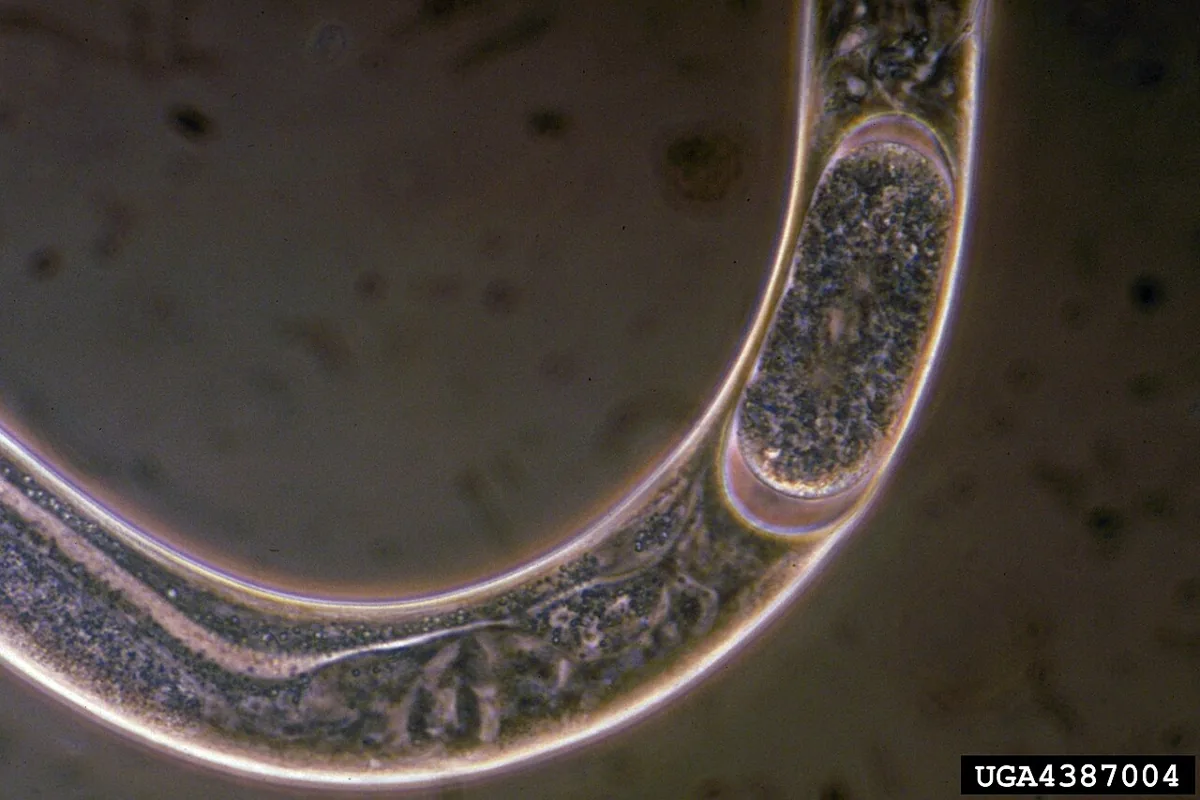
- The nematode is microscopic, so a lab has to extract it from a wood sample to confirm pine wilt.[3][1]
Look-alikes
| Look-alike | How to tell them apart |
|---|---|
| Environmental stress and transplant shock | Pines declining from environmental stress or transplant shock can show similar symptoms, so a lab test is needed to confirm pine wilt.[2] |
| Pine sawyers | Native longhorned beetles that carry the nematode; their larvae tunnel under the bark of dying and dead pines.[2][3] |
Where it lives
The pinewood nematode is native to North America. Pine wilt has killed many mature Scots pines across Nebraska since 2000 and is also reported by extension services in Illinois, Pennsylvania and Connecticut; a USDA review says it has a larger impact in China, Japan, Korea, Taiwan, Portugal and Spain.[6][3][2][1][4]
Biology and life cycle
In spring, pine sawyer beetles emerging from infected trees carry the nematodes and pass them to healthy or stressed pines as they feed.[1][4]
Inside the tree the nematodes feed on cells around the resin ducts and multiply quickly; in weak or dying trees they feed on blue-stain fungi instead. Sources give different generation times: Illinois says 4 to 12 days from egg to adult depending on temperature, Connecticut 5 to 10 days, and Penn State as few as 5 days under ideal conditions.[2][1][4]
Sawyer beetles lay their eggs in dying and dead pines; when the beetle pupae form, nematodes move into them and leave with the new adults, and both overwinter in the infected tree.[1][4][3]
Damage and signs
- Scots pine is the most susceptible. Sources differ on other pines: Connecticut says Austrian pine is also highly susceptible while mugo, Japanese black and white pines are moderately susceptible or resistant; Nebraska says it occasionally kills Austrian, jack and mugo pines and rarely white pine, and has not been known to kill ponderosa pine; Illinois calls eastern white pine one of the most resistant.[2][4][3]
- Illinois says plant vigor does not seem to affect which trees become infected, but stressed pines are more likely to be killed; Connecticut says trees under heat and drought stress are more likely to be killed.[2][4]
Health risk
It infects pines, and no cited source describes any risk to people or pets.[1][2]
Control
Prevention
Where pine wilt occurs, don't replant Scots pine. Connecticut calls eastern white, jack and pitch pine moderately to highly resistant and recommends larch, fir, spruce or Douglas-fir as replacements; Nebraska says spruces, firs, red cedar, junipers and white and ponderosa pine face little threat; Penn State advises not planting susceptible pines where mean summer temperatures are above 68 degrees F.[4][3][1]
Sanitation
Have a dying pine tested; if pine wilt is confirmed, remove and destroy infected and dead pines before the sawyer beetles emerge. Nebraska says trees dying between May 1 and October 1 should be cut promptly and burned, buried or chipped, those found after October 1 by the end of April, and the wood should not be kept for firewood.[2][1][4][3]
When to call a professional
Sources disagree on chemical protection. Penn State says no recommendations are available; Nebraska says abamectin trunk injections by professional arborists protect high-value pines to some degree (about 70 percent a year for about three years); Connecticut says abamectin or emamectin benzoate injections by a certified arborist can protect healthy high-value trees but are no longer effective once a tree is infected.[1][3][4]
Regulatory status
A USDA Agricultural Research Service review notes that the pinewood nematode is included in the APHIS U.S. Regulated Plant Pest Table, and that many countries outside the United States list it as a quarantine nematode because of the threat to their native conifers.[6]
Common questions
- Why did my Scots pine turn brown and die in a few months?
- Rapid browning and death of a Scots pine, often by late summer or fall, is typical of pine wilt, caused by the pinewood nematode; a lab test of a wood sample can confirm it.[3][2][1]
- Can pine wilt spread to my other pines?
- Yes; pine sawyer beetles carry the nematodes from infected trees to nearby pines, which is why infected trees should be removed promptly.[1][2]
Sources
- Penn State Extension, “Pine Wilt Disease.” extension.psu.edu/pine-wilt-disease (accessed 2026-11-13)
- University of Illinois Extension, “Pine Wilt (Plant Problems).” extension.illinois.edu/plant-problems/pine-wilt (accessed 2026-11-13)
- University of Nebraska-Lincoln Extension, “Pine Wilt in Nebraska (G1899).” extensionpubs.unl.edu/publication/g1899/2008/html/view (accessed 2026-11-13)
- Connecticut Agricultural Experiment Station, “Pine Wilt (Y. Li, June 7, 2023).” portal.ct.gov/-/media/caes/documents/publications/fact_sheets/plant_pathology_and_ecology/pine-wilt.pdf (accessed 2026-11-13)
- Global Biodiversity Information Facility (GBIF), “Bursaphelenchus xylophilus Steiner & Buhrer, 1934 (GBIF Backbone Taxonomy).” api.gbif.org/v1/species/8848401 (accessed 2026-11-13)
- USDA Agricultural Research Service, “Top Ten Most Important U.S.-Regulated and Emerging Plant-Parasitic Nematodes (Kantor and Carta, 2022, Horticulturae 8:208).” www.ars.usda.gov/ARSUserFiles/2279/Kantor%20et%20al.%202022.pdf (accessed 2026-11-13)