On this page
How to identify it
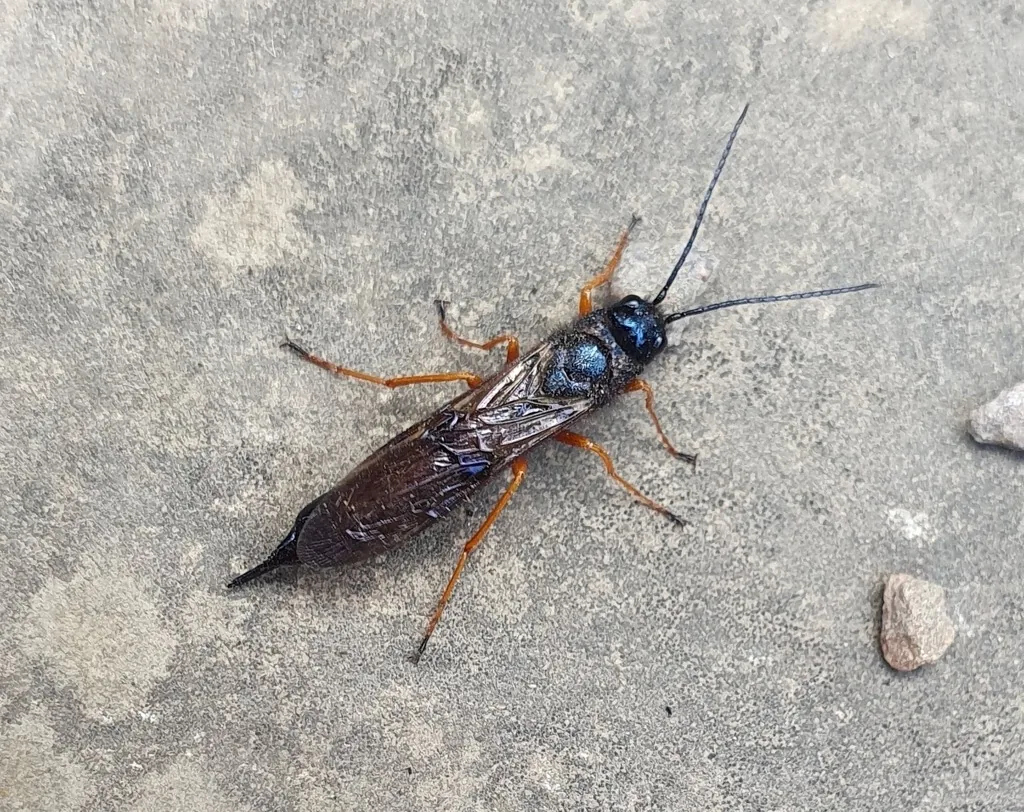
- Adults have a cylindrical body, a spear-shaped plate at the tip of the abdomen and black antennae. Size varies widely, from about 1/4 to nearly 1 1/2 inches; females tend to be larger.[3][1]
- Females are metallic blue-black with orange legs and a long, spiky egg-laying tube. Males have a metallic blue head and thorax, an abdomen that is orange in the middle and black at the rear, and black legs with thicker hind legs.[3][1]
- Larvae are creamy white, cylindrical, up to 1 1/4 inches long, with a dark spine at the tip of the abdomen, and are only found inside the wood.[1][2]
- Many native woodwasps look very similar, so a suspected find needs an entomologist's identification.[3]
Look-alikes
| Look-alike | How to tell them apart |
|---|---|
| Native horntails and woodwasps | Native woodwasps look very similar but attack only dead or dying trees.[3][4] |
Where it lives
Native to Europe, northern Africa and Asia. First detected in North America in New York in 2004; UMass lists it in at least nine states (New York, Pennsylvania, Vermont, Connecticut, Ohio, Michigan, New Jersey, Massachusetts and New Hampshire) and in Ontario and Quebec. Washington's invasive species council says it is not in Washington.[1][4][3]
Biology and life cycle
Adults fly from about July through September (sometimes from June) and live only one to two weeks. Eggs hatch in 16 to 28 days, and larvae take at least a year to develop, tunneling in the sapwood and feeding on the fungus their mother introduced; adults usually emerge the next summer.[1][2]
A female first drills to test the tree. In a healthy tree with high resin pressure she may only inject fungus and venom; in a weak tree she lays eggs too. Females can also lay unfertilized eggs, which develop into males.[2][1]
Adults are attracted to light. Monitoring programs use black panel traps baited with host-tree scents, which catch more than funnel traps.[1]
Damage and signs
- It attacks pines. UMass lists Scots, red and jack pine as preferred North American hosts; Cornell adds that all pines are likely susceptible and that Scots, red and white pine are confirmed hosts in New York. Washington's invasive species council says it sometimes attacks spruce and fir.[1][2][3]
- Overstocked, unmanaged Scots and red pine stands on poor sites suffer most, and within a stand it goes after suppressed, shaded, smaller or injured trees and trees with broken tops.[1][2]
- Signs: fading yellow, red or brown crowns in late summer or fall, beads or drips of resin on the trunk from late July into September, and round exit holes 1/8 to 5/16 inch across, often grouped near branch nodes. Split wood shows galleries packed with fine sawdust.[2][1]
Health risk
The female's long egg-laying tube is for drilling into wood; none of the sources reports stings or other harm to people.[3][1]
Control
Prevention
Don't move firewood: buy it where you burn it. The woodwasp arrived in imported wood products.[3][5]
Thin crowded pine stands from below during November through April, when it isn't flying, removing suppressed, injured, diseased and recently dead trees so the rest stay vigorous. Keep landscape pines, especially Scots pine, on suitable sites and as stress-free as possible.[2][1]
Sanitation
Don't move infested trees off the site; chip or burn the wood on site if possible.[2]
Biological control
Native parasitic wasps attack the eggs and larvae; one, Ibalia leucospoides, accounted for close to 20 percent parasitism in an Ontario study, and UMass says native parasitoids may kill up to 25 percent of larvae.[7][1][2]
Pesticides
UMass notes that no insecticides registered in Massachusetts are labeled specifically for the Sirex woodwasp.[1]
Reporting and regulations
It was first detected in a USDA cooperative pest survey trap near Fulton, New York, collected in September 2004 and identified in February 2005. It was then found in Pennsylvania (2006), Vermont and Michigan (2007), and USDA APHIS assessed a quarantine and biological control program for the infested Northeastern states in 2008.[4][1][5]
Cornell's fact sheet says eradication isn't possible and directs New York landowners to Cornell Cooperative Extension, the NYS Department of Environmental Conservation, the NYS Department of Agriculture and Markets, APHIS or the USDA Forest Service.[2]
In states where it isn't known, report it: Washington asks that a suspected Sirex woodwasp go to WSU Extension, the Washington State Department of Agriculture or the state Department of Natural Resources.[3]
Where sources disagree
The nematode: Cornell describes the parasitic nematode Deladenus siricidicola as the primary biological control used in several countries, sterilizing female woodwasps. In North America, UMass says the strain that arrived with the woodwasp has little impact and doesn't sterilize it, and an Ontario study found nematodes in about a third of females but never sterilizing their eggs.[2][1][7]
Jack pine: UMass lists it among preferred hosts. In a caged-log test in Ontario, females did lay in jack pine but it was the poorest host for larval survival; Scots and red pine were best, and white pine suited larvae but got fewer eggs.[1][6]
Common questions
- What is the large blue-black wasp with orange legs on my pine?
- A large, metallic blue-black woodwasp with orange legs and a long egg-laying tube on a pine may be a Sirex woodwasp, but native woodwasps look similar, so have it identified.[3][1]
- Can firewood spread the Sirex woodwasp?
- Yes. It was introduced in imported wood products and spreads when infested wood is moved, so buy firewood where you burn it and keep infested trees on site.[3][2]
Sources
- UMass Extension Landscape, Nursery and Urban Forestry Program (Landscape Insect & Mite Guide), “Sirex noctilio (Sirex Wood Wasp).” www.umass.edu/agriculture-food-environment/landscape/publications-resources/insect-mite-guide/sirex-noctilio (accessed 2026-11-11)
- Cornell University Cooperative Extension (ForestConnect), “Biology and Silvicultural Management of Sirex Woodwasp (ForestConnect Fact Sheet Series).” blogs.cornell.edu/cceforestconnect/files/2022/12/Sirex-Fact-Sheet.pdf (accessed 2026-11-11)
- Washington Invasive Species Council, “Sirex Woodwasp (priority species page).” invasivespecies.wa.gov/priorityspecies/sirex-woodwasp/ (accessed 2026-11-11)
- USDA APHIS Plant Protection and Quarantine, “Proposed Program for the Control of the Woodwasp Sirex noctilio in the Northeastern United States: Environmental Assessment (August 2008).” www.aphis.usda.gov/sites/default/files/SirexEA-final-northeast.pdf (accessed 2026-11-11)
- USDA National Invasive Species Information Center, “Sirex Woodwasp (species profile).” invasivespeciesinfo.gov/terrestrial/invertebrates/sirex-woodwasp (accessed 2026-11-11)
- PLoS One, via PubMed, “Suitability of eastern pines for oviposition and survival of Sirex noctilio (Haavik, Dodds and Allison 2017).” pubmed.ncbi.nlm.nih.gov/28334011/ (accessed 2026-11-11)
- Environmental Entomology, via PubMed, “Natural enemies associated with Sirex noctilio and S. nigricornis in Ontario, Canada (Ryan et al. 2012).” pubmed.ncbi.nlm.nih.gov/22507001/ (accessed 2026-11-11)
- iNaturalist, “Sirex noctilio taxon page (order and family).” www.inaturalist.org/taxa/202629 (accessed 2026-11-11)