On this page
How to identify it
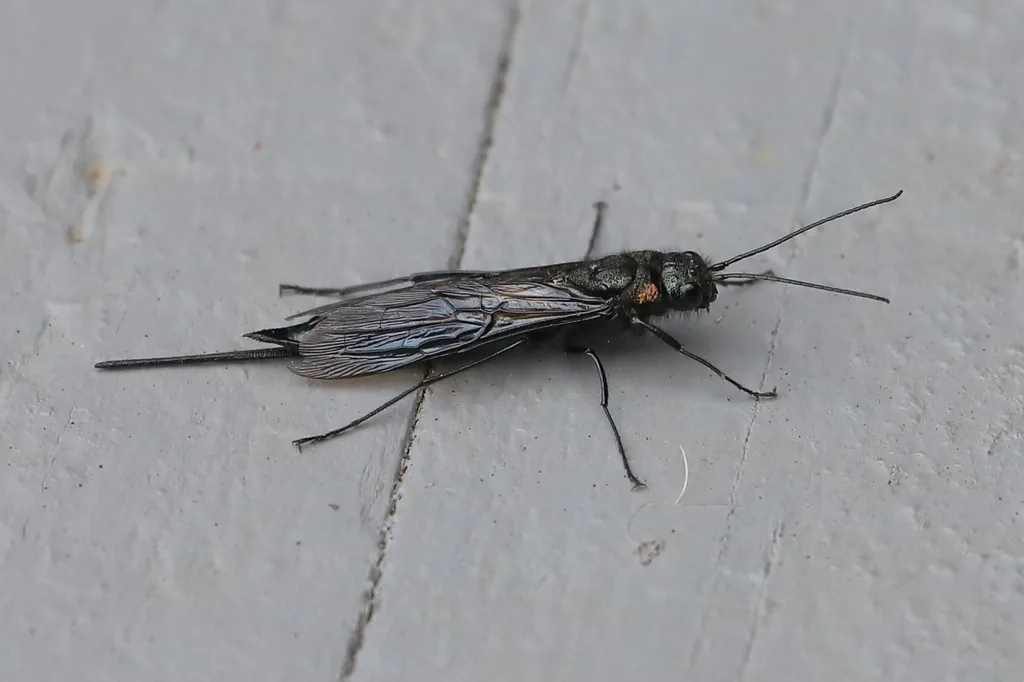
- Large insects with a long cylindrical body and no narrow wasp waist; often black or metallic dark blue, or combinations of black, red and yellow. Sources give the size as 1 inch or longer (UC IPM and Cornell), 1 1/4 inches (Iowa State) and about 1.5 inches (Colorado State and Mississippi State).[1][3][2][4][5]
- Both sexes have a hornlike spine at the tail end, which gives horntails their name.[2][4]
- Females are larger and carry a long egg-laying tube, the ovipositor, that can be longer than the body; it is used only to drill into wood and can't sting.[1][5]
- They make a loud buzz in flight. UC IPM gives the round exit holes as 1/4 to 1/2 inch across; Iowa State describes 1/4 inch holes.[1][2]
- Many are boldly colored to mimic stinging wasps. Mississippi State puts it simply: wood wasps can't sting, but they can bluff.[5]
Look-alikes
| Look-alike | How to tell them apart |
|---|---|
| Powderpost beetle | Wood-boring beetles like powderpost beetles can attack furniture and structural wood; horntails attack only trees and won't bore into wood in buildings or furniture.[1] |
| Old house borer | Horntails won't lay eggs in dry, finished lumber, so there's no second generation in the studs.[1][2] |
Where it lives
Horntails can show up anywhere infested timber is used for construction. About a dozen similar species occur in California, Oregon and Washington, and Colorado State counts 28 species of Sirex horntails in North America, not all of them native. The pigeon tremex is the most common species in New York State, and emergences in new homes have been reported in Iowa.[1][4][3][2]
Biology and life cycle
A female drills nearly 3/4 inch into a weakened or dying tree, lays 1 to 7 eggs at a time along with a wood-softening fungus, and may lay up to 200 eggs in all. Mississippi State notes she carries the fungal spores in special pockets, called mycangia, at the base of her ovipositor.[1][3][5]
Horntails as a group bore in both hardwoods and conifers. Most Sirex species favor conifers, especially pines, while the pigeon tremex develops in maple, elm, beech and other hardwoods.[3][4][5]
Legless, milky white larvae up to 1 3/4 inches long tunnel through the wood. UC IPM says development takes at least a year and up to 5 years in cool climates, leaving galleries 10 to 12 inches long; Iowa State gives 2 to 3 years and burrows 1 to 2 feet long.[3][1][2]
Studs cut from infested logs can carry larvae that survive milling, especially when the lumber wasn't kiln dried or was dried inadequately.[2][1]
Natural enemies include nematodes, parasitic wasps and woodpeckers. One giant ichneumon wasp that hunts the pigeon tremex drills its own ovipositor 3 to 4 or more inches into wood to reach a horntail larva.[4][3]
Damage and signs
- Damage in buildings is cosmetic rather than structural; usually fewer than a dozen wasps emerge in a house.[1][2]
- Emerging adults chew through wallboard, plaster, hardwood floors, linoleum, carpet and other surfaces covering the infested wood.[1][2]
- Most emerge within the first year after construction, though a few may appear 2 or 3 years later.[2]
- In forests most native horntails attack only dead or dying trees, but the European Sirex woodwasp, Sirex noctilio, first detected in the northeastern U.S. in 2004, threatens pines.[5][4][3]
Health risk
Horntails don't sting or bite people; the female's long tail is only for laying eggs in trees.[1][2][3]
Control
Prevention
Step 2: for new construction, kiln drying or vacuum fumigation of lumber is the only effective way to kill larvae that survive milling; fumigating finished buildings hasn't worked.[1]
Outdoors, don't move pine firewood, pallets or wild-cut Christmas trees from areas with the invasive Sirex woodwasp; transporting infested wood spreads it.[4]
Traps and physical control
Step 1: swat or vacuum up individual wasps as they emerge, then patch and repaint the exit holes. Iowa State calls this the only advised management; there's no practical way to treat lumber already inside walls.[2][1]
Step 3: if 5 or more horntails emerge from a single stud, it may be damaged enough to justify replacing it.[2][1]
Pesticides
No insecticide is recommended: UC IPM says waiting out the life cycle and repairing cosmetic damage is about all that can be done in an infested building.[1]
Common questions
- Will horntails keep coming out of my walls for years?
- No. Females won't lay eggs in dry, finished lumber, so once the original larvae have emerged, the problem ends. Most come out in the first year, a few up to 2 or 3 years after construction.[1][2]
- Can a horntail sting me?
- No. Neither males nor females sting or bite; the long spike on the female is an egg-laying tool, and the bold colors are a bluff.[2][3][5]
- Will horntails attack my furniture?
- No. They attack only trees and won't bore into wood in buildings or furniture; some wood-boring beetles can, so have a beetle identified.[1][2]
- Should I spray my house for horntails?
- No. Fumigating finished buildings hasn't worked, and the few wasps that emerge can simply be swatted.[1][2]
Sources
- University of California Statewide IPM Program, “Pest Notes: Wood Wasps and Horntails, Publication 7407.” ipm.ucanr.edu/home-and-landscape/wood-wasps-and-horntails/ (accessed 2026-11-12)
- Iowa State University Extension and Outreach, “Horntail Wasp (Yard and Garden, last reviewed October 2022).” yardandgarden.extension.iastate.edu/encyclopedia/horntail-wasp (accessed 2026-11-12)
- Cornell University, Department of Entomology, “Horntails or Wood Wasps (fact sheet).” pesticidecert.cfans.umn.edu/sites/pesticidecert.cfans.umn.edu/files/2022-04/11.Horntails_Cornell.pdf (accessed 2026-11-12). Cornell fact sheet as posted by the University of Minnesota pesticide certification program
- Colorado State University, Department of Agricultural Biology, “Horntails.” agsci.colostate.edu/agbio/ipm-pests/horntails-woodwasps/ (accessed 2026-11-12)
- Mississippi State University Extension Service, “Wood Wasps (Bug's Eye View, Vol. 8, No. 30).” extension.msstate.edu/taxonomy/term/4171/2022/wood-wasps-vol-8-no-30 (accessed 2026-11-12)
- iNaturalist, “Sirex areolatus taxon page (order and family).” www.inaturalist.org/taxa/788019 (accessed 2026-10-06)