On this page
How to identify it
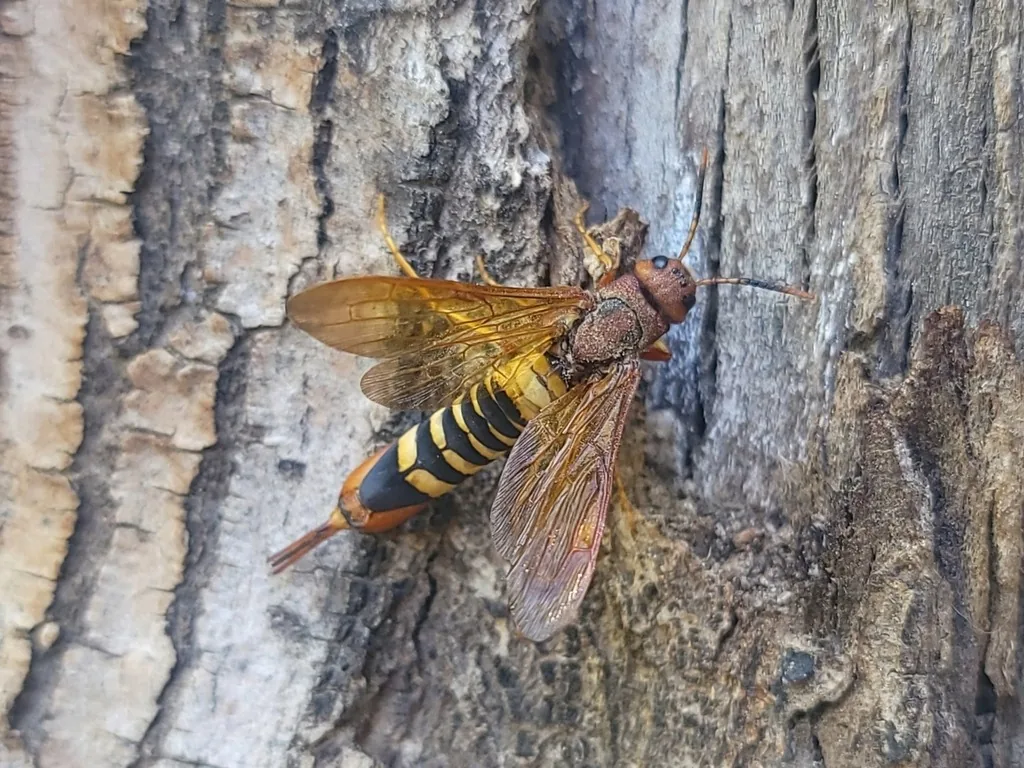
- Adults are 1 to 2 inches long with thick, cylindrical bodies, reddish brown to black with yellow and black bands on the abdomen, and dark wings.[2][1][3]
- Females carry a stout spine at the rear, an ovipositor about 1/2 inch long, used to drill eggs into wood. It looks like a stinger, but the pigeon tremex can't sting. A short horn sits above it, which is where the name horntail comes from.[1][3][2]
- Females are much larger than males. Dead females are sometimes found stuck to a trunk with the ovipositor still embedded.[3]
- The larvae are cream-colored, cylindrical grubs up to 2 inches long with a horn at the rear, living in round tunnels in the wood.[1][3][2]
Look-alikes
| Look-alike | How to tell them apart |
|---|---|
| Giant ichneumon wasps | Often seen on the same dying trees, these are its most common natural enemy: very elongated wasps with long tail-like ovipositors, more than 5 inches long overall, that lay their eggs into the wood onto pigeon tremex larvae.[3] |
| Conifer horntails | Other horntails in Colorado develop in conifers, usually in forests; the pigeon tremex attacks hardwoods.[3] |
Where it lives
Widespread in North America. GBIF holds more than 5,000 U.S. records, most from New York, Michigan, Ohio, Illinois, Colorado, Pennsylvania, Massachusetts and Utah, plus about 1,500 from Canada. NC State notes it was once a fairly common pest in the northeastern U.S. and is more of a curiosity in North Carolina, and Colorado State and Utah State cover it on landscape hardwoods in the West.[6][2][3][1]
Biology and life cycle
It attacks only stressed, declining or very recently dead hardwoods: elms and sugar maple are preferred, along with ash, cottonwood, oak, hickory, sycamore, beech, apple and pear.[2][1][3]
Adults are active from summer into early October. A female drills about 1/2 inch into the wood and lays two to seven eggs along with a white rot fungus, which softens the wood and which the larvae need to develop.[1][3]
Larvae feed in the wood until the next summer, spending the winter deep in the heartwood, then pupate just below the bark. There is typically one generation a year.[1]
Its population can build locally as host trees age or become diseased.[3]
Females carry spores of a white rot fungus (named Cerrena unicolor by UMass and NC State, Daedalea unicolor by Colorado State) into the wood with their eggs. The larvae need it to develop, and it speeds the decay already under way.[5][2][3]
Larvae reach about 2 inches (50 mm) and bore into the heartwood, leaving round tunnels about as wide as a pencil.[5][2]
Fun fact: Linnaeus named it Tremex columba, columba being the pigeon genus, and NC State calls the link between this slender wasp and pigeons a mystery.[2]
Damage and signs
- The round tunnels and the rot fungus weaken the wood, which can make limbs more likely to break under wind, ice or snow. Adults leave round exit holes.[1][2]
- It is not considered a serious pest, because attacks are limited to trees or limbs already in serious decline or very recently dead.[3][1]
- On maples especially, check that round exit holes are not from the Asian longhorned beetle before assuming pigeon tremex.[5]
Health risk
Despite the stinger-like ovipositor, it is a non-stinging wasp; the sources describe no risk to people.[3][1][2]
Control
Prevention
Keep trees healthy and avoid wounding the bark. Finding pigeon tremex means the tree or limb is already in serious decline or recently dead.[2][1][3]
Plant trees on suitable sites, plant them properly, and avoid stress from other pests, diseases and drought that leads to decline.[5]
Traps and physical control
Scout dead branches and declining trees for irregular round exit holes. They mark dead wood, so the tree or limb may be hazardous; use that when deciding on branch or tree removal.[5]
Biological control
Giant ichneumon wasps are its most common natural enemy, laying their eggs on pigeon tremex larvae inside the wood.[3]
Pesticides
Spraying isn't recommended: no insecticide is available that kills the larvae deep in the wood, and the wasp attacks trees that are dying or dead anyway.[1][2]
Where sources disagree
Life cycle: Utah State and UMass describe about one generation a year, and Colorado State says larvae take nearly a year to grow; NC State says development takes up to two years.[1][5][3][2]
Size: NC State gives adults 1 to 1 1/2 inches long; Utah State gives females 1 1/2 to 2 inches.[2][1]
Spraying: Utah State says pesticides are not recommended and NC State that no insecticide reaches the larvae; Colorado State says controls have not been developed but it likely can be temporarily managed with insecticides as for other wood borers.[1][2][3]
Common questions
- Can a pigeon tremex sting me?
- No. The long spine at the rear is an egg-laying tool for drilling into wood, and the pigeon tremex is a non-stinging wasp.[3][1]
- Does a pigeon tremex mean my tree is dying?
- It means that tree or limb is already in serious decline or very recently dead; the wasp doesn't attack healthy wood.[3][1]
- Should I spray the tree?
- No. No insecticide is effective against larvae deep in the wood, and treatment is not recommended.[2][1]
- Where is the pigeon tremex found?
- Across much of the United States and Canada. GBIF holds more than 5,000 U.S. records, most from New York, Michigan, Ohio, Illinois and Colorado, and more than 1,500 from Canada.[6]
- What is the giant wasp with the very long tail on the same tree?
- Probably a giant ichneumon wasp. Its ovipositor is about 8 cm long, and it drills into the wood to lay eggs on pigeon tremex larvae. It is a natural enemy, not a pest.[5][3]
Sources
- Utah State University Extension, Integrated Pest Management, “Pigeon Tremex (Ornamental Pest Guide).” extension.usu.edu/planthealth/ipm/ornamental-pest-guide/arthopods/wood-borers/pigeon-tremex (accessed 2026-11-12)
- NC State Extension, “Pigeon Tremex (J. Baker; published November 2013, reviewed May 2024).” content.ces.ncsu.edu/pigeon-tremex (accessed 2026-11-12)
- Colorado State University Extension, “Pigeon Tremex Horntail and the Giant Ichneumon Wasp, Fact Sheet 5.604.” extension.colostate.edu/resource/pigeon-tremex-horntail-and-the-giant-ichneumon-wasp (accessed 2026-11-12)
- iNaturalist, “Tremex columba taxon page (order and family).” www.inaturalist.org/taxa/63275 (accessed 2026-11-12)
- UMass Amherst Center for Agriculture, Food, and the Environment, “Tremex columba (Insect & Mite Guide).” www.umass.edu/agriculture-food-environment/landscape/publications-resources/insect-mite-guide/tremex-columba (accessed 2026-11-12)
- Global Biodiversity Information Facility (GBIF), “Tremex columba: occurrence records.” www.gbif.org/species/1358461 (accessed 2026-11-12). State and country counts from the GBIF occurrence API, read 2026-11-12.