On this page
How to identify it
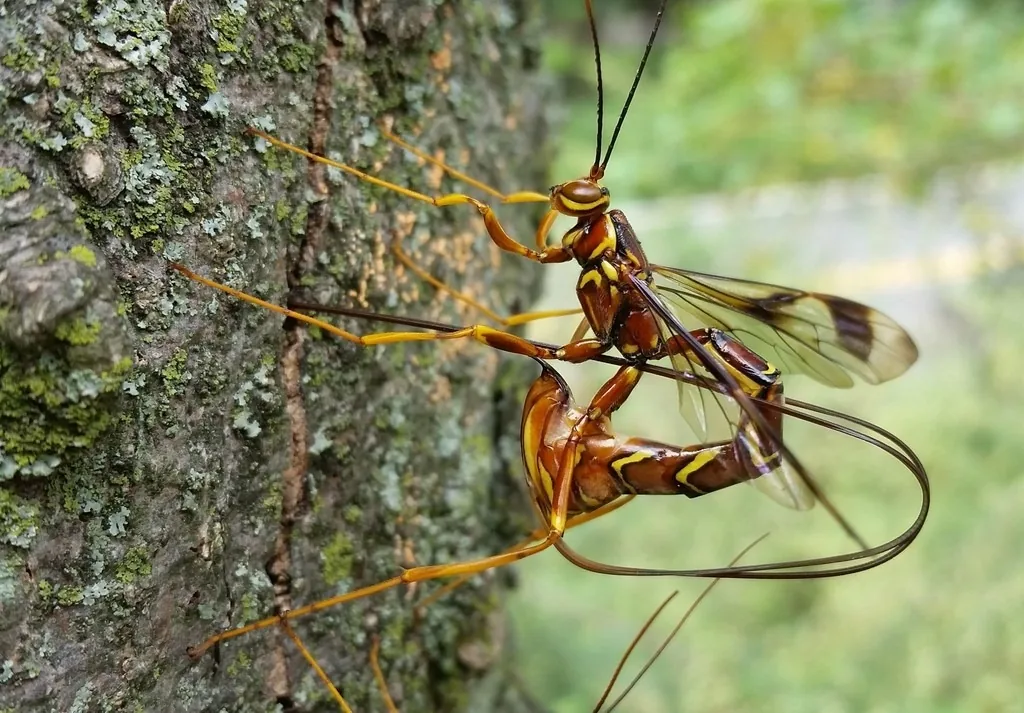
- University of Minnesota Extension gives a body about 1 1/2 inches long with a 2 to 3 inch ovipositor (egg-laying tube), about 4 inches in all; Mississippi State Extension says a large female can be over 2 inches long with an ovipositor of 4 inches or more.[1][2]
- Megarhyssa macrurus is reddish brown with yellow and black markings; M. atrata is mostly black with a yellow to orange head.[1][3]
- Two protective sheaths run alongside the ovipositor, so the female looks like she has three tails.[1][2]
- Males look similar but have long, slender abdomens with no ovipositor.[2]
Look-alikes
| Look-alike | How to tell them apart |
|---|---|
| Horntails (wood wasps) | Horntails, their hosts, have thick cylindrical bodies with no narrow waist; their sturdy ovipositor is not nearly as long as the giant ichneumon's. The Forest Service adds that horntails are named for a hornlike projection on the last abdominal segment, have head, thorax and abdomen of equal width, and that the pigeon tremex female is 37 to 50 mm long with a black abdomen banded and spotted with ocher yellow and smoky brown wings.[4][2][5] |
Where it lives
Found on and around declining or recently dead hardwood trees and logs, mostly from May through July in Minnesota.[1]
Biology and life cycle
Females lay eggs on horntail larvae, which tunnel in dying or recently dead hardwoods such as oak, maple, birch and elm; the pigeon tremex is the favored host of the black giant ichneumon. The Forest Service's 1972 manual Eastern Forest Insects calls the pigeon tremex (Tremex columba) the most common horntail and says it breeds in a wide variety of dead or weakened deciduous trees, including beech, maple, birch, elm, hickory, oak and sycamore.[1][2][5]
A female locates a larva deep in the wood, drills in with her ovipositor, paralyzes the larva with venom and lays an egg beside it. The same manual says horntail larvae are parasitized by several Megarhyssa species, whose females use their extremely long ovipositors to bore deep holes into the wood and lay eggs on or near horntail larvae in their galleries; it singles out M. atrata and M. macrurus for their striking appearance.[2][1][5]
The wasp larva slowly feeds on the horntail larva, eventually killing it; after maturing, the adult wasp emerges from the tree.[1]
Damage and signs
Health risk
Not aggressive toward people. If mishandled, a female may jab with her ovipositor in self-defense, which generally causes only a minor wound.[1][3]
Control
Prevention
No control is needed: ignore them and they'll leave on their own. Pesticide treatment isn't necessary.[1]
Their presence points to declining or recently dead hardwoods with horntails inside; the wasps feed only on the horntails, not on the tree.[1]
Common questions
- Can a giant ichneumon wasp sting me with that long tail?
- It isn't aggressive and avoids people. The long tail is an egg-laying tube; a female handled roughly may jab with it, usually causing only a minor wound.[1][3]
- Is it killing my tree?
- No. It drills into the wood only to lay eggs on horntail larvae and doesn't hurt the tree, though the horntails it hunts live in trees that are already declining or dead. The Forest Service says horntails usually prefer trees or parts of trees that are dead or badly weakened, and pigeon tremex tunnels frequently weaken a tree and lead to wind breakage.[1][5]
- Are giant ichneumon wasps used for biological control?
- Elsewhere, yes. UF/IFAS says Megarhyssa and other parasitic wasps (Ibalia, Rhyssa and Schlettererius) were introduced into Australasia against the invasive Sirex woodwasp in pine plantations, though it is not yet clear whether parasitoids are an effective option in the southeastern US. For the Asian horntail, another introduced woodwasp in the Southeast, UF/IFAS says there are no native North American parasitoid wasps or nematodes that could help manage it.[6][7]
Sources
- University of Minnesota Extension, “Ichneumonid Wasp (Yard and Garden Insects, reviewed 2024).” extension.umn.edu/yard-and-garden-insects/ichneumonid-wasp (accessed 2026-11-12)
- Mississippi State University Extension, “Black Giant Ichneumon Wasp, Bug's Eye View Vol. 7, No. 30 (2021).” extension.msstate.edu/newsletters/bugs-eye-view/2021/black-giant-ichneumon-wasp-vol-7-no-30 (accessed 2026-11-12)
- University of Minnesota Extension, “Giant Ichneumon Wasps (What Insect Is This?).” apps.extension.umn.edu/garden/diagnose/insect/general-curiosity-insects/flies/large/giantichneumon.html (accessed 2026-11-12)
- University of California Statewide IPM Program, “Pest Notes: Wood Wasps and Horntails, Publication 7407.” ipm.ucanr.edu/home-and-landscape/wood-wasps-and-horntails/ (accessed 2026-11-12)
- USDA Forest Service, “Eastern Forest Insects, Miscellaneous Publication 1175 (W. L. Baker, February 1972; scanned copy).” archive.org/details/easternforestins1175bake (accessed 2026-11-14). Scanned copy of the USDA Forest Service publication on the Internet Archive; text read from the archive.org full-text (djvu.txt) file.
- University of Florida IFAS Extension (EDIS), “Sirex Woodwasp, Sirex noctilio Fabricius, EENY-671/IN1154 (Featured Creatures).” ask.ifas.ufl.edu/publication/IN1154 (accessed 2026-11-14)
- University of Florida IFAS Extension (EDIS), “Asian Horntail, Eriotremex formosanus (Matsumura), EENY 628/IN1095 (Featured Creatures).” ask.ifas.ufl.edu/publication/IN1095 (accessed 2026-11-14)
- iNaturalist, “Megarhyssa macrurus taxon page (order and family).” www.inaturalist.org/taxa/47963 (accessed 2026-10-06)