On this page
How to identify it
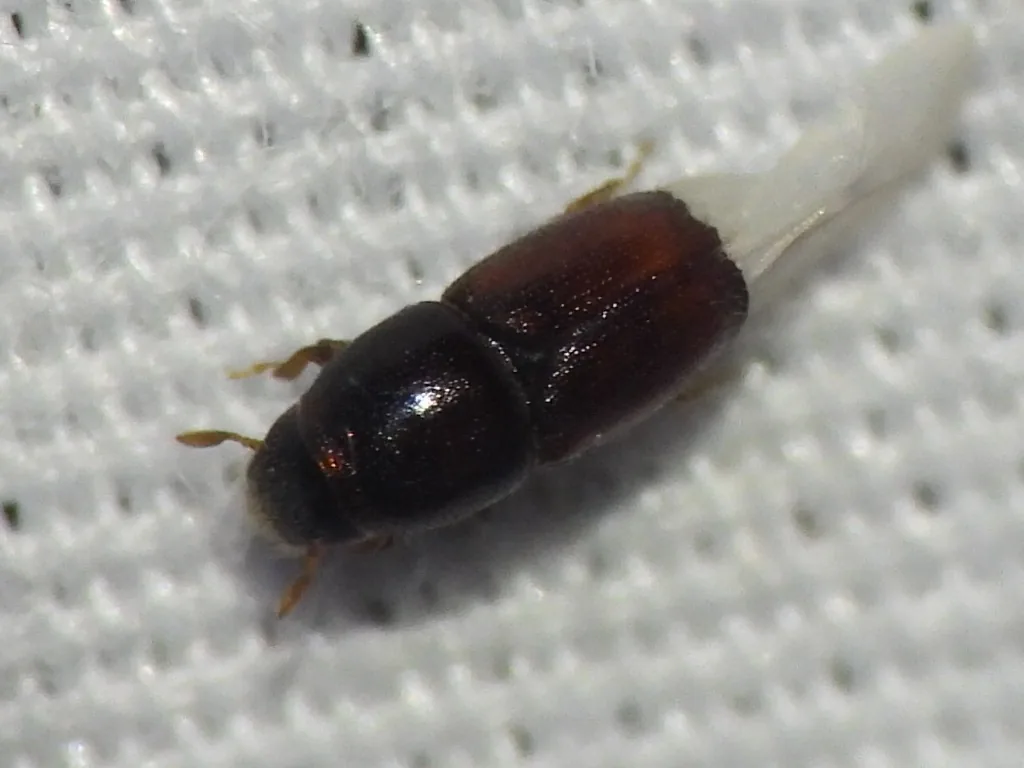
- The smaller European elm bark beetle is shiny dark reddish brown with a concave rear underside bearing a spine. NC State gives its length as about 1/8 inch; Utah State gives 1/13 to 1/9 inch.[1][3]
- The banded elm bark beetle is slightly larger, 1/9 to 1/6 inch, reddish brown with a black band across the wing covers.[3]
- The native elm bark beetle is brown to dark brown, rough, and covered with short, stiff yellow hairs.[2]
- Larvae are small, white, legless grubs with a brown head under the bark.[1][3]
- Galleries differ: smaller European egg galleries run with the grain and larval tunnels across it; native elm bark beetle egg galleries run across the grain and larval tunnels follow it.[1][2]
Look-alikes
| Look-alike | How to tell them apart |
|---|---|
| Ash and other bark beetles | Elm bark beetles breed in elms. NC State says elms seem to be the only hosts of the native elm bark beetle and that the smaller European elm bark beetle also infests Japanese zelkova; Utah State lists elm and possibly hackberry for it.[2][1][3] |
Where it lives
The smaller European and native elm bark beetles occur where elms grow in the East. The banded elm bark beetle, first reported in North America from Colorado in 2003, had been found in 21 states by 2005, is most abundant in the West, and is very common in Utah.[1][2][3][8][9]
Biology and life cycle
Beetles overwinter as larvae under bark. The smaller European and banded elm bark beetles have two or three generations a year; NC State says smaller European adults are active from April to October in North Carolina, while the native elm bark beetle probably has one generation there.[1][2][3]
New adults fly to healthy elms to feed in twig crotches, then to dying or dead elms to breed; they cannot breed in healthy trees.[1]
Native elm bark beetles overwinter in the outer bark near the base of living elms and as grubs in dead elms, and breed even in elm firewood.[2]
Damage and signs
- Larval feeding can girdle branches or trees, but without Dutch elm disease neither species usually kills trees.[3]
- Dutch elm disease spreads through root grafts and on beetles. Beetles emerging from diseased brood trees carry the fungus to healthy elms where they feed, and the fungus plugs the water-conducting vessels; American, red, rock and cedar elms are very susceptible and Siberian elm is tolerant but not resistant.[1][2][7]
- Drought stress makes exotic elms more likely to be infested.[1]
- The smaller European elm bark beetle has been the main Dutch elm disease vector in Colorado since 1948. A USDA Forest Service study found the banded elm bark beetle can also transmit the fungus through its feeding wounds, but no more efficiently than the smaller European elm bark beetle.[9][7]
Health risk
They breed in elms, and no cited source describes any risk to people or pets.[1][3]
Control
Prevention
Keep elms watered and healthy, and don't prune healthy elms between April 1 and August 31, when beetles are drawn to fresh wounds.[2][3]
Where elms are planned, choose cultivars resistant to Dutch elm disease.[2]
Sanitation
Remove and destroy dead and dying elms, dying branches and elm firewood, which are breeding sites.[2][3]
Pesticides
Where Dutch elm disease is a concern, Utah State says a labeled systemic fungicide can protect susceptible trees. NC State suggests a pyrethroid on the lower 6 feet of the trunk in April and May for native elm bark beetles, which does not stop smaller European elm bark beetles; for those it describes a whole-canopy pyrethroid spray before budbreak and again after new growth.[3][2][1]
When to call a professional
Utah State notes these beetles rarely damage common Siberian elms there and can be tolerated.[3]
The banded elm bark beetle
The banded elm bark beetle (Scolytus schevyrewi) is an Asian species first reported in North America in Colorado in April 2003; Forest Service researchers concluded it had been in the U.S. for at least 10 years and found it in 21 states.[9][8]
It attacks mainly American and Siberian elms and appears to have become the dominant elm bark beetle in the Rocky Mountain region, competing with and displacing the smaller European elm bark beetle.[8][7]
A study in Colorado and Wyoming found the banded beetle is strongly drawn to elm odors with no sign of an aggregation pheromone, unlike the smaller European species, which may help explain the displacement.[10]
The Dutch elm disease fungus was isolated from most emerging adults of both species in Colorado. Forest Service researchers say removing breeding sites, promptly removing infected elms and planting resistant elms remain effective.[9][7]
Common questions
- What are the tiny holes in my elm's bark?
- Often exit holes of elm bark beetles; peel bark to find their galleries.[1][3]
- Do elm bark beetles kill trees?
- Mostly by spreading Dutch elm disease; without it they seldom kill trees.[1][3][7]
- Can I keep elm firewood?
- Elm firewood is a breeding site for native elm bark beetles; removing it reduces them.[2]
- When should I prune elms?
- NC State advises against pruning healthy elms from April 1 to August 31.[2]
Sources
- NC State Extension, “Smaller European Elm Bark Beetle (PDIC Factsheet).” content.ces.ncsu.edu/smaller-european-elm-bark-beetle-scolytus-multistriatus (accessed 2026-11-13)
- NC State Extension, “Native Elm Bark Beetle (PDIC Factsheet).” content.ces.ncsu.edu/native-elm-bark-beetle (accessed 2026-11-13)
- Utah State University Extension (Integrated Pest Management), “Elm Bark Beetles (Ornamental Pest Guide).” extension.usu.edu/planthealth/ipm/ornamental-pest-guide/arthopods/bark-beetles/elm-bark-beetles.php (accessed 2026-11-13)
- Global Biodiversity Information Facility (GBIF), “Scolytus multistriatus (T.Marsham, 1802) (GBIF Backbone Taxonomy).” api.gbif.org/v1/species/1189289 (accessed 2026-11-13)
- Global Biodiversity Information Facility (GBIF), “Scolytus schevyrewi A.P.Semenov Tjan-Shansky, 1902 (GBIF Backbone Taxonomy).” api.gbif.org/v1/species/5013250 (accessed 2026-11-13)
- Global Biodiversity Information Facility (GBIF), “Hylurgopinus rufipes J.M.Swaine, 1918 (GBIF Backbone Taxonomy).” api.gbif.org/v1/species/1183866 (accessed 2026-11-13)
- USDA Forest Service (Treesearch), “Scolytus schevyrewi as a vector of Dutch elm disease (Jacobi, Koski and Negron, 2013, Forest Pathology 43:232-237).” research.fs.usda.gov/treesearch/43814 (accessed 2026-11-13)
- USDA Forest Service (Treesearch), “The banded elm bark beetle: a new threat to elms in North America (Negron et al., 2005, American Entomologist 51(2):84-94).” research.fs.usda.gov/treesearch/39853 (accessed 2026-11-13)
- Plant Disease (via PubMed), “Association of Ophiostoma novo-ulmi with Scolytus schevyrewi (Scolytidae) in Colorado (Jacobi et al., 2007) (abstract).” pubmed.ncbi.nlm.nih.gov/30780555/ (accessed 2026-11-13)
- Environmental Entomology (via PubMed), “Semiochemical-mediated flight strategies of two invasive elm bark beetles: a potential factor in competitive displacement (Lee et al., 2010) (abstract).” pubmed.ncbi.nlm.nih.gov/20388298/ (accessed 2026-11-13)