On this page
How to identify it
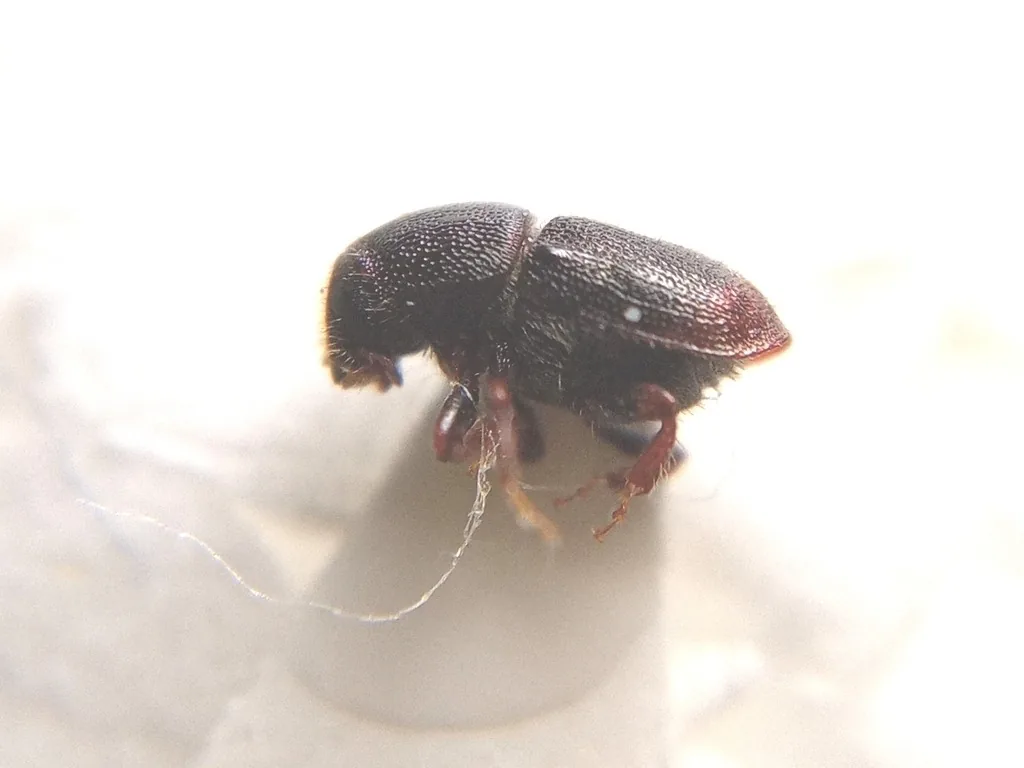
- Adults are dark brown to black, blunt at both ends and about 1/10 inch (about 3 mm) long, with reddish-brown tips on the antennae, legs and wing covers, which carry rows of shallow punctures.[1][2]
- Larvae are white, legless grubs with a reddish head and dark brown mouthparts, about 1/8 inch long when grown.[1][2]
- Signs are clusters of tiny, round 'shot' holes, clear gum oozing from them, and boring dust in bark crevices. PNW Handbooks says to look in late spring for holes about 0.08 inch across; on stone fruits they are sealed with gummy ooze and sawdust-like frass.[1][2][6]
- Fun fact: peel back the bark and the gallery pattern looks like a centipede, with a short egg tunnel as the body and larval tunnels running off it like legs.[4][5]
Look-alikes
Where it lives
Native to Europe; now found throughout the United States.[1][2]
Biology and life cycle
It overwinters as larvae under the bark; adults emerge in April and May and fly considerable distances to weakened trees.[1][2]
Females bore through the bark and make short egg galleries running with the grain; larvae tunnel across the grain in the sapwood.[1][2]
Utah has 2-3 generations a year, with adults flying almost continuously from spring to fall; UC IPM gives one to three generations a year.[2][4]
Larvae feed in their own galleries for 6-8 weeks according to Utah State; Penn State says they feed on sapwood for about a month.[2][1]
Damage and signs
- Penn State says it attacks a wide variety of deciduous fruit trees and other trees; Utah State lists most fruit trees and many ornamentals, including hawthorn and cherry.[1][2]
- It mostly attacks weak, declining, cut or broken limbs and stems and hastens their death; when abundant it may bore into buds and twigs of nearby healthy trees. Bark beetles can also carry diseases into the tree.[1][6]
- Healthy trees exude resin that usually kills the attackers; in injured or weakened trees the larvae may girdle the tree or a limb and kill it.[4][5]
- Infested trees may show yellowing and wilting foliage and branch dieback.[2]
Health risk
None to people or pets; Penn State, Utah State and UC IPM treat it only as a tree pest.[1][2][4]
Control
Prevention
Keep trees healthy and vigorous; the beetles target stressed trees. Utah State suggests deep watering once a week in hot July and August.[1][2][4]
Protect smooth bark from sunburn and winter injury: Utah State suggests white tree wrap from December to April or a 50% white latex paint and 50% water mix, and Penn State notes whitewash or white latex paint can help repel adults on young trees.[2][1][6]
Sanitation
Remove and destroy infested trees, limbs and prunings before adults emerge each April, by burning, chipping, solarizing or debarking, and remove nearby wild fruit trees that serve as breeding sites.[1][2]
Don't leave pruned limbs, stumps or woodpiles near fruit trees, since beetles emerge from them before the wood dries.[4][6]
Biological control
Parasitic wasps, predatory beetles and woodpeckers feed on bark beetles.[6]
Pesticides
Sprays are generally not recommended and no product lists shothole borer on the label. Utah State says carbaryl, bifenthrin, permethrin or spinosad may be used if the tree type is on the label, and Penn State says a residual spray can protect infested trees from reinfestation; systemic imidacloprid does not work, and nothing controls beetles already inside.[2][1]
Where sources disagree
Generations: Utah State says 2-3 a year; UC IPM says one to three; Penn State notes two or more may develop in a tree after it dies.[2][4][1]
Spraying: UC IPM recommends no insecticide treatments, Utah State calls them generally not recommended, and Penn State says a residual spray can prevent reinfestation.[4][2][1]
Common questions
- What are the tiny holes oozing sap on my cherry tree?
- Often shothole borer holes on a stressed tree.[1][2]
- Will shothole borers kill my tree?
- They rarely kill healthy trees; they speed the decline of weakened ones.[1]
- Should I spray for shothole borer?
- Usually not. UC IPM recommends no insecticide for it and Utah State says sprays are generally not recommended; nothing controls beetles already inside the tree.[4][2][1]
- Can I keep fruit tree prunings as firewood?
- Not near fruit trees while the wood is fresh. Beetles can emerge from cut limbs and stumps before they dry out; once the bark dries and sloughs off, the wood is no longer a host.[4][6]
Sources
- Penn State Extension, “Tree Fruit Insect Pest - Shothole Borer (updated October 12, 2026).” extension.psu.edu/tree-fruit-insect-pest-shothole-borer/ (accessed 2026-11-12)
- Utah State University Extension (Integrated Pest Management), “Shothole Borer (Ornamental Pest Guide and fact sheet).” extension.usu.edu/planthealth/ipm/notes_orn/list-treeshrubs/shothole-borer.php (accessed 2026-11-12)
- iNaturalist, “Scolytus rugulosus taxon page (order and family).” www.inaturalist.org/taxa/230655 (accessed 2026-11-12)
- University of California Statewide IPM Program, “Shothole Borer (Plum Pest Management Guidelines).” ipm.ucanr.edu/PMG/r611302711.html (accessed 2026-11-12)
- University of California Statewide IPM Program, “Shothole Borer (Apricot Pest Management Guidelines).” ipm.ucanr.edu/PMG/r5301311.html (accessed 2026-11-12)
- Pacific Northwest Pest Management Handbooks (Oregon State, Washington State and University of Idaho Extension), “Landscape pests: Bark beetle.” pnwhandbooks.org/insect/hort/landscape/common/landscape-bark-beetle (accessed 2026-11-12)