On this page
How to identify it
- Females are 1/16 to 1/10 inch long and brown to black; the smaller males can't fly. The polyphagous and Kuroshio shothole borers look identical, and only DNA tests tell them apart.[1][3]
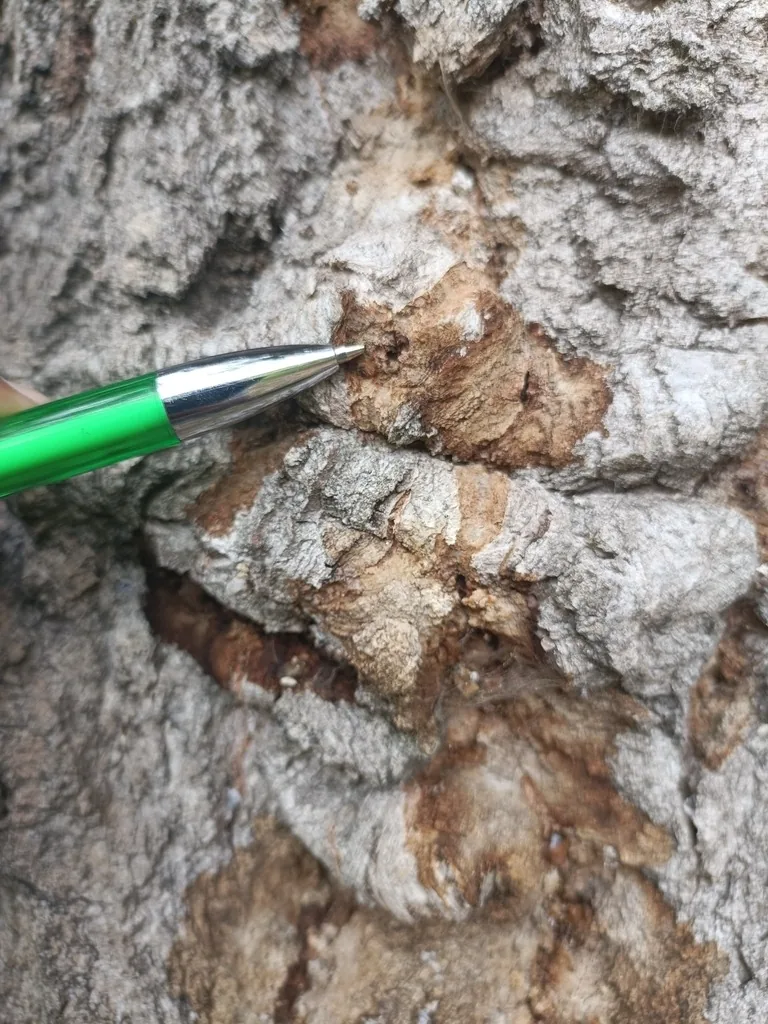
- Entry holes are perfectly round, about 1/32 inch (0.85 mm) across, roughly the size of a ballpoint pen tip. Depending on the tree you may also see wet staining, gumming, boring dust pushed out in long strands, or a white sugary crust that San Mateo County calls "sugary volcanoes" on avocado.[1][4]
- A third species, the greater shothole borer (Euwallacea interjectus), was found in Santa Cruz County in October 2024. It's larger, with females about 3.78 mm long against about 2 mm for the other two, and it leaves larger holes.[3][5]
Look-alikes
| Look-alike | How to tell them apart |
|---|---|
| Native ambrosia and bark beetles | Most native look-alikes attack only stressed, injured or dying trees, while invasive shothole borers colonize mostly healthy trees.[1] |
Where it lives
Polyphagous shothole borer was first collected in California in 2003 at Whittier Narrows in Los Angeles County. It's established in Los Angeles, Orange and Riverside counties and has spread to San Bernardino, Ventura and Santa Barbara counties; Kuroshio shothole borer was detected in San Diego County in 2014. In 2023 an infestation was confirmed in Santa Clara County, and San Mateo County reports confirmed finds in San Jose and in Felton, Santa Cruz County.[2][3][4]
Biology and life cycle
Females bore galleries, lay eggs and grow the fungus that larvae and adults eat; the beetles don't eat wood.[1]
Development takes 25 to 50 days, and models suggest 5 to 11 generations a year in Southern California. A female can start a colony by mating with her own sons, so a single beetle can found a new population.[1]
Females fly only when it's warmer than 68°F, and most bore new galleries in the tree where they hatched, so early infestations stay in a few trees. UC IPM says dispersal usually peaks around February and again from September to November.[1]
Damage and signs
- UC IPM counts more than 78 tree and shrub species worldwide where the beetles breed, plus 247 more species in 64 families that they attack without breeding. San Mateo County puts the number attacked in California at 66 tree species. Trees UC IPM lists as killed in California include California sycamore, box elder, valley oak, arroyo and red willow, black and Fremont cottonwood, bigleaf maple and Japanese maple.[1][4]
- Effects range from branch dieback to tree death, depending on the host. The beetles first drew notice in 2012 on diseased backyard avocado trees in Los Angeles County.[1][2][3]
Health risk
No cited source describes any risk to people or pets; the beetles and their fungus attack trees.[1][3]
Control
Prevention
Check host trees regularly for entry holes and keep them watered and healthy. UC IPM says trees that aren't infested should be monitored, not treated.[1]
Don't move infested wood or green waste. Buy firewood locally or use kiln-dried wood.[1][4]
Sanitation
Prune out infested branches before the beetles reach the trunk. UC IPM's decision table calls for removing trees with 150 or more entry holes plus dieback; grind the stump, because beetles can survive in stumps for years.[1]
Chip infested wood as small as possible: UC IPM says chips 1 inch or smaller kill 99.9 percent of the beetles. A 2020 UC Davis and Forest Service study found chipping cut emergence by more than 97 percent in box elder, sycamore and red willow, while unchipped logs kept releasing beetles for up to 14 weeks (box elder) or five months (sycamore and willow). Both recommend covering chips with clear plastic so the sun heats out the survivors.[1][6]
Biological control
UC IPM says no biological controls are available yet, though natural enemies are being researched.[1]
When to call a professional
Choices depend on the tree species, location, infestation level, hazard and tree value. UC IPM says the products that cut attacks in trials are sold only to licensed applicators, and consumer products aren't concentrated enough. Professional options include trunk sprays timed to dispersal flights and systemic treatments; trunk injections can wound the tree.[1]
Spread to Northern California and how to report it
In October 2024 Santa Cruz County found the greater shothole borer along Zayante Creek near Felton, the first find of that species in the western United States; CDFA confirmed the identification. It attacked mainly box elders, along with California sycamore, coast live oak, arroyo willow, red willow and black cottonwood.[5][3]
The sources differ on an earlier Santa Cruz County record. CDFA's rating mentions a single beetle trapped there in 2013 that could have been polyphagous or tea shothole borer, while UC ANR dates a single trapped beetle to 2014.[2][3]
San Mateo County is surveying and trapping, and asks residents to inspect their trees and report suspected damage through the ISHB Detection Assessment or the county agriculture office. Santa Cruz County asks residents to report suspected damage to its Department of Agriculture.[4][5]
Outside California, polyphagous shothole borer has been found in Mexico, Israel, South Africa, Australia and Taiwan. UC IPM says forecasting suggests the Sacramento and San Francisco Bay areas could also suit it.[1]
CDFA notes that molecular analysis shows the San Diego County population came from a separate introduction, and that plants in one California nursery were destroyed after the beetles' Fusarium fungus was found there.[2]
Common questions
- What are the tiny round holes with wet stains on my sycamore?
- They may be invasive shothole borer entry holes, perfectly round and about the size of a ballpoint pen tip. San Mateo and Santa Cruz counties ask residents to report suspected damage to the county agriculture department.[1][4][5]
- Can invasive shothole borers be eradicated?
- UC IPM says eradication is unlikely where established, but consistent management can contain infestations.[1]
- Is there a quarantine for invasive shothole borers?
- CDFA's pest rating gives the polyphagous shothole borer a B rating and says it isn't known to be under official control in any state or country. Colombia, Honduras, Japan, South Korea and Mexico list Euwallacea fornicatus as a quarantine pest. California counties ask people to report suspect trees and not to move infested wood.[2][4][5]
Sources
- University of California Statewide IPM Program, “Invasive Shothole Borers (Pest Notes).” ipm.ucanr.edu/home-and-landscape/invasive-shothole-borers/ (accessed 2026-11-13)
- California Department of Food and Agriculture (Pest Ratings), “California Pest Rating: Euwallacea sp. nr. fornicatus: Polyphagous Shot Hole Borer (PSHB).” blogs.cdfa.ca.gov/Section3162/?p=640 (accessed 2026-11-13)
- University of California Agriculture and Natural Resources, “Pest Overview (Invasive Shothole Borers).” ucanr.edu/sites/pshb/pest-overview/ (accessed 2026-11-13)
- San Mateo County Department of Agriculture/Weights and Measures, “Invasive Shothole Borers (ISHB).” smcgov.org/agwm/invasive-shothole-borers-ishb (accessed 2026-11-13)
- County of Santa Cruz, “Invasive Beetle Identified as Novel to West Coast (news release, December 11, 2024).” www.santacruzcountyca.gov/portals/0/county/CAO/press%20releases/2024/BorerUpdate.12112024.pdf (accessed 2026-11-13)
- Environmental Entomology, 2020 (via PubMed), “Reproduction and Control of the Invasive Polyphagous Shot Hole Borer in Three Species of Hardwoods: Effective Sanitation Through Felling and Chipping (abstract).” pubmed.ncbi.nlm.nih.gov/32885817/ (accessed 2026-11-13)
- Global Biodiversity Information Facility (GBIF), “Euwallacea fornicatus (Wood & Bright, 1992) (GBIF Backbone Taxonomy).” api.gbif.org/v1/species/8379851 (accessed 2026-11-13)
- Global Biodiversity Information Facility (GBIF), “Euwallacea kuroshio (Gomez & Hulcr, 2018) (GBIF Backbone Taxonomy).” api.gbif.org/v1/species/10858136 (accessed 2026-11-13)