On this page
How to identify it
- The best sign is small holes, about 1/16 inch across, typically in the lower two to three feet of the trunk, with columns of compressed sawdust, called toothpicks, sticking out of them. Natural Resources Canada says these frass sticks show up in early summer.[1][2]
- Wilting and dieback are usually the first symptoms noticed, along with dry, dark, blistery bark and oozing sap; general decline and death often follow.[1]
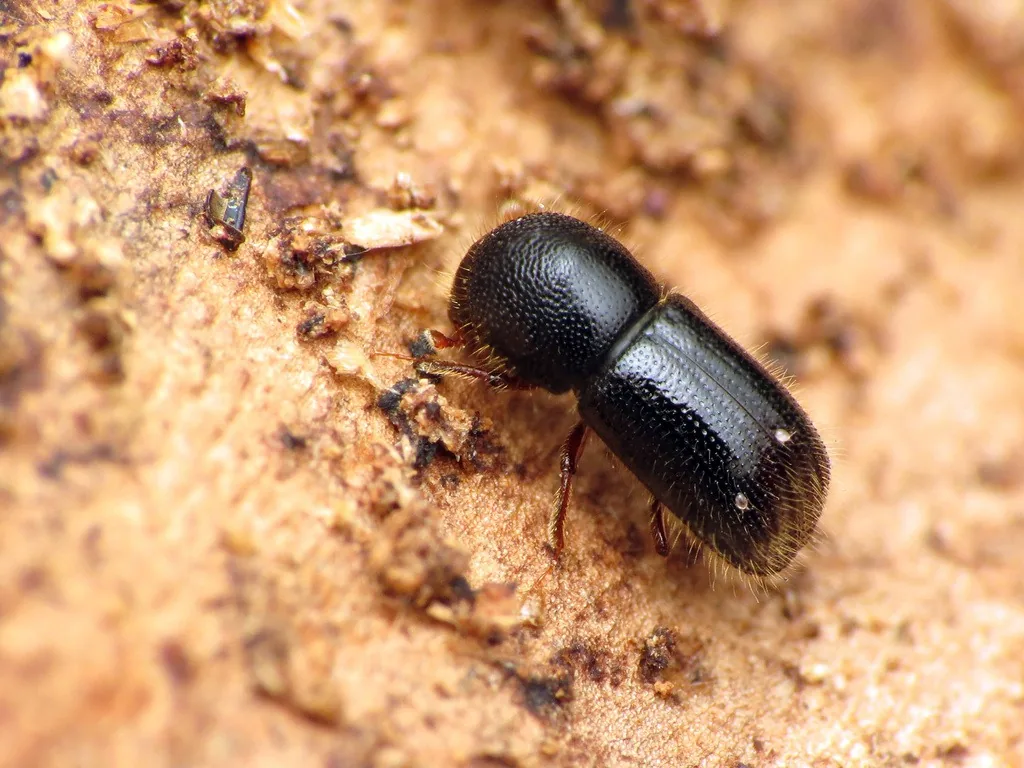
- Adults are tiny and cylindrical, reddish brown to nearly black, 1/16 to 1/8 inch long, and only females are known to fly. Natural Resources Canada says females are shiny black and 2 to 2.5 mm long, and males are light brown and smaller, about 1 to 1.8 mm.[1][2]
- Larvae are small, white, legless grubs living in the tunnels.[1]
Look-alikes
| Look-alike | How to tell them apart |
|---|---|
| Granulate ambrosia beetle | A related ambrosia beetle that also pushes sawdust toothpicks out of small holes. UW-Madison says identifying the black stem borer takes a microscope and training, and suggests sending a specimen or a good photo to its Insect Diagnostic Lab.[1] |
Where it lives
Native to eastern Asia, including Japan, Korea, China, Vietnam and Taiwan, and introduced to central Europe and North America. It was first detected in New York in the 1930s; Natural Resources Canada reports it near Point Pelee, Ontario, around 1994 and in greater Vancouver in 1995, and UW-Madison says it has been found in 21 Wisconsin counties since 2013.[1][2]
Biology and life cycle
Adults, mostly females, overwinter in host trees, usually in higher numbers in wooded areas, and become active in late April to early May after one or two days at 68 °F or warmer. Females can fly more than 330 feet to new trees and prefer trunks three inches or less in diameter.[1]
Females bore tunnels under the bark and lay one egg a day, up to 18. Larvae develop in about 30 days, new adults appear in July, and a second generation, which overwinters, appears from late August into September.[1]
Neither adults nor larvae eat the wood: they feed on a fungus, Ambrosiella hartigii, that the female carries in internal pouches and spreads in the tunnels.[1][2]
Damage and signs
- Trees stressed by flooding, frost injury or drought give off ethanol and other chemicals that attract the beetles. Natural Resources Canada says females may carry a Fusarium fungus that causes cankers and crown dieback, and mortality can be high in small-diameter trees.[1][2]
- UW-Madison says it can attack more than 200 kinds of ornamental trees, including oak, elm, red maple, beech, hickory, chestnut, magnolia, dogwood, black cherry, tupelo and black walnut, plus apple, apricot, cherry, grape, pear and plum. Natural Resources Canada adds freshly cut hardwoods and spruce logs, where tunnels lower log value.[1][2]
Health risk
It attacks trees. UW-Madison and Natural Resources Canada describe tree and log damage only and don't mention any risk to people or pets.[1][2]
Control
Prevention
Minimize stress from drought, flooding and frost injury, since stressed trees attract the beetles; UW-Madison says young trees near woodlot edges are at greatest risk.[1]
UW-Madison suggests ethanol-baited bottle traps hung near sensitive trees, especially next to woods, to show when females are flying in spring, checked at least weekly. It says not to use rubbing alcohol in the traps.[1]
Sanitation
Remove infested wood. UW-Madison says to remove and burn trees with 75 percent or more of their branches dying and to flail-mow or burn large brush piles; Natural Resources Canada says affected parts should be removed and burned if possible.[1][2]
Pesticides
Insecticides are a judgment call; see where the sources disagree below. UW-Madison says systemic insecticides that control other borers won't work, because the beetles feed on fungus rather than wood.[1]
Where the sources disagree
Insecticides: UW-Madison says trunk sprays of pyrethroids, particularly permethrin, applied when females emerge in spring may help protect young trees where the beetle is a problem, but should be weighed against harm to pollinators. Natural Resources Canada says ambrosia beetles appear resistant to most traditional insecticides.[1][2]
Adult size: UW-Madison gives 1/16 to 1/8 inch and calls adults reddish brown to nearly black; Natural Resources Canada gives 2 to 2.5 mm for the shiny black females and 1 to 1.8 mm for the lighter males.[1][2]
Regulatory status
EPPO's database lists Xylosandrus germanus on the A1 quarantine lists of Argentina and Chile (added 2019) and on the A2 list of COSAVE, the South American regional plant protection organization (added 2018). No U.S. agency listing was found.[3]
Common questions
- What are the little sawdust sticks coming out of my young tree?
- Columns of compressed sawdust poking out of tiny holes low on the trunk are the classic sign of ambrosia beetles such as the black stem borer.[1][2]
- Why did ambrosia beetles attack my tree?
- UW-Madison says they're drawn to trees stressed by drought, flooding or frost, which give off ethanol, and prefer trunks three inches across or less.[1]
Sources
- University of Wisconsin-Madison Extension (Wisconsin Horticulture), “Black Stem Borer (Wisconsin Horticulture).” hort.extension.wisc.edu/articles/black-stem-borer/ (accessed 2026-11-13)
- Natural Resources Canada, Canadian Forest Service, “Black stem borer (Trees, insects and diseases of Canada's forests).” tidcf.nrcan.gc.ca/en/insects/factsheet/1000094 (accessed 2026-11-13)
- EPPO Global Database, European and Mediterranean Plant Protection Organization, “Xylosandrus germanus (XYLBGE): Categorization.” gd.eppo.int/taxon/XYLBGE/categorization (accessed 2026-11-13)
- Global Biodiversity Information Facility (GBIF), “Xylosandrus germanus (GBIF Backbone Taxonomy).” api.gbif.org/v1/species/1216929 (accessed 2026-11-13)
- iNaturalist, “Xylosandrus germanus taxon page (order and family).” www.inaturalist.org/taxa/233855 (accessed 2026-10-06)