On this page
How to identify it
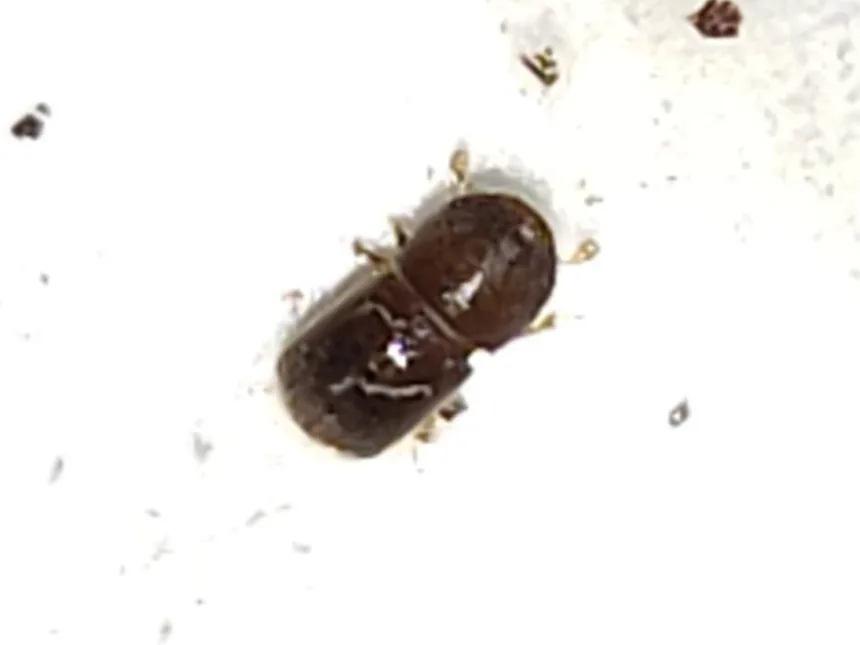
- Adults are solid black, shiny and about 1/16 inch long. UGA's ambrosia beetle field guide puts females at less than 1.7 mm.[1][2]
- Look for tiny entrance holes about 1/32 inch across, roughly the size of a pencil lead, usually on the underside of twigs and small branches. Attacked branches are generally 7/8 inch in diameter or less.[1]
- Twigs wilt within a week or more after the beetles bore in, then die from the point of attack outward. Dead leaves may stay attached, and the pith shows dark stains from the beetles' fungus.[1]
- Where several females enter the same twig, cankers 1/2 inch to 8 inches long form around the attacked area.[1]
Look-alikes
| Look-alike | How to tell them apart |
|---|---|
| Granulate ambrosia beetle | A larger relative in the same genus. UGA gives the female granulate ambrosia beetle as about 3 mm long and reddish or orange-brown, against less than 1.7 mm and black for the black twig borer.[2] |
| Black stem borer | Another black Xylosandrus ambrosia beetle, about 2 mm long: smaller than the granulate ambrosia beetle but bigger than the black twig borer.[2] |
Where it lives
An introduced beetle from Asia (Southeast Asia according to Clemson; subtropical East Asia according to a 2021 study), it reached Florida in 1941 and has spread up the coast of Georgia, South Carolina and North Carolina. It has invaded 54 countries, including Italy, France, Greece and Spain, and it is a serious pest of coffee in the Kona region of Hawaii. GBIF has 97 U.S. records since 1990, most from Florida and Alabama, with a few from Louisiana, Hawaii, Georgia, Mississippi and South Carolina.[1][3][4][5][6]
Biology and life cycle
Adults spend the winter inside infested twigs and branches. Females start to emerge about the time dogwoods bloom, and the beetles are most active in early spring. Cold winters can reduce their numbers or slow development.[1]
A female bores into a new twig, cuts a brood gallery in the pith and lays her eggs there. Egg to adult takes about 28 to 30 days, and 10 to 15 beetles may develop in a single gallery.[1]
The beetles carry spores of the fungus Fusarium solani into the gallery. Adults and grubs feed on the fungus, not on the wood. The fungus is also a tree pathogen: it clogs the twig's water-conducting tissue, which is why the tip wilts and dies.[1]
Clemson lists flowering dogwood, redbud, red maple, magnolias, willows, live oak, pecan, grape and black gum among its common hosts. UGA lists apples, magnolias and maples as its economically important hosts.[1][2]
In Georgia nurseries and orchards, ethanol-baited traps caught Xylosandrus beetles, this species included, from February or March until the traps came down in July or August, with peaks in March, April and May once average weekly temperatures reached about 15.5°C (60°F). More beetles were caught along wood lines than inside the nursery or orchard.[11]
Damage and signs
- Ornamental shrubs and shade trees seldom die from it, but the twig dieback can badly spoil their appearance.[1]
- In Hawaii coffee plantations, damage was strongly clumped: a few areas of a planting were hit hard rather than the whole field evenly.[4]
- A 2026 review counts it among the most destructive ambrosia beetles in North American nurseries, where fewer than five attacks can make a thin-barked deciduous tree unmarketable.[10]
Health risk
It is a pest of trees and shrubs, and no cited source describes any risk to people or pets.[1][2]
Control
Prevention
Keep trees vigorous so they recover: in summer drought, water established trees about 1 inch a week, keep a 3- to 4-inch layer of mulch, fertilize lightly based on a soil test, and keep broadleaf weed killers away from trees and shrubs.[1]
Traps and physical control
If only a few branches are hit, prune twigs back 3 to 4 inches below the entrance holes and cankers, and burn or dispose of the cuttings right away.[1]
Pesticides
Once beetles are inside a twig, sprays can't reach them, and fungicides don't work against the fungus. Clemson suggests protective permethrin or bifenthrin sprays on the twigs and small limbs of infested and nearby susceptible trees after pruning, every 2 to 3 weeks from late February through March, because an attacked tree draws more beetles. Trees become less attractive once their new leaves are fully expanded.[1]
Systemic soil drenches or granules of imidacloprid don't work, because the beetles feed on their fungus rather than on plant tissue.[1]
When to call a professional
Clemson suggests hiring a landscape professional to spray large trees.[1]
Still spreading
It turned up in mainland Spain in 2020, attacking twigs of bay laurel and sweetgum, a year after its detection in Mallorca.[3]
A 2021 climate model found it has not yet reached all the areas suitable for it. The models predicted that much of the Mediterranean rim and the Atlantic coast of France could suit it, and that under future climates suitability would increase toward the poles.[7]
Where the sources disagree
Where it comes from: Clemson says Southeast Asia, while a 2021 study of its spread puts its native range in subtropical East Asia.[1][3]
Healthy or stressed plants: Clemson says it is one of the few ambrosia beetles that attack healthy as well as stressed plants, while a 2026 review says these Xylosandrus species preferentially colonize physiologically stressed hosts by following the ethanol they give off.[1][10]
When it is active: Clemson says females start to emerge around dogwood bloom and the beetles are most active in early spring, while Georgia trapping found flight from February or March into July or August, with peaks from March through May.[1][11]
Hosts: Clemson lists flowering dogwood, redbud, red maple, magnolias, willows, live oak, pecan, grape and black gum, while UGA's field guide names apples, magnolias and maples as its economically important hosts.[1][2]
Repeat sprays: Clemson suggests protective permethrin or bifenthrin sprays every 2 to 3 weeks in late winter, while a UGA nursery study found ambrosia beetles landed on permethrin-treated wood but did not bore into it, implying fresh residues may not be needed.[1][9]
U.S. spread: Clemson describes it spreading up the coast of Georgia, South Carolina and North Carolina, while most of GBIF's U.S. records since 1990 come from Florida and Alabama.[1][5]
Scientific name: UGA and recent papers credit Xylosandrus compactus to Eichhoff, while the GBIF Backbone Taxonomy credits it to Wood & Bright, 1992.[2][10][8]
Common questions
- Why are twig tips dying on my shrubs?
- In the Southeast, black twig borers are one possible cause. Look for pencil-lead holes on the underside of the dying twigs and dark stains in the pith when you cut one open.[1]
- How do I manage it?
- Prune infested twigs 3 to 4 inches below the holes and dispose of them, keep plants well watered and mulched, and if attacks continue, use protective bark sprays in late winter and early spring. Systemic soil treatments don't work against it.[1]
Sources
- Clemson Cooperative Extension, Home & Garden Information Center, “Black Twig Borer on Ornamental Trees and Shrubs in South Carolina.” hgic.clemson.edu/factsheet/black-twig-borer/ (accessed 2026-11-13)
- University of Georgia Cooperative Extension, “Field Guide to Ambrosia Beetles of Agricultural Importance in the Eastern and Southern United States (Circular 1239).” fieldreport.caes.uga.edu/publications/C1239/field-guide-to-ambrosia-beetles-of-agricultural-importance-in-the-eastern-and-southern-united-states/ (accessed 2026-11-13)
- Zootaxa, via PubMed, “First records of Xylosandrus compactus in the Iberian Peninsula: an expanding alien species? (Riba-Flinch, Leza and Gallego 2021).” pubmed.ncbi.nlm.nih.gov/34186902/ (accessed 2026-11-13)
- Environmental Entomology, via PubMed, “Dispersion and sequential sampling plan for Xylosandrus compactus infesting Hawaii coffee plantations (Greco and Wright 2013).” pubmed.ncbi.nlm.nih.gov/23575018/ (accessed 2026-11-13)
- Global Biodiversity Information Facility (GBIF), “Xylosandrus compactus: U.S. occurrence records since 1990 by state (GBIF occurrence search).” api.gbif.org/v1/occurrence/search?taxonKey=1216917&country=US&hasGeospatialIssue=false&occurrenceStatus=PRESENT&year=1990%2C2026&facet=stateProvince&facetLimit=400&limit=0 (accessed 2026-11-13). Exact count at access: 97 U.S. records since 1990 (Florida 54; Alabama 25; Louisiana 5; Hawaii 4; Georgia 3; Mississippi 1; South Carolina 1).
- Global Biodiversity Information Facility (GBIF), “Xylosandrus compactus: occurrence records since 1990 by country (GBIF occurrence search).” api.gbif.org/v1/occurrence/search?taxonKey=1216917&hasGeospatialIssue=false&occurrenceStatus=PRESENT&year=1990%2C2026&facet=country&limit=0 (accessed 2026-11-13). Exact counts at access: 186 records since 1990; United States 97, Peru 23, Madagascar 16, Suriname 9, India 6, Malaysia 6.
- Scientific Reports, via PubMed, “Climate change impact on the potential geographical distribution of two invading Xylosandrus ambrosia beetles (Urvois et al. 2021).” pubmed.ncbi.nlm.nih.gov/33446689/ (accessed 2026-11-13)
- Global Biodiversity Information Facility (GBIF), “Xylosandrus compactus Wood & Bright, 1992 (GBIF Backbone Taxonomy).” api.gbif.org/v1/species/1216917 (accessed 2026-11-13)
- Journal of Insect Science, 2023 (via PubMed), “Effects of permethrin on ambrosia beetles (Coleoptera: Curculionidae: Scolytinae) in ornamental nurseries (abstract).” pubmed.ncbi.nlm.nih.gov/37418248/ (accessed 2026-11-13)
- Journal of Economic Entomology, 2026 (via PubMed), “Natural history, landscape ecology, and management of ambrosia beetles (Coleoptera: Curculionidae) as pests of nursery crops (abstract).” pubmed.ncbi.nlm.nih.gov/41967471/ (accessed 2026-11-13)
- Environmental Entomology, 2022 (via PubMed), “Ambrosia beetle occurrence and phenology of Xylosandrus spp. in ornamental nurseries, tree fruit, and pecan orchards in Georgia (abstract).” pubmed.ncbi.nlm.nih.gov/36000696/ (accessed 2026-11-13)