On this page
How to identify it
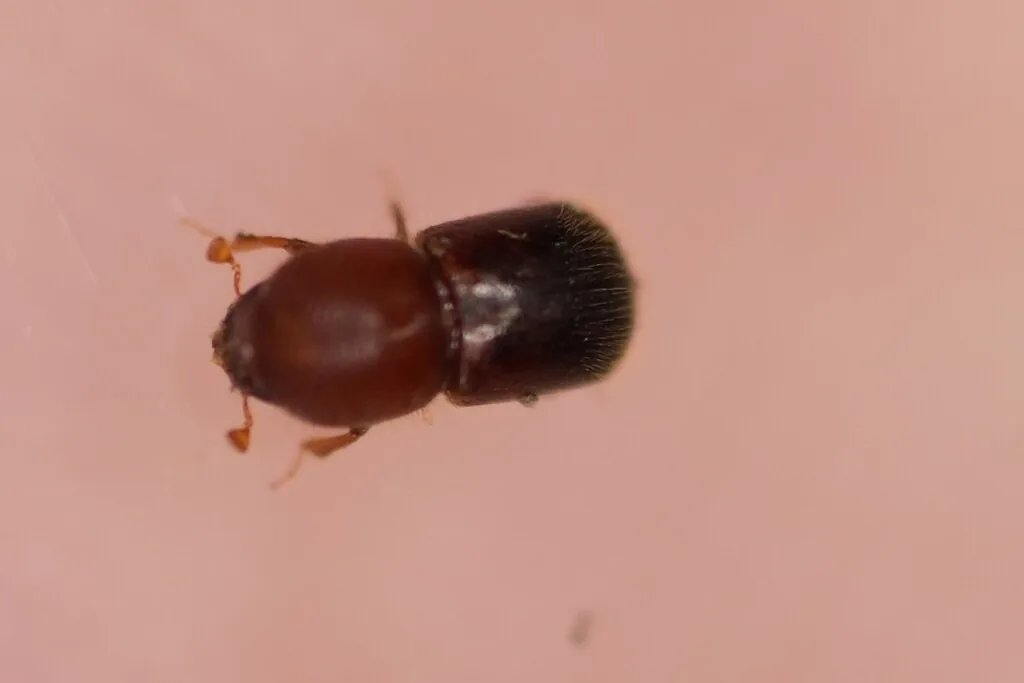
- Females are about 2.1 to 2.9 mm long, stout, smooth and cylindrical, and usually dark reddish brown.[1]
- Males are smaller, about 1.5 mm, hunch-backed and flightless; they are rare and stay in the gallery, so the females are the ones you see.[1][3]
- The surest sign is frass tubes: fragile, toothpick-like strands of boring dust sticking out up to 1.5 inches from tiny holes in the bark. Wind or rain knocks them off, leaving the hole.[1][3]
- Entrance holes are about 2 mm across, the size of pencil lead. Clemson reports attacks on stems 2 to 30 cm across; Arkansas mentions thin-barked stems and branches 1.0 to 2.5 inches across.[1][3]
- Larvae, found only inside the galleries, are white, chunky and C-shaped.[1]
Look-alikes
| Look-alike | How to tell them apart |
|---|---|
| Pine bark beetles | Bark beetles feed on the living inner bark (phloem), while ambrosia beetles feed on fungus they grow in their tunnels; the granulate ambrosia beetle doesn't attack conifers such as pines.[1] |
| Native ambrosia beetles | Native species are usually secondary pests of stressed, dying or dead trees; the granulate ambrosia beetle can also attack healthy hosts.[1] |
Where it lives
First found in the U.S. in peach trees near Charleston, South Carolina, in 1974; Clemson says it has spread to at least 29 states, and Arkansas describes it as widespread through the southeastern, Gulf Coast and surrounding states from Texas and Oklahoma east to Virginia.[1][3]
Biology and life cycle
Females bore galleries into the wood and introduce a symbiotic ambrosia fungus, which both adults and larvae eat; they don't eat the wood itself.[1][3]
Eggs, larvae and pupae develop together inside the galleries, with no separate egg niches or larval tunnels; females stay with their brood, and high humidity is needed for reproduction.[3][1]
Young females mate with their brothers inside the gallery or reproduce without mating, then fly off to attack new plants.[1][3]
Activity peaks in spring: Mississippi State gives a spring flight from mid-February through April, and Arkansas reports activity from March with a peak in mid to late April. Clemson and Arkansas say two generations a year are likely in the Southeast; Mississippi State says several.[2][3][1]
Damage has been reported in more than 100 woody plants, including dogwood, redbud, maple, ornamental cherry, crape myrtle, pecan, peach, plum, persimmon, fig, magnolia, sweetgum and azalea; it does not attack conifers.[1][3]
Research in Tennessee nurseries found one generation took an average of 55 days.[3]
Damage and signs
- The fungus it introduces disrupts the plant's vascular system, causing wilting and branch dieback.[1]
- Heavily infested trees may show stunted growth, late leaf-out and early leaf drop.[1]
- Attacks on nursery stock or newly transplanted trees are often fatal, especially during leaf-out, while larger trees usually survive unless they face another stress.[1][3][2]
- Holes also let in secondary disease organisms such as Fusarium, which add to the decline.[1]
- Trees in excessively wet soil, such as poorly drained parts of orchards or landscapes, are especially prone to attack, and attacking beetles release pheromones that draw in more.[2]
- Split infested wood is distinctly discolored and may smell foul; a single plant can hold from one to more than 50 beetles.[3]
Health risk
The harm is to trees and shrubs: attacks can cost ornamental plants and nursery stock their appearance and value.[1]
Control
Prevention
Keep plants healthy: choose species suited to the site, plant correctly and give good care, since stressed and newly planted trees are most vulnerable.[1]
Ethanol-baited traps, such as commercial Lindgren funnel traps or homemade soda-bottle traps, show when beetles are flying and help time preventive sprays; Mississippi State notes trapping mostly pays off for nurseries and orchards with past losses.[3][2][1]
Sanitation
Remove and destroy heavily infested plants. Arkansas and Mississippi State suggest leaving a newly attacked tree for three to four weeks as a trap tree, then removing it before the beetles complete their life cycle.[1][3][2]
Pesticides
Preventive pyrethroid trunk sprays such as permethrin (for example, Hi-Yield 38 Plus) or bifenthrin can stop females from boring in, but must go on before attack and be repeated while beetles are active; Mississippi State says permethrin residual lasts only two to three weeks.[1][3][2]
Once beetles are inside, insecticides and fungicides help little, and soil-applied systemic imidacloprid does not work, because the beetles don't eat the wood and are protected deep in the tree.[1][3][2]
When to call a professional
Mississippi State notes the longer-lasting bifenthrin trunk product OnyxPro is a Restricted Use insecticide that only licensed applicators may apply, and it is not labeled for fruit trees.[2]
Common questions
- What are the sawdust toothpicks on my young tree?
- Strings of boring dust pushed out of tiny holes are a classic sign of ambrosia beetles such as the granulate ambrosia beetle; they break off easily in wind or rain.[1][3]
- Can ambrosia beetles in firewood infest my house?
- No. Ambrosia and bark beetles that emerge from firewood or new lumber are forest insects and can't reinfest the wood in a finished structure.[4]
Sources
- Clemson Cooperative Extension, Home & Garden Information Center, “Granulate Ambrosia Beetle (Xylosandrus crassiusculus), HGIC 2516 (November 20, 2023).” hgic.clemson.edu/factsheet/granulate-ambrosia-beetle-xylosandrus-crassiusculus/ (accessed 2026-11-12)
- Mississippi State University Extension Service, “Granulate Ambrosia Beetle.” extension.msstate.edu/lawn-and-garden/ornamental-plants/granulate-ambrosia-beetle (accessed 2026-11-12)
- University of Arkansas System Division of Agriculture, Cooperative Extension Service, “Granulate Ambrosia Beetle (FSA7064).” www.uaex.uada.edu/publications/pdf/FSA-7064.pdf (accessed 2026-11-12)
- University of California Statewide IPM Program, “Pest Notes: Wood-Boring Beetles in Homes, Publication 7418.” ipm.ucanr.edu/home-and-landscape/wood-boring-beetles-in-homes/ (accessed 2026-11-12)
- iNaturalist, “Xylosandrus crassiusculus taxon page (order and family).” www.inaturalist.org/taxa/233854 (accessed 2026-11-12)