On this page
How to identify it
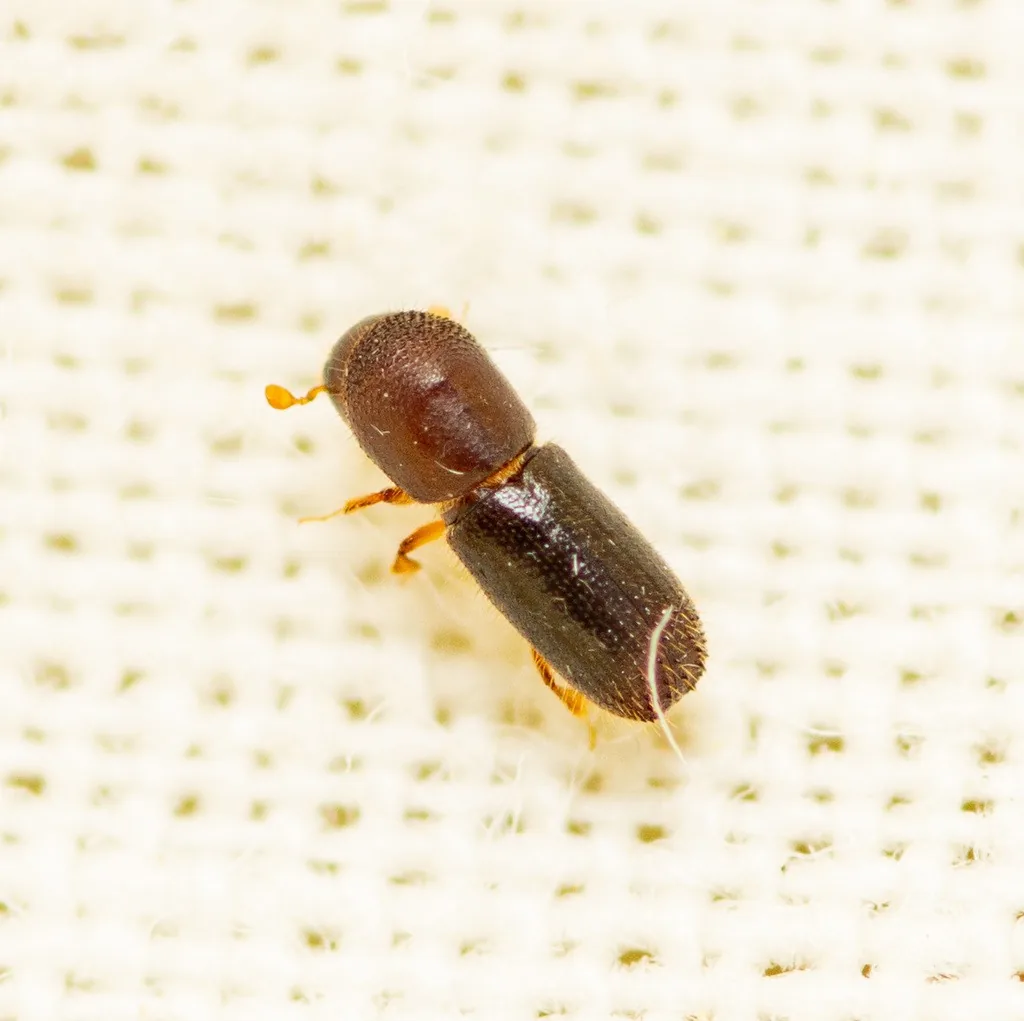
- Females are 1.9 to 2.4 mm long and reddish-brown to black, with small spines on the sloping rear of the wing covers and a cone-shaped, hairy scutellum (the small triangle between the wing covers).[3]
- The body is thinly covered in hairs. Males are smaller, 1.6 to 1.8 mm, cannot fly and are much rarer than females.[1]
- Adults are cylindrical with short, scattered hairs, and the head can't be seen from above. The larvae are pinkish white, legless and slightly curved.[2]
- As a female bores in, she pushes compacted sawdust out of the entry hole, where it can stick out of the bark like little toothpicks. The entry holes are round and about 1 to 3 mm across.[2][3]
- Baker's Eastern Forest Insects (USDA Forest Service, 1972), under the older name Xyleborus saxeseni, describes the adult as light brown to black and 1.5 to 2.2 mm long. The rear slope of the female's wing covers is steep, with rows of sharp granules and a tooth-like bump on each side of the seam; the male's slope starts so far forward that it looks humpbacked.[6]
Look-alikes
| Look-alike | How to tell them apart |
|---|---|
| Granulate ambrosia beetle (Xylosandrus crassiusculus) | Larger, about 3 mm, with a hairy, dull, bumpy rear slope on the wing covers and front leg bases set apart instead of touching.[3] |
| Black stem borer and other Xylosandrus ambrosia beetles | Separated by microscope features such as the front leg bases, the rear slope of the wing covers and the scutellum; UGA's field guide illustrates each species.[3] |
Where it lives
Originally from Europe, it is now recorded across Eurasia and in Australia, South America and Canada (British Columbia and Ontario). It has been recorded in 34 US states, including Texas, Utah, Washington and several Idaho counties.[1]
Biology and life cycle
Females tunnel straight into the sapwood for 3 to 5 cm and widen the end into a chamber where they lay up to 100 eggs. Unlike the other ambrosia beetles in Idaho, which raise each larva in its own cradle, its larvae share one chamber.[1]
The larvae feed on an ambrosia fungus that the parents bring into the tunnel. Females sometimes get into a tree through tunnels made by other bark beetles.[1]
In warm areas a generation takes one to two months. Females can produce male offspring without mating.[1]
Natural Resources Canada says young adults spend the winter inside the wood and emerge between April and August, with peak flight from late June to mid-July; the life cycle takes about 10 weeks, with one or sometimes two generations a year.[2]
Females of this and other ambrosia beetles are commonly attracted to alcohol-baited traps.[3]
Baker describes the gallery as a single tunnel bored straight into the wood and widened into a chamber where the eggs are laid and the larvae live and feed, with a life cycle that can be completed in 2 months.[6]
Damage and signs
- Economically important hosts include apples, peaches, pecans, pines, magnolias and maples.[3]
- It mostly attacks trees already weakened by disease, injury or drought, and Natural Resources Canada says it threatens mainly ornamental and fruit trees such as apricot, cherry and plum. Infested foliage turns yellow, then brown, and wilts, and a severe infestation can kill trees.[2][3]
- Baker calls it common throughout southern Canada and the United States, breeding in a wide variety of trees; important eastern hosts include pecan, hickory, honey locust, walnut, sweetgum, yellow poplar, dogwood, persimmon, holly, hemlock, cypress and shortleaf and loblolly pines.[6]
- Natural Resources Canada adds that it also infests logs lying on the ground and builds up after windthrow and ice storms, and that its tunneling can let fungal infections into the tree and lower wood quality, though it is not considered an economically important forest pest.[2]
Health risk
UGA Extension, the University of Idaho and Natural Resources Canada describe it only as a pest of trees and don't mention any risk to people or pets.[3][1][2]
Control
Prevention
Keeping trees healthy is the main defense. UGA lists frost, flooding, poor drainage, drought, injury and disease as stresses that promote ambrosia beetle attack, and Natural Resources Canada says this beetle prefers weakened trees.[3][2]
When to call a professional
To monitor, UGA describes alcohol-baited bottle and bolt traps set out before the warmer spring weather (about 68 °F), along with checking trunks for sawdust toothpicks and holes. For management advice, UGA says to contact your local Extension office.[3]
Where the sources disagree
Size: UGA and Idaho give females as 1.9 to 2.4 mm and Natural Resources Canada as 2.0 to 2.4 mm; Idaho gives males as 1.6 to 1.8 mm and Natural Resources Canada as 1.5 to 2.0 mm.[3][1][2]
Color: Idaho says dark brown, UGA reddish-brown to black, and Natural Resources Canada blackish brown or yellowish brown.[1][3][2]
Brood: Idaho describes tunnels 3 to 5 cm deep with up to 100 eggs in a shared chamber; Natural Resources Canada describes tunnels of 0.6 to 3.8 cm and about 40 eggs on average.[1][2]
Conifers: Idaho says it rarely attacks conifers; UGA lists pines among its hosts, and Natural Resources Canada lists Scots pine and notes it in Douglas-fir stands in British Columbia.[1][3][2]
Importance: UGA lists economically important hosts such as apples, peaches and pecans; Natural Resources Canada says it is not considered an economically important pest.[3][2]
Generation time: Baker (1972) says the life cycle can be completed in 2 months; Natural Resources Canada says 10 weeks, with one or sometimes two generations a year.[6][2]
Size (older source): Baker (1972) gives adults as 1.5 to 2.2 mm, smaller than the 2.0 to 2.4 mm Natural Resources Canada gives for females and the slightly larger sizes UGA and Idaho give.[6][2]
Common questions
- What are the little sawdust toothpicks sticking out of my tree?
- Compacted sawdust pushed out by female ambrosia beetles as they bore in; Natural Resources Canada and UGA both describe these toothpick-like tubes on trees attacked by the fruit-tree pinhole borer and its relatives.[2][3]
- Can it kill a healthy tree?
- It usually attacks trees that are already weakened. Natural Resources Canada says it prefers trees stressed by disease, injury or prolonged drought, and UGA lists tree stress as what promotes attack, which is why keeping trees healthy is the main recommendation.[2][3]
- How do I know it is this beetle and not the granulate ambrosia beetle?
- Size and a few microscope features: this species is 1.9 to 2.4 mm with touching front leg bases, while the granulate ambrosia beetle is about 3 mm with separated front leg bases.[3]
Sources
- University of Idaho, Idaho Forest, Wildlife and Range Experiment Station, “Furniss and Johnson. Field Guide to the Bark Beetles of Idaho and Adjacent Regions, Station Bulletin 74 (2002).” objects.lib.uidaho.edu/fwres/fwres201.pdf (accessed 2026-11-13)
- Natural Resources Canada, Canadian Forest Service, “Lesser shothole borer, Trees, insects and diseases of Canada's forests.” tidcf.nrcan.gc.ca/en/insects/factsheet/1000191 (accessed 2026-11-14)
- University of Georgia Cooperative Extension, “Field Guide to Ambrosia Beetles of Agricultural Importance in the Eastern and Southern United States (Circular 1239).” fieldreport.caes.uga.edu/publications/C1239/field-guide-to-ambrosia-beetles-of-agricultural-importance-in-the-eastern-and-southern-united-states/ (accessed 2026-11-13)
- Global Biodiversity Information Facility (GBIF), “Xyleborinus saxesenii (Ratzeburg, 1837) (GBIF Backbone Taxonomy).” api.gbif.org/v1/species/4468550 (accessed 2026-11-13)
- iNaturalist, “Xyleborinus saxesenii taxon page (order and family).” www.inaturalist.org/taxa/409196 (accessed 2026-11-10)
- USDA Forest Service (scan at Internet Archive), “Eastern Forest Insects, Miscellaneous Publication No. 1175 (W. L. Baker, 1972).” archive.org/details/easternforestins1175bake (accessed 2026-11-14)