On this page
How to identify it
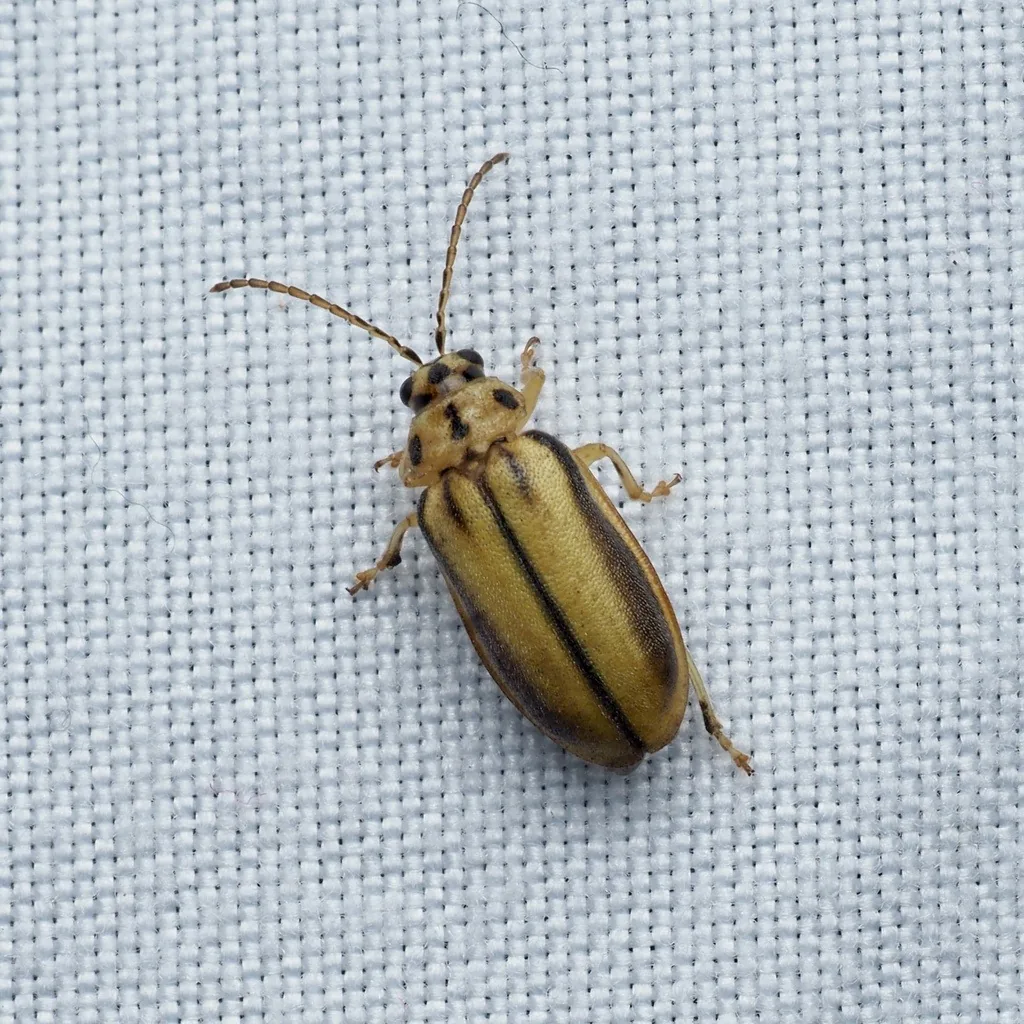
- Adults are about 1/4 inch long and yellow to olive green, with black stripes along the edges and center of the back and noticeable dark spots.[1][2][3]
- Beetles turn a darker khaki or olive green while they overwinter, so the ones found indoors look duller than summer beetles on the tree.[2]
- Eggs are yellowish, spindle-shaped and laid in clusters of about 5 to 25 on the undersides of elm leaves, turning gray before they hatch.[1][3]
- Larvae look like small caterpillars, black at first, then yellowish to green with rows of dark bumps that look like two black stripes along the sides.[1][2]
- Penn State gives the adult length as about 1/4 inch (6 to 8 mm) and says mature larvae reach up to 1/2 inch (13 mm), elongate and somewhat grub- or caterpillar-like.[5]
- Overwintering adults found in homes have dark yellow to almost entirely black wing covers, so they can look quite different from summer beetles; Penn State notes multicolored Asian lady beetles invade homes in fall at the same time.[5]
Look-alikes
| Look-alike | How to tell them apart |
|---|---|
| European elm flea weevil | Also chews holes in elm leaves, but its shot-hole damage has edges that look singed, which elm leaf beetle feeding usually lacks.[3][1] |
| Dutch elm disease | From a distance, heavily chewed foliage can look like the browning and dieback of Dutch elm disease, so check leaves closely for chewing.[1] |
Where it lives
First detected in the United States in 1830, it now occurs throughout North America wherever elms are planted and is especially important in the West.[2]
Biology and life cycle
Adults overwinter in bark cracks, woodpiles, mulch, brush piles, garages, attics and wall voids, and do not feed or reproduce while sheltering.[1][2][3]
In spring they fly to elms as new leaves appear, feed, and lay egg clusters; larvae feed for about three weeks, then crawl down the trunk to pupate at the base.[3][1]
New adults emerge after about 10 days to two weeks, and the last generation of the year becomes the beetles that overwinter.[1][3]
There are one to three generations a year depending on climate; Kentucky usually sees two.[1][3]
English and Siberian elms are favored hosts; many Chinese elms, zelkova and newer resistant cultivars are attacked much less.[1][2][3]
Eggs are laid on end in groups of 5 to 25 on the underside of elm leaves, and each female may lay 400 to 800 eggs over her life.[5]
Fun fact: when the beetle lays eggs on a field elm, the tree starts giving off a scent of more than 40 compounds, mostly terpenoids. A tiny egg-parasite wasp, Oomyzus gallerucae, follows that scent to find the eggs, so the tree is in effect calling for help.[7][1]
Another fun fact: in a study in Iran, overwintering adults could be chilled to a median of about -20.7°C in January before their bodies froze.[8]
Damage and signs
- Adults chew holes through leaves, while larvae skeletonize the leaf surface, turning foliage brown to whitish.[1][2]
- Heavy infestations can defoliate large elms, and repeated defoliation weakens trees, leaving them prone to wind breakage, disease and borers.[1][2]
- Indoors, overwintering adults don't feed, mate or damage anything; they are a nuisance only.[3][2]
Health risk
Elm leaf beetles are not a health threat; Colorado State considers the adults that invade homes only a nuisance pest.[2][3]
Control
Prevention
Keep elms vigorous with summer watering where needed, remove dead branches, and plant cultivars that resist both elm leaf beetle and Dutch elm disease.[1][2]
Keep them out
Repair screens, add door sweeps and seal exterior cracks in early summer, before beetles try to move indoors as temperatures drop.[2][3]
Traps and physical control
Vacuum or sweep up beetles found indoors; this works best on warm days when they gather on windows and walls.[2][3]
Biological control
Native predators and an introduced parasitic tachinid fly help keep populations low; trees don't need treatment in most years.[1]
Pesticides
Don't use bug bombs indoors; spot treatments of entry points with a labeled insecticide, such as permethrin or bifenthrin, can help alongside sealing.[3][2]
When trees need protection, UC IPM lists spinosad or neem sprays on young larvae, bark banding with a residual insecticide once larger larvae appear, and systemic treatments such as imidacloprid; Penn State adds that neem (azadirachtin) deters feeding and slows larval growth, and that spot treatments should go to trees with high egg densities rather than every susceptible tree. Many tree uses require a professional applicator.[1][3][2][5]
When to call a professional
Trunk injection of abamectin or imidacloprid reduced elm leaf beetle defoliation in a California study when it was timed by monitoring for peak egg density, which fits a program that treats only when monitoring shows the need.[6]
Where sources disagree
Generations per year: UC IPM gives at least one in northern California and two to three in central and southern California; Kentucky usually sees two; Penn State says Pennsylvania has one complete generation and a partial second.[1][3][5]
Common questions
- Why are there striped beetles in my house in winter?
- If elms grow nearby, they are probably elm leaf beetles that came in to overwinter. They won't feed, breed or damage the house.[2][3]
- Will spraying my house stop elm leaf beetles?
- Sealing entry points is the main defense; spot treatments at entry points can help alongside it, but bug bombs indoors are not recommended.[2][3]
- Do tree injections work for elm leaf beetle?
- In a five-year California study, trunk injections of abamectin or imidacloprid reduced defoliation when they were applied after monitoring showed egg clusters at their peak, and a first-generation treatment also protected trees through the second and third generations. Leaves from treated trees were no longer toxic the following year. UC IPM notes many tree treatments need a professional applicator.[6][1]
Sources
- University of California Statewide IPM Program, “Elm Leaf Beetle (Pest Notes, Home and Landscape).” ipm.ucanr.edu/home-and-landscape/elm-leaf-beetle/ (accessed 2026-11-12)
- Colorado State University, Department of Agricultural Biology, “Elm leaf beetle, Xanthogaleruca luteola (IPM pests).” agsci.colostate.edu/agbio/ipm-pests/elm-leaf-beetle/ (accessed 2026-11-12)
- University of Kentucky Entomology, “ENTFACT-400: Elm Leaf Beetle (revised January 2025).” entomology.ca.uky.edu/sites/entomology.ca.uky.edu/files/ef400_1.pdf (accessed 2026-11-12)
- iNaturalist, “Xanthogaleruca luteola taxon page (order and family).” www.inaturalist.org/taxa/233683 (accessed 2026-11-12)
- Penn State Extension, “Elm Leaf Beetle.” extension.psu.edu/elm-leaf-beetle (accessed 2026-11-12)
- Journal of Economic Entomology (2003), via PubMed, “Evaluation of systemic insecticides as a treatment option in integrated pest management of the elm leaf beetle, Xanthogaleruca luteola.” pubmed.ncbi.nlm.nih.gov/14650518/ (accessed 2026-11-12). Cited from the PubMed abstract.
- Journal of Chemical Ecology (2001), via PubMed, “Analysis of volatiles induced by oviposition of elm leaf beetle Xanthogaleruca luteola on Ulmus minor.” pubmed.ncbi.nlm.nih.gov/11441441/ (accessed 2026-11-12). Cited from the PubMed abstract.
- Environmental Entomology (2011), via PubMed, “Cold tolerance and supercooling capacity in overwintering adults of elm leaf beetle Xanthogaleruca luteola.” pubmed.ncbi.nlm.nih.gov/22217772/ (accessed 2026-11-12). Cited from the PubMed abstract.