On this page
How to identify it
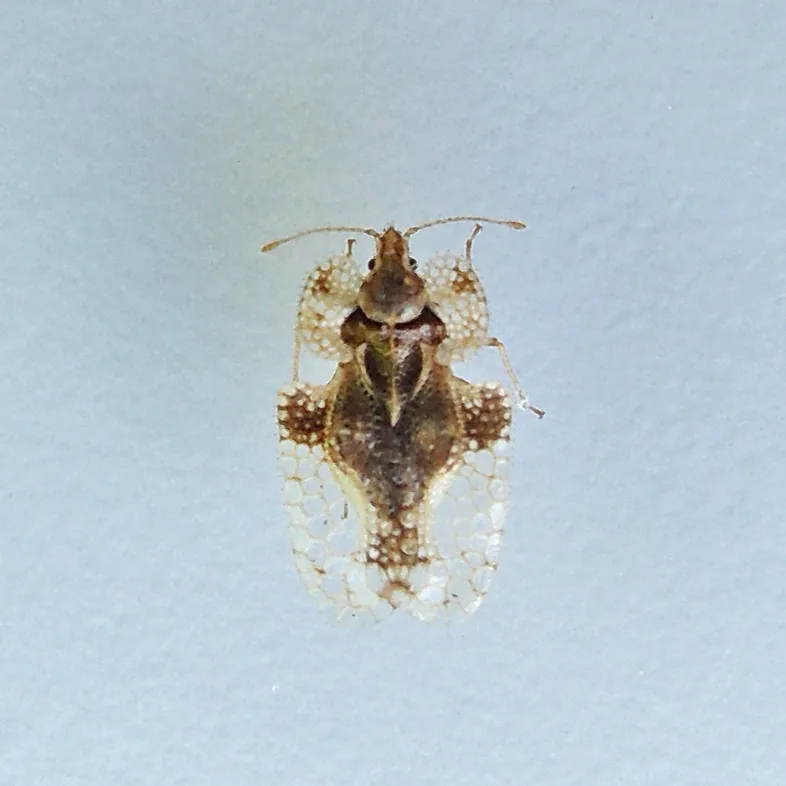
- Adults are tannish brown, about 1/8 inch long, and covered with small cells that make them look like lace. The antennae and legs are pale brown.[1]
- The top of the thorax swells up into a hood that stands about twice as high as the rest of the thorax. The flared, lacy side margins carry a single row of tiny spines.[1]
- Nymphs are small and black or dark brown with very pale legs and antennae. Older nymphs are oval and flat, with spines around the edge of the body.[1]
- Look on the lower leaf surface: adults, nymphs, cast skins and dark 'fly speck' excrement collect there under the pale spots.[1]
Look-alikes
| Look-alike | How to tell them apart |
|---|---|
| Spider mites and thrips | Their feeding also leaves pale spots on leaves, but lace bug injury is coarser, and lace bugs leave dark excrement specks and cast skins on the leaf underside.[1] |
| Sycamore lace bug | A close relative in the same genus (Corythucha ciliata) and one of the most common lace bug pests in Ohio. Ohio State says it is fairly well restricted to its namesake host, sycamore, and has two and occasionally three generations a summer; NC State lists American elm as the elm lace bug's only host. The USDA Forest Service adds that it occasionally feeds on ash, hickory and mulberry, and that heavily infested sycamore leaves turn white and drop early.[3][1][2] |
| Oak lace bug | Another Corythucha species (C. arcuata) that Ohio State lists among the most common lace bug pests in Ohio. It is fairly well restricted to oaks and has two and occasionally three generations a summer. The USDA Forest Service lists white, bur and chestnut oaks as hosts and says infested leaves look grayish-white.[3][2] |
Where it lives
NC State describes it as rarely reported. GBIF holds 40 U.S. records since 1990 from 8 state-level areas, the most from Kansas (20), New Jersey (6) and Pennsylvania (5). The USDA Forest Service's Eastern Forest Insects places it on American elm in many Eastern States and southern Canada, and on Siberian elm on the Northern Great Plains.[1][4][2]
Biology and life cycle
American elm is the only host NC State lists. The USDA Forest Service adds Siberian elm on the Northern Great Plains.[1][2]
Very little has been published on this species' life cycle. NC State considers it highly likely that adults spend the winter in bark cracks and crevices and crawl to the new leaves in spring, as other lace bugs on deciduous trees do.[1][3]
Females probably lay dark brown, elongate eggs like other Corythucha species. Nymphs molt through five stages, and development probably takes at least seven weeks.[1]
For lace bugs in general, the USDA Forest Service says the winter is spent either as adults under bark scales or other cover on the host tree, or as eggs cemented to or embedded in the leaves, and that most species have two generations a year. No source gives a generation count for the elm lace bug itself.[2]
The USDA Forest Service notes that a given lace bug species usually lives on a single host or on closely related ones. One relative, Corythucha pergandei, feeds mainly on alder but occasionally on elm, so a lace bug on elm is not automatically the elm lace bug.[2]
Damage and signs
- Feeding on the leaf underside causes yellow or pale spots on the upper surface. With heavy feeding the leaves can look almost bleached.[1]
- The USDA Forest Service says the elm lace bug is capable of defoliating its host. With lace bugs generally, leaves of heavily infested trees may turn entirely brown and fall off.[2]
Health risk
It sucks sap from elm leaves. NC State, Ohio State and the USDA Forest Service describe only leaf feeding and mention no risk to people or pets.[1][3][2]
Control
Prevention
Turn over a few leaves when spotting appears so you catch the bugs early. Spots already on the leaves will not fade after the lace bugs are controlled.[1][3]
Traps and physical control
On small trees, a hard jet of water from a hose dislodges young nymphs, which often die before they can find their way back to a leaf.[3]
Biological control
Green lacewings, mites and assassin bugs attack lace bugs. Using water sprays or insecticidal soap instead of standard insecticides helps keep these predators around.[3]
Pesticides
Insecticidal soaps and horticultural oils kill only the bugs they hit, so cover the undersides of the leaves. EPA's product search lists insecticidal soap products with active registrations.[3][5]
Elm lace bugs are hard to control on large trees. Most landscape insecticides give adequate control when the tree is small enough to spray well. Imidacloprid applied to the soil beneath the tree early in the growing season should give season-long suppression; EPA's product search lists many imidacloprid products with active registrations.[1][6]
Where the sources disagree
Where adults spend the winter: NC State thinks it highly likely they hide in cracks and crevices of bark; Ohio State says lace bug adults hibernate under loose bark and among leaf litter.[1][3]
Hosts: NC State lists American elm as the only host; the USDA Forest Service's Eastern Forest Insects also records it on Siberian elm on the Northern Great Plains.[1][2]
Common questions
- Why are my elm leaves pale and speckled?
- Sap-feeding insects on the leaf undersides are a likely cause. Elm lace bugs leave pale spots on top and dark excrement specks, cast skins and the bugs themselves below. Spider mites and thrips leave finer spotting.[1]
- Do I need to spray for elm lace bugs?
- Not always. On small trees a hard water spray or insecticidal soap on the leaf undersides can help. Large trees are hard to spray, and NC State suggests a soil-applied imidacloprid treatment early in the season instead.[3][1]
- Does the elm lace bug harm Siberian elm too?
- The USDA Forest Service records it on Siberian elm on the Northern Great Plains as well as on American elm, and says it is capable of defoliating its host.[2]
Sources
- NC State Extension, “Elm Lace Bug (PDIC Factsheet).” content.ces.ncsu.edu/elm-lace-bug (accessed 2026-11-14)
- USDA Forest Service, “Eastern Forest Insects, Miscellaneous Publication 1175 (W. L. Baker, 1972; scanned copy).” archive.org/details/easternforestins1175bake (accessed 2026-11-14). Read from the Internet Archive's full-text (djvu.txt) copy of the scan.
- Ohio State University Extension, Ohioline, “HYG-2150: Lace Bugs (D. J. Shetlar, 2011).” ohioline.osu.edu/factsheet/HYG-2150-10 (accessed 2026-11-14)
- Global Biodiversity Information Facility (GBIF), “Corythucha ulmi: U.S. occurrence records since 1990 by state (GBIF occurrence API).” api.gbif.org/v1/occurrence/search?taxonKey=2020636&country=US&hasGeospatialIssue=false&occurrenceStatus=PRESENT&year=1990%2C2026&facet=stateProvince&facetLimit=400&limit=0 (accessed 2026-11-14). 40 records from 8 state-level areas; Kansas 20, New Jersey 6, Pennsylvania 5; fetched 2026-11-13.
- U.S. EPA Pesticide Product Label System, “Pesticide Product Label System: product-name search 'Insecticidal Soap'.” ordspub.epa.gov/ords/pesticides/cswu/ProductSearch/partialprodsearch/v2/riname/Insecticidal%20Soap (accessed 2026-11-14). 92 rows, 72 Active, including 42697-1 SAFER INSECTICIDAL SOAP CONCENTRATE; saved 2026-11-13.
- U.S. EPA Pesticide Product Label System, “Pesticide Product Label System: product-name search 'Imidacloprid'.” ordspub.epa.gov/ords/pesticides/cswu/ProductSearch/partialprodsearch/v2/riname/Imidacloprid (accessed 2026-11-14). 269 rows, 222 Active; saved 2026-11-13.
- Global Biodiversity Information Facility (GBIF), “Corythucha ulmi Drake, 1916 (GBIF Backbone Taxonomy).” api.gbif.org/v1/species/2020636 (accessed 2026-11-14). ACCEPTED; order Hemiptera, family Tingidae