On this page
How to identify it
- To the naked eye they look like tiny moving dots; a 10X hand lens shows them clearly.[1]
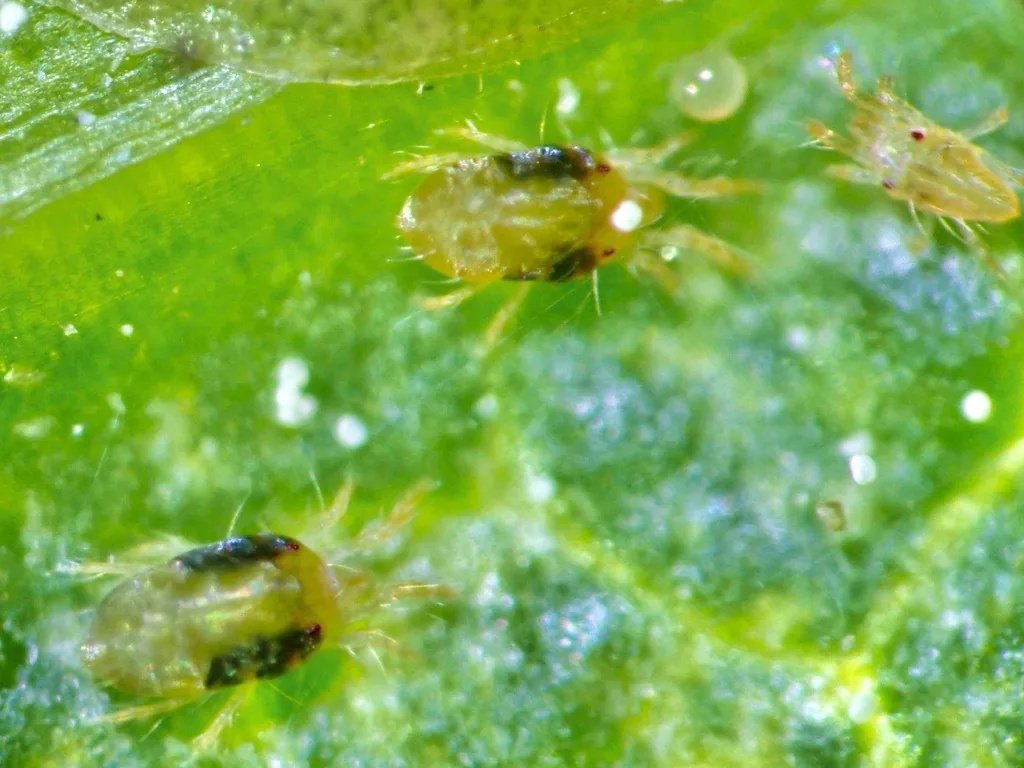
- Adults have eight legs and an oval body with two red eyespots near the head. The twospotted spider mite has a large dark spot on each side, and the spots can spread to cover the body as it feeds. UF/IFAS says green, greenish-yellow or almost translucent mites are most common, though they may be brown or orange-red, and that the dark spots are body wastes showing through the transparent body wall, so newly molted mites may lack them.[1][4][3][5]
- Overwintering females turn orange or red and lose their spots. Colorado State says this color change may be why mites are sometimes called red spiders. UF/IFAS also describes overwintering females as orange to orange-red.[4][1][2][5]
- Silk webbing on infested leaves is the easiest way to tell spider mites from other mites and from aphids or thrips. It is heaviest in large infestations; spider webs and cottonwood fluff are sometimes mistaken for it.[1][2][3]
- Eggs are round and translucent, like tiny droplets, turning cream-colored before they hatch; NC State says they are clear to pale green and about 1/200 inch (0.14 mm) across. Empty egg shells stay on the leaf and help confirm a mite problem.[1][4][2]
Look-alikes
| Look-alike | How to tell them apart |
|---|---|
| Predatory mites | About the same size but with longer legs, a more teardrop shape and much faster movement; they eat spider mites and should be protected. UF/IFAS adds that predatory mites often hold the front pair of legs forward and are often red or orange.[1][2][5] |
| Clover mite | A turfgrass mite that commonly wanders into homes in fall and spring. Webbing on leaves points to spider mites instead.[2][1] |
Where it lives
The twospotted spider mite is native to Eurasia and now established worldwide, a pest of outdoor and protected crops with a very broad host range. Dry conditions favor spider mites, one reason they matter so much in the more arid parts of the country, and indoors the twospotted spider mite is the most important mite on house plants. UF/IFAS says it was first described from European specimens and is a temperate-zone species that also occurs in subtropical regions; in greenhouses it is found throughout the United States, surviving winters beyond its natural limits.[4][6][7][2][5]
Biology and life cycle
Newly hatched larvae have six legs; the two nymph stages and adults have eight.[1][4]
In hot weather a generation can be completed in less than a week, and mites can be full-grown about a week after hatching.[1][2]
Mated females produce both male and female offspring; unmated females lay eggs that develop only into males. Generations overlap, so all life stages are usually present at once.[4]
In colder areas mated females overwinter under rough bark and in ground litter, then resume feeding and laying eggs in spring. In milder parts of California they can keep feeding all year on plants that stay green.[1][4][2]
Numbers usually build from June through September and often crash in late summer as predators catch up, the weather cools or rain falls. As leaves decline, females ride wind currents to new plants.[1]
Dry conditions favor spider mites: they feed more when humidity is low, most of their predators need moister air, and drought-stressed plants become more nutritious to them.[2][1]
UF/IFAS says eggs are attached to fine silk webbing and hatch in about three days. The mite passes through egg, larva, two nymph stages (protonymph and deutonymph) and adult, and at about 80 degrees F it develops in five to twenty days; the adult female lives two to four weeks and can lay several hundred eggs.[5]
UF/IFAS says the twospotted spider mite prefers the hot, dry weather of summer and fall but can turn up any time of year, and overwintering females hibernate in ground litter or under the bark of trees and shrubs.[5]
Damage and signs
- Feeding first shows as fine pale stippling or flecking on leaves; leaves may then bronze, yellow or redden and drop.[1][2][3]
- Damage is worst in hot, dusty conditions and on water-stressed plants, and the symptoms can be mistaken for drought stress.[1][3]
- Leaf loss on squash, melons and other annual vegetables can cut yields and lead to sunburned fruit, and on beans and sugar peas they attack the pods. On ornamentals the damage is mostly cosmetic, though very high numbers can kill annual plants.[1]
- Hosts include blackberries, blueberries, strawberries, raspberries, currants, cucumbers, snap beans, peas, tomatoes, eggplant, lettuce, marigolds, New Guinea impatiens, arborvitae, azalea, spruce and roses; azaleas may develop distorted leaves and flowers. UF/IFAS puts the host count at over 200 plant species and adds camellia, citrus, hollies, ligustrum, pittosporum, pyracantha, viburnum, maple, elm, redbud, squash and field-grown chrysanthemums; it is also a serious greenhouse pest.[3][2][5]
- UF/IFAS says each feeding site collapses the leaf tissue and leaves a small pale spot, with an estimated 18 to 22 cells destroyed per minute. Continued feeding stipples and bleaches the leaves, which turn yellow, gray or bronze, and complete leaf loss can follow. On open flowers the petals brown and wither in a way that looks like spray burn.[5]
Health risk
Spider mites feed only on plants, piercing plant tissue to suck out cell contents; their harm is to leaves, flowers and fruit.[1][3][2]
Control
Prevention
Keep plants well watered, which Minnesota puts at about one inch of water a week for most plants, and don't fertilize during drought. Dusty conditions often lead to outbreaks, so water dusty paths and areas regularly and hose dust off plants.[1][3][2]
UF/IFAS says destroying weeds such as pokeweed, Jerusalem oak, jimsonweed, wild blackberry and wild geranium can reduce the number of mites that survive the winter.[5]
Traps and physical control
Spray the undersides of leaves forcefully with water; on gardens and small fruit trees this often keeps numbers low. It also washes away webbing and dust that shelter the mites from predators.[1][3][2]
On house plants, treat every susceptible plant at the same time: trim and bag heavily infested leaves, discard badly infested plants, rinse small plants in the sink or shower and wipe larger leaves with a damp cloth, repeating every one to two weeks.[2]
Biological control
Predatory mites, sixspotted thrips, spider mite destroyer lady beetles, minute pirate bugs, bigeyed bugs and lacewing larvae all eat spider mites; protecting them is key. UF/IFAS lists predatory mites in Amblyseius, Neoseiulus, Metaseiulus and Phytoseiulus, Stethorus lady beetles, Orius pirate bugs, Leptothrips thrips and Chrysopa lacewings, and in greenhouses even the ghost ant.[1][2][3][5]
Predatory mites can be bought and released. UC IPM suggests about one predator for every 10 spider mites, concentrated in hot spots, after a soap spray if mites are heavy. UF/IFAS lists six predatory mites sold in the United States: Phytoseiulus persimilis, Mesoseiulus longipes, Neoseiulus californicus, Neoseiulus cucumeris, Galendromus occidentalis and Amblyseius fallicus. P. persimilis, the most common, eats all stages and can consume 20 eggs or five adults a day.[1][5]
Pesticides
If treatment is needed, use insecticidal soap or horticultural oil with thorough coverage of leaf undersides; skip water-stressed plants and days above 90 degrees F. Minnesota advises against homemade soap solutions, which can burn plants. UF/IFAS calls soaps and oils effective against mites and the least toxic to people, other organisms and the environment, but says laundry soaps, detergents and vegetable oils give less consistent results, and plant varieties differ in how easily they burn.[1][3][2][5]
Avoid carbaryl, malathion, some pyrethroids such as bifenthrin and permethrin, and soil-applied imidacloprid where mites are a problem: they kill mite predators and can set off spider mite outbreaks.[1][2][3]
Spider mites develop resistance quickly; a review calls the twospotted spider mite the most resistant species by the number of pesticides its populations resist. Most miticides don't kill eggs, so Colorado State says a repeat application about 10 to 14 days later is usually needed. UF/IFAS also says the twospotted spider mite becomes resistant to most acaricides after prolonged use, and that two or more applications are needed because most miticides don't kill eggs.[2][6][5]
How to check for mites
Hold a sheet of white paper under a branch and shake or tap the foliage; mites fall onto the paper and are easy to see moving. UF/IFAS calls a 10X to 15X magnifier a necessity and says to check leaf undersides for mites, cast skins and webbing.[1][3][5]
Confirm live mites before treating, because they may be gone by the time damage shows, and plants often recover.[1]
Check garden plants every 3 to 5 days, especially during drought.[3]
Where sources disagree
Size: UC IPM says adult females are less than 1/20 inch long; NC State says the summer female twospotted spider mite is less than 1/50 inch (0.4 mm), and UF/IFAS gives about 1/50 inch for the mite, with females about 0.4 mm.[1][4][5]
Color: NC State describes summer females as greenish yellow; Minnesota describes the twospotted spider mite as yellow-orange; UF/IFAS says green, greenish-yellow or nearly translucent is most common, though brown or orange-red mites also occur.[4][3][5]
How they spend the winter: UC IPM, Colorado State and NC State say as mated or diapausing adult females in bark cracks and litter; Minnesota says as eggs on vegetation.[1][2][4][3]
Egg laying: Colorado State says mated females may lay a dozen eggs a day for a couple of weeks; NC State says roughly one egg a day.[2][4]
Buying predatory mites: UC IPM says releases can help in large plantings and orchards; Colorado State says they have worked on interior plants but effective outdoor use has not been demonstrated in Colorado, partly because they need humid conditions.[1][2]
Repeat treatments: Colorado State says a repeat application about 10 to 14 days later is usually needed; UF/IFAS says to repeat at five-day intervals in summer or seven-day intervals in winter.[2][5]
Common questions
- Why did spider mites get worse after I sprayed?
- Some broad-spectrum insecticides kill the mites' natural enemies, and some even speed up mite reproduction, leading to outbreaks within days in hot weather.[1][2]
- Are spider mites insects?
- No. They are arachnids, in the same class as spiders and ticks, with eight legs as adults.[1][3]
- Why are spider mites so hard to get rid of on house plants?
- Indoors there are generally no natural enemies and few effective products besides soaps and oils, so you have to treat all plants at once and repeat.[2]
- Does spraying with water really help?
- Yes. A forceful spray on the undersides of leaves knocks off and kills many mites and removes the dust and webbing that protect them.[1][2][3]
- How fast do spider mites multiply?
- UF/IFAS says that at about 80 degrees F they go from egg to adult in five to twenty days, generations overlap through the year, and each female can lay several hundred eggs in her two to four weeks of life.[5]
Sources
- University of California Statewide IPM Program, “Spider Mites (Pest Notes, Home and Landscape).” ipm.ucanr.edu/home-and-landscape/spider-mites/ (accessed 2026-11-11)
- Colorado State University Extension, “Spider Mites (Fact Sheet 5.507).” extension.colostate.edu/topic-areas/insects/spider-mites-5-507/ (accessed 2026-11-11)
- University of Minnesota Extension, “Twospotted spider mites in home gardens.” extension.umn.edu/yard-and-garden-insects/spider-mites (accessed 2026-11-11)
- NC State Extension, “Twospotted Spider Mite.” content.ces.ncsu.edu/twospotted-spider-mite (accessed 2026-11-11)
- University of Florida IFAS Extension (EDIS), “Twospotted Spider Mite, Tetranychus urticae Koch, EENY150/IN307 (T. R. Fasulo and H. A. Denmark; Featured Creatures).” ask.ifas.ufl.edu/publication/IN307 (accessed 2026-11-14)
- Insect Biochemistry and Molecular Biology, via PubMed, “Acaricide resistance mechanisms in the two-spotted spider mite Tetranychus urticae and other important Acari: a review (Van Leeuwen et al. 2010).” pubmed.ncbi.nlm.nih.gov/20685616/ (accessed 2026-11-11)
- BioEssays, via PubMed, “Spider Mites: Genetic Models to Inform Herbivore and Chelicerate Biology (Clark et al. 2026).” pubmed.ncbi.nlm.nih.gov/42179317/ (accessed 2026-11-11)
- iNaturalist, “Tetranychus urticae taxon page (order and family).” www.inaturalist.org/taxa/203333 (accessed 2026-11-11)