On this page
How to identify it
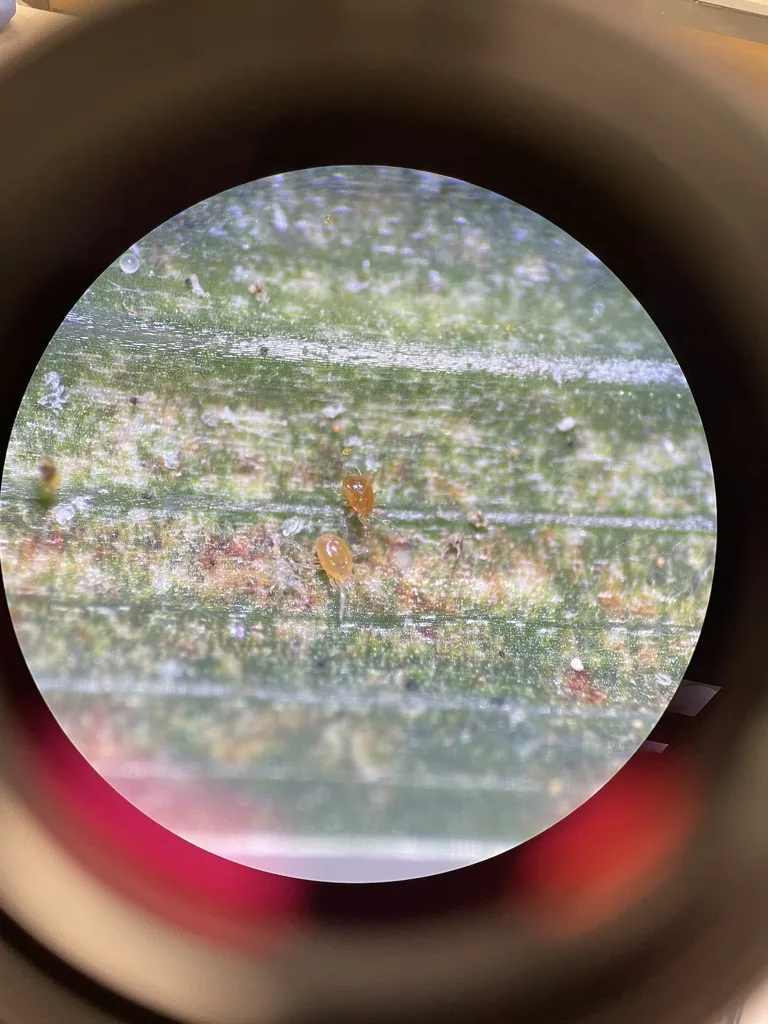
- Adults are pear-shaped, bright reddish to orange (Tennessee State calls them shiny orange to red), and about 1/50 inch (0.5 mm) long; a hand lens shows them.[1][2]
- Compared with spider mites they move faster and have longer legs. UC IPM and Colorado State say they are slightly larger than their prey, while Tennessee State puts them at about the size of a twospotted spider mite.[1][3][2]
- Nymphs are pale salmon colored. Eggs are oval and pale orange when laid, darkening as they near hatching; UC IPM says they are about twice the size of spider mite eggs, Tennessee State two to three times.[1][2]
Look-alikes
| Look-alike | How to tell them apart |
|---|---|
| Twospotted spider mite | Twospotted spider mites can turn reddish over winter, but they usually show two dark blotches on the body, which the predator lacks.[1][2] |
| Euseius predatory mites | These can also turn reddish after feeding; telling the predatory species apart takes expert examination.[1] |
Where it lives
It has no resting (diapause) stage, so it stays active year-round in greenhouses, interior plantscapes and areas with mild winters, and it can be common in almost any crop infested with twospotted spider mites.[1]
Biology and life cycle
Eggs hatch in 2 to 3 days. A six-legged larva that doesn't feed is followed by two eight-legged nymph stages, and feeding starts with the nymphs.[1][3]
Egg to adult takes about 25 days at 59°F but only about 5 days at 86°F.[1]
Lifespan figures differ. UC IPM says a female lays up to 60 eggs over a lifespan of about 50 days at an average of 74°F, but in a lab study adult females with a constant food supply lived 19 days on average, the shortest of four predatory mites tested. Generations run 7 to 17 days, about twice as fast as its prey.[1][4]
Dry air hurts them. UC IPM says development almost stops at 25 to 30% relative humidity and that humidity below 70% makes it harder for young mites to molt; Tennessee State says eggs fail to hatch below 60%. In a lab study at 20°C (68°F), about 16% of P. persimilis eggs died even at 75 to 80% humidity, more than in three other predatory mites.[1][2][4]
Eggs can adapt somewhat. In a 2020 study, females kept at low humidity began laying drought-resistant eggs within 24 hours, while eggs from females kept at high humidity did not survive dry conditions.[5]
Sources differ on diet. Colorado State says it eats spider mites and thrips and turns cannibalistic when prey runs short, while UC IPM and Tennessee State say it can survive and reproduce only on spider mites.[3][1][2]
Damage and signs
Health risk
Phytoseiulus persimilis feeds, reproduces and completes its development only on plant-feeding spider mites.[1][2]
Control
Prevention
Before treating red mites, check with a hand lens: fast, unspotted, pear-shaped orange mites may be predators.[1][2][3]
To help them work, UC IPM advises controlling ants, hosing dust off plants and avoiding broad-spectrum, persistent insecticides and miticides. Colorado State says imidacloprid, carbaryl and malathion can cut predatory mite numbers and make spider mite outbreaks worse.[1][3]
Biological control
It can be bought for release in crops such as caneberries, strawberries and nursery ornamentals; Colorado State says it is marketed against twospotted spider mites on greenhouse and garden vegetables and ornamentals.[1][3]
Released mites must have spider mites to eat, or they disperse or starve. Tennessee State notes they often eat out their prey and die off, so they may need to be released again when spider mites return.[1][2]
Tennessee State says the mite works best around 68°F and 75% relative humidity, and that above 86°F spider mites often outpace it. Release in early morning or late evening to avoid temperature extremes.[2]
Common questions
- Are the red mites on my plants pests or predators?
- Predators move faster, have longer legs and lack the two dark blotches that usually mark twospotted spider mites.[1][2][3]
- Why didn't the predatory mites I released work?
- They need spider mites to eat and fairly humid air. With no prey they leave or starve, and Tennessee State says their eggs fail to hatch below 60% relative humidity.[1][2]
Sources
- University of California Statewide IPM Program, “Phytoseiulus Predatory Mites (Natural Enemies Gallery).” ipm.ucanr.edu/natural-enemies/phytoseiulus-predatory-mites/ (accessed 2026-11-12)
- Tennessee State University Cooperative Extension, “Persimilis Mite (TSU-20-0096).” www.tnstate.edu/extension/documents/Persimilis%20Mite.pdf (accessed 2026-11-12)
- Colorado State University, Department of Agricultural Biology, “Predatory mites.” agsci.colostate.edu/agbio/ipm-pests/predatory-mites/ (accessed 2026-11-12)
- Exp Appl Acarol 2004;32(1-2):1-13, via PubMed, “Phytoseiid mites in protected crops: the effect of humidity and food availability on egg hatch and adult life span of Iphiseius degenerans, Neoseiulus cucumeris, N. californicus and Phytoseiulus persimilis (2004).” pubmed.ncbi.nlm.nih.gov/15139268/ (accessed 2026-11-12)
- Oecologia 2020;192(1):29-41, via PubMed, “Maternal effect determines drought resistance of eggs in the predatory mite Phytoseiulus persimilis (2020).” pubmed.ncbi.nlm.nih.gov/31773312/ (accessed 2026-11-12)
- iNaturalist, “Phytoseiulus persimilis taxon page (order and family).” www.inaturalist.org/taxa/395199 (accessed 2026-11-12)