On this page
How to identify it
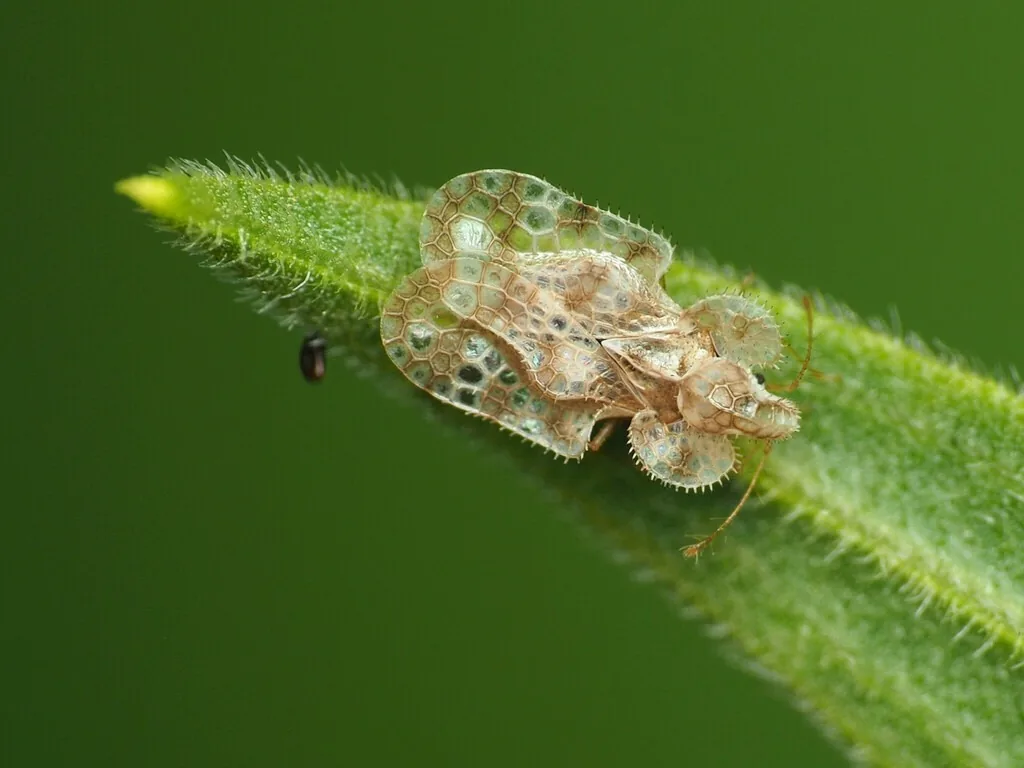
- Adults are about 1/8 inch long, with an inflated hood over the head and wings covered in small transparent cells like lace; NC State says the wings have four irregular smoky-brown bands, though the markings vary and are usually more intense in males.[1]
- Nymphs are tiny, shiny and spiny and often cluster in groups of 6 to 100 on the leaves.[1][2]
- Damaged leaves are pale-speckled above and below, with small black, tar-like specks of excrement.[2][1]
Look-alikes
| Look-alike | How to tell them apart |
|---|---|
| Twospotted spider mite | Spider mites also speckle leaves but spin fine webbing and leave no tar-like specks of excrement, which lace bugs do.[2] |
Where it lives
It feeds on aster-family plants in gardens and landscapes; NC State and Ohio State report it on mums, asters, goldenrod, ragweed, sunflower and black-eyed Susan.[1][2]
Biology and life cycle
Females insert tiny dark eggs into the leaf along the larger veins, in groups of 4 to 75, leaving only a yellowish cap showing, and cover them with a dark, varnish-like excretion.[1][2]
Nymphs pass through five stages before becoming adults.[1][2]
They spend the winter in dry leaves, under stones, in grass clumps and other sheltered debris.[1]
Damage and signs
Health risk
NC State and Ohio State Extension describe plant damage only and don't mention any risk to people or pets.[1][2]
Control
Traps and physical control
Knock nymphs and adults off with a strong stream of water aimed at both the upper and lower leaf surfaces; Ohio State says this will likely need repeating.[2]
Biological control
Ohio State says natural enemies, including lady beetles, lacewings, minute pirate bugs, spiders, plant bugs and assassin bugs, usually keep populations in check; NC State says parasitic wasps and predatory bugs help but may not prevent noticeable damage (see where the sources disagree).[2][1]
Pesticides
Insecticidal soaps and horticultural oils kill nymphs and adults on contact and are easier on natural enemies, but they don't kill the eggs and leave no residue, so repeat them. If those fail, both sources name soil-applied systemic insecticides such as dinotefuran (Safari) and imidacloprid.[2][1]
Where the sources disagree
Whether control is needed: Ohio State says management is usually unnecessary because natural enemies keep populations in check; NC State says natural control may fail to prevent noticeable damage and lace bugs can be relatively hard to control, and suggests watching mums for the first signs of damage.[2][1]
Common questions
- Why are my asters' leaves speckled white with black spots underneath?
- Most likely chrysanthemum lace bugs; their feeding leaves pale speckles and they leave tar-like specks of excrement on the leaves.[2][1]
- Is it lace bugs or spider mites on my plants?
- Look for webbing and tar spots: spider mites spin fine webbing, while lace bugs leave tar-like droplets and no webbing.[2]
Sources
- NC State Extension, “Chrysanthemum Lace Bug.” content.ces.ncsu.edu/chrysanthemum-lace-bug (accessed 2026-11-13)
- Ohio State University Extension, “Chrysanthemum Lace Bugs Abound on Asteraceae (Buckeye Yard & Garden onLine).” bygl.osu.edu/node/2039 (accessed 2026-11-13)
- Global Biodiversity Information Facility (GBIF), “Corythucha marmorata (Uhler, 1878) (GBIF Backbone Taxonomy).” api.gbif.org/v1/species/2020635 (accessed 2026-11-13)
- iNaturalist, “Corythucha marmorata taxon page (order and family).” www.inaturalist.org/taxa/320845 (accessed 2026-10-06)