On this page
How to identify it
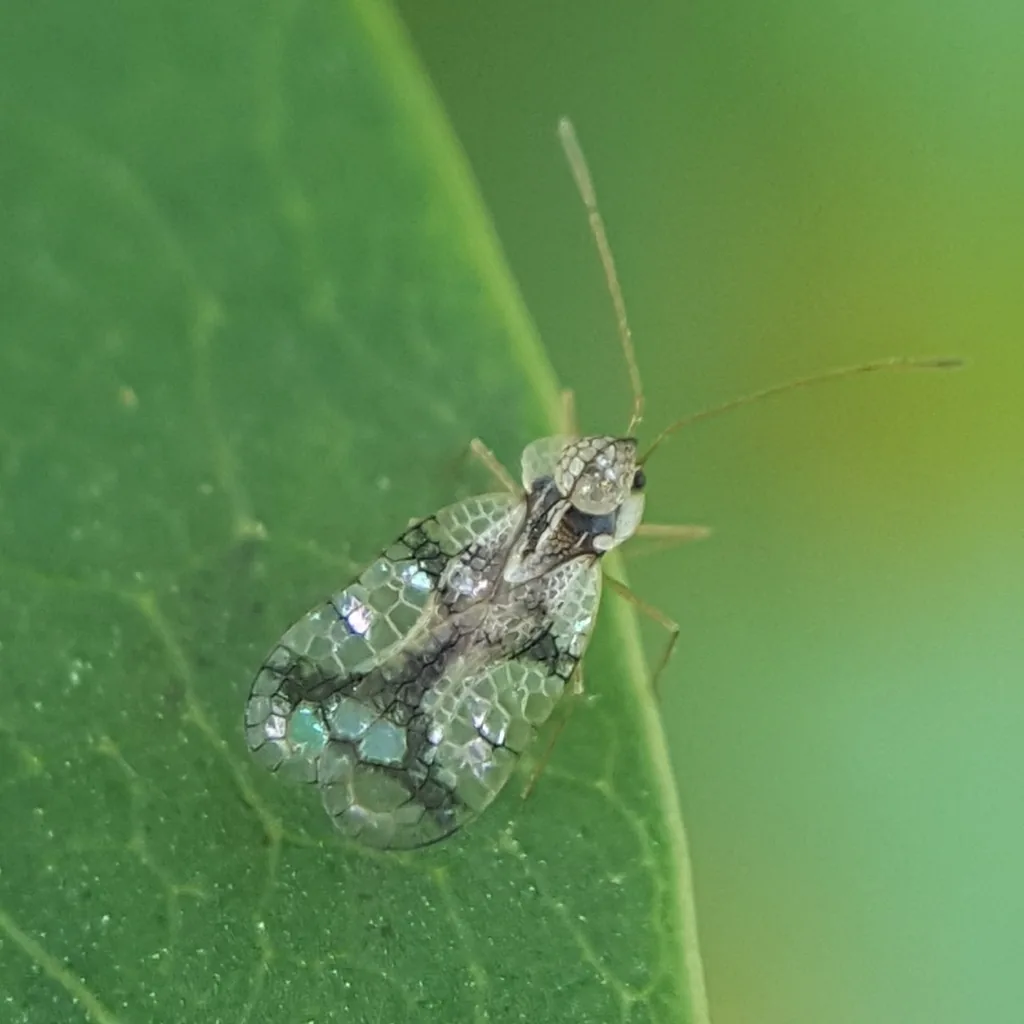
- Adults have expanded, see-through wings and thorax made of many small cells that look like lace. UC IPM and NC State give a length of about 1/8 inch; UMass gives about 1/10 inch for the azalea lace bug.[1][2][4]
- Nymphs are wingless, smaller, oval, usually dark and spiny.[1][2]
- Adults and nymphs feed together in groups on leaf undersides, along with black specks of excrement.[1][2]
- Each species feeds on one or a few related plants; this profile uses the azalea lace bug, the insect most often reported in landscapes in North Carolina.[1][2]
Look-alikes
| Look-alike | How to tell them apart |
|---|---|
| Spider mites | Mites also stipple leaves but leave no dark excrement specks, and they may leave fine webbing and cast skins.[1][2] |
| Thrips | Thrips injury looks similar but is finer than the coarser stippling lace bugs cause.[2] |
Where it lives
UC IPM says more than a dozen lace bug species occur in California on hosts including alder, ash, avocado, birch, ceanothus, photinia, sycamore, toyon and willow. The azalea lace bug, native to Japan, attacks evergreen and deciduous azaleas and mountain laurel.[1][4][2]
Biology and life cycle
Females insert eggs into leaf tissue, often along the midrib, and cover them with dark excrement that hardens into a varnish-like shield.[2][1]
Azalea lace bugs usually spend winter as eggs inside leaves; up to 90 eggs have been found in a single leaf.[2]
Nymphs are almost colorless at hatching and soon turn dark and spiny. UC IPM and UMass say they pass through five stages; NC State says the azalea lace bug molts six times.[1][4][2]
Generation counts vary by place: NC State says at least two a year for azalea lace bug in North Carolina, with the spring generations doing the most damage; UMass says two to four (four in Maryland); a Washington state study found two full generations and a partial third.[2][4][5]
Damage and signs
- Feeding empties leaf cells and leaves pale stippling that merges until leaves look bleached, yellow or bronzed.[2][1]
- Black, varnish-like specks of excrement foul leaf undersides and can drip onto pavement below.[1]
- Sources disagree on how serious it is. UC IPM says lace bugs are not a serious threat to plant health or survival; UMass says azaleas in full sun are often badly damaged and may be killed in heavy infestations.[1][4]
- Plants in full sun suffer the most damage; UMass advises checking those first.[4][1]
Health risk
Lace bugs feed on plants, and no cited source describes any risk to people or pets.[1][2]
Control
Prevention
Tolerate light damage, and grow plants suited to the site; UC IPM and UMass both suggest partial shade for azaleas. UMass reports resistance in several native azaleas, including R. atlanticum, R. arborescens, R. canescens, R. periclymenoides and R. prunifolium.[1][4]
Inspect new growth weekly from late winter or early spring and act when nymphs become abundant, before damage spreads.[1][2]
Traps and physical control
On small shrubs, a forceful spray of water to the leaf undersides early in the season, repeated as needed, can suppress lace bugs.[1]
Biological control
Parasitic wasps, assassin bugs, lacewing larvae, lady beetles, jumping spiders, pirate bugs and predatory mites eat lace bugs; avoid persistent sprays that kill them. NC State and UMass say natural enemies often fail to prevent damage, and UMass notes more complex plantings support more of them.[1][2][4]
Pesticides
Insecticidal soap, horticultural oil, neem oil and pyrethrins control nymphs and adults if they thoroughly wet the leaf undersides, but they don't kill eggs, so repeat as needed.[1][2]
Systemic dinotefuran or imidacloprid applied to the soil can give season-long control; don't apply systemics during or just before bloom, to protect pollinators.[1][2]
UC IPM advises against long-lasting foliar sprays such as carbaryl, malathion and pyrethroids, which kill natural enemies and can trigger spider mite outbreaks.[1]
Damage doesn't go away
No treatment restores stippled leaves; the damage stays until it is pruned off or replaced by new growth, so the goal is protecting the next flush.[1]
In USDA greenhouse tests on rhododendrons, plants treated with calcium silicate or calcium carbonate had less lace bug excrement and egg-laying in three of four choice studies, but adult numbers weren't consistently lower, and in one no-choice study egg-laying was higher on silicon-treated plants.[6]
Common questions
- Why are my azalea leaves turning white and speckled?
- Check the leaf undersides: lacy-winged bugs, spiny dark nymphs and black specks of excrement mean azalea lace bugs.[2][1]
- Will lace bugs kill my shrubs?
- Sources differ. UC IPM says lace bugs generally don't threaten plant survival, while UMass says azaleas in full sun can be killed in heavy infestations.[1][4]
Sources
- University of California Statewide IPM Program, “Lace Bugs (Pest Notes, Home and Landscape).” ipm.ucanr.edu/home-and-landscape/lace-bugs/ (accessed 2026-11-13)
- NC State Extension, “Azalea Lace Bug (reviewed/revised June 21, 2023).” content.ces.ncsu.edu/azalea-lace-bug (accessed 2026-11-13)
- Global Biodiversity Information Facility (GBIF), “Stephanitis pyrioides (Scott, 1874) (GBIF Backbone Taxonomy).” api.gbif.org/v1/species/2020689 (accessed 2026-11-13)
- UMass Extension Landscape, Nursery and Urban Forestry Program (Landscape Insect & Mite Guide), “Stephanitis pyrioides (Azalea Lace Bug).” www.umass.edu/agriculture-food-environment/landscape/publications-resources/insect-mite-guide/stephanitis-pyrioides (accessed 2026-11-13)
- Journal of Economic Entomology (via PubMed), “Development of azalea lace bug, Stephanitis pyrioides, on susceptible and resistant Rhododendron species in western Washington (Garrison and Tobin, 2022) (abstract).” pubmed.ncbi.nlm.nih.gov/34984439/ (accessed 2026-11-13)
- Journal of Economic Entomology (via PubMed), “Silicon supplementation can reduce infestation by azalea lace bug (Graham et al., 2024) (abstract).” pubmed.ncbi.nlm.nih.gov/39028322/ (accessed 2026-11-13)